
Louvered Panels and Bin Rail Systems for Small-Parts Storage
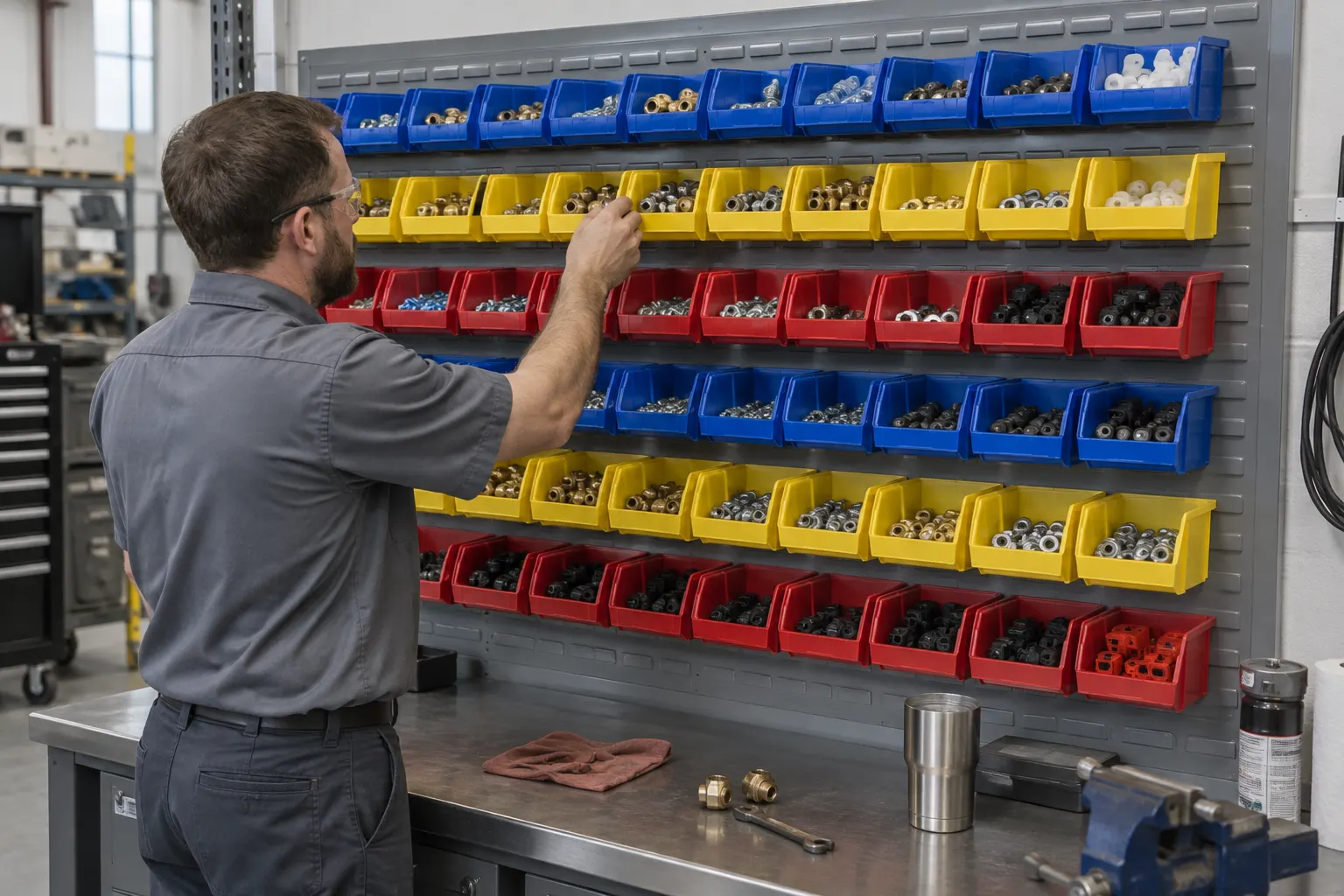
Hang open-front bins on walls, benches, rack ends and rolling racks. Louvered panels and bin rails put fasteners, fittings and components at the point of use, in any mix of bin sizes, and rearrange in seconds when the parts change.
16 gauge
Cold-rolled steel louvered panels
Up to 165
Small bins on one 48" x 61" panel
1,200 lb
Mobile double-sided louvered racks
800-326-4403
Free layout and quote
How Louvered Panels and Bin Rails Work
A louvered panel is a steel sheet stamped with rows of narrow horizontal ledges, called louvers. Hang-and-stack bins have a molded hook on the back that drops over a louver, so the bin hangs flat against the panel with its open hopper front facing the user. No tools, no shelf, no clips. Lift a bin off and hang it somewhere else, or swap three small bins for one large one, in a few seconds.
A bin rail does the same job with a single horizontal steel channel instead of a full sheet. Bins hook over the top edge of the rail and slide sideways along it. Rails are mounted to a wall, a workbench riser or a freestanding rail rack frame, and they suit long, straight rows of the same bin size.
Both are a different way of presenting small parts than bin shelving, where bins sit on flat or sloped shelves. Panels and rails win where floor space is short, where parts need to be at the work rather than in a stockroom aisle, or where the mix of bin sizes changes often.
What a good louvered or rail system should do
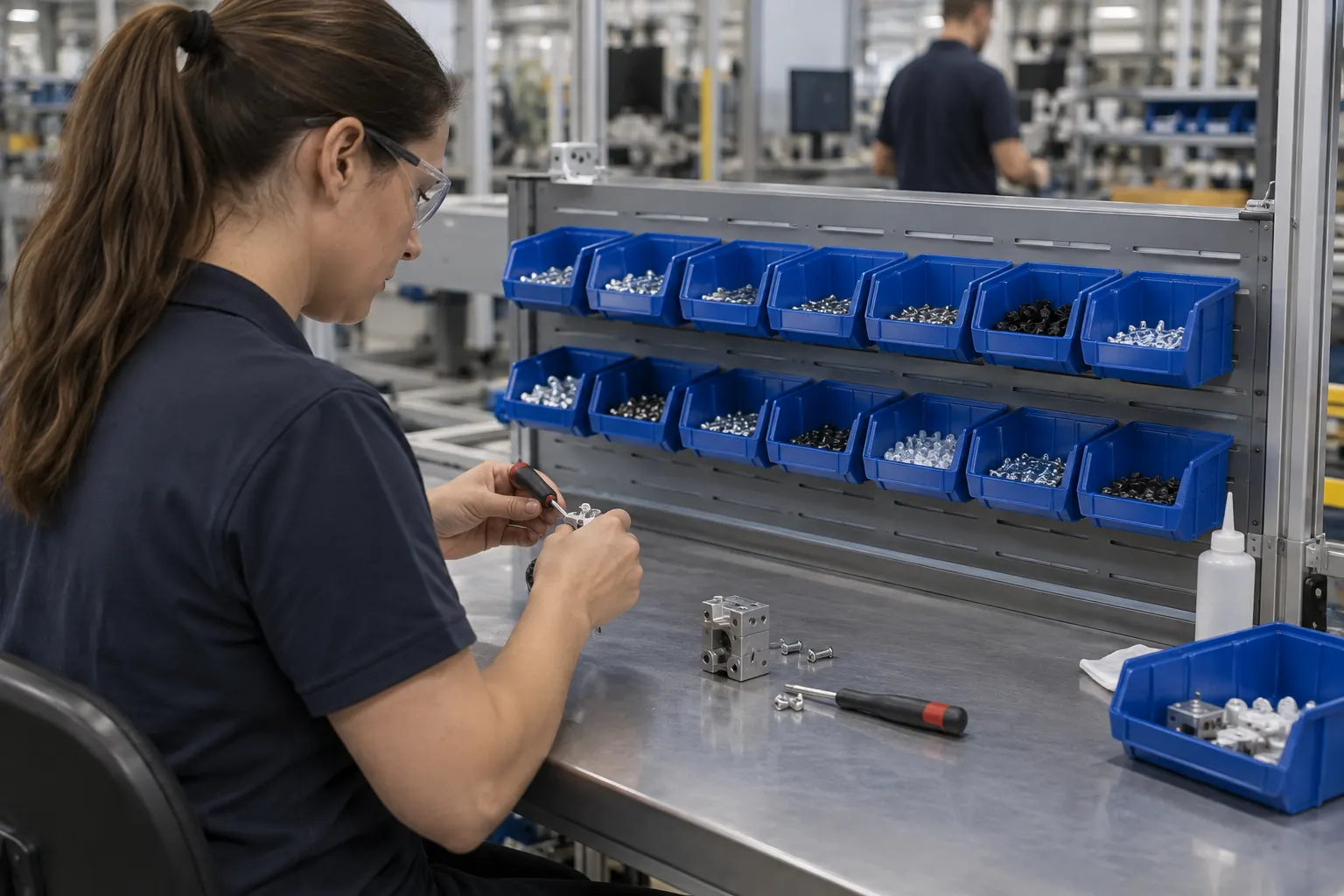
- Put parts at the point of use: above the bench, on the rack end or beside the machine, not a walk away.
- Show every part at a glance: open hopper fronts and label holders face the user, so empty bins are obvious.
- Mix bin sizes on one face: small bins for screws, large bins for fittings, on the same panel.
- Reconfigure without tools: when a product or job changes, move the bins, not the steel.
- Carry the real load: panel, bins and the wall or frame behind them are all rated for what is stored.
Types of Louvered and Bin Rail Systems
The same hang-and-stack bins work on every format below, so a facility can start with wall panels and add bench racks, rail racks or a rolling rack later without changing bins.
| System | Typical sizes | Mounting | Best for |
|---|---|---|---|
| Wall-mounted louvered panels | 18" or 36" long x 19" high; 18", 36" or 48" long x 61" high | Fastened to a wall, partition, cabinet, cart or rack end (hardware not included) | Maintenance shops, parts rooms, rack ends, walls above benches |
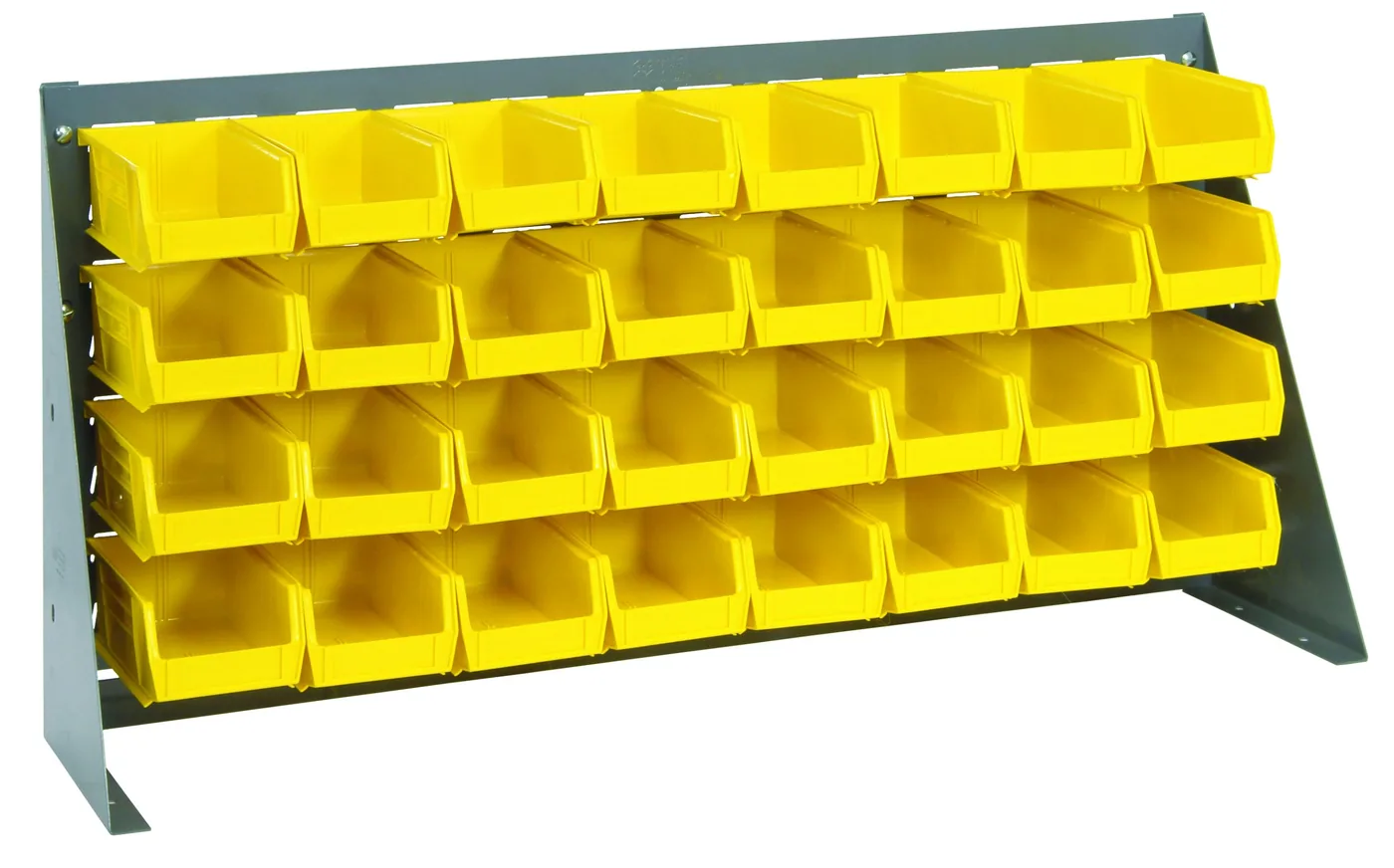
| Louvered bench racks | About 27-3/4" and 36" long, roughly 19–21" high | Freestanding on a bench or counter; units join into continuous runs | Assembly cells, repair benches, kitting and pack stations |
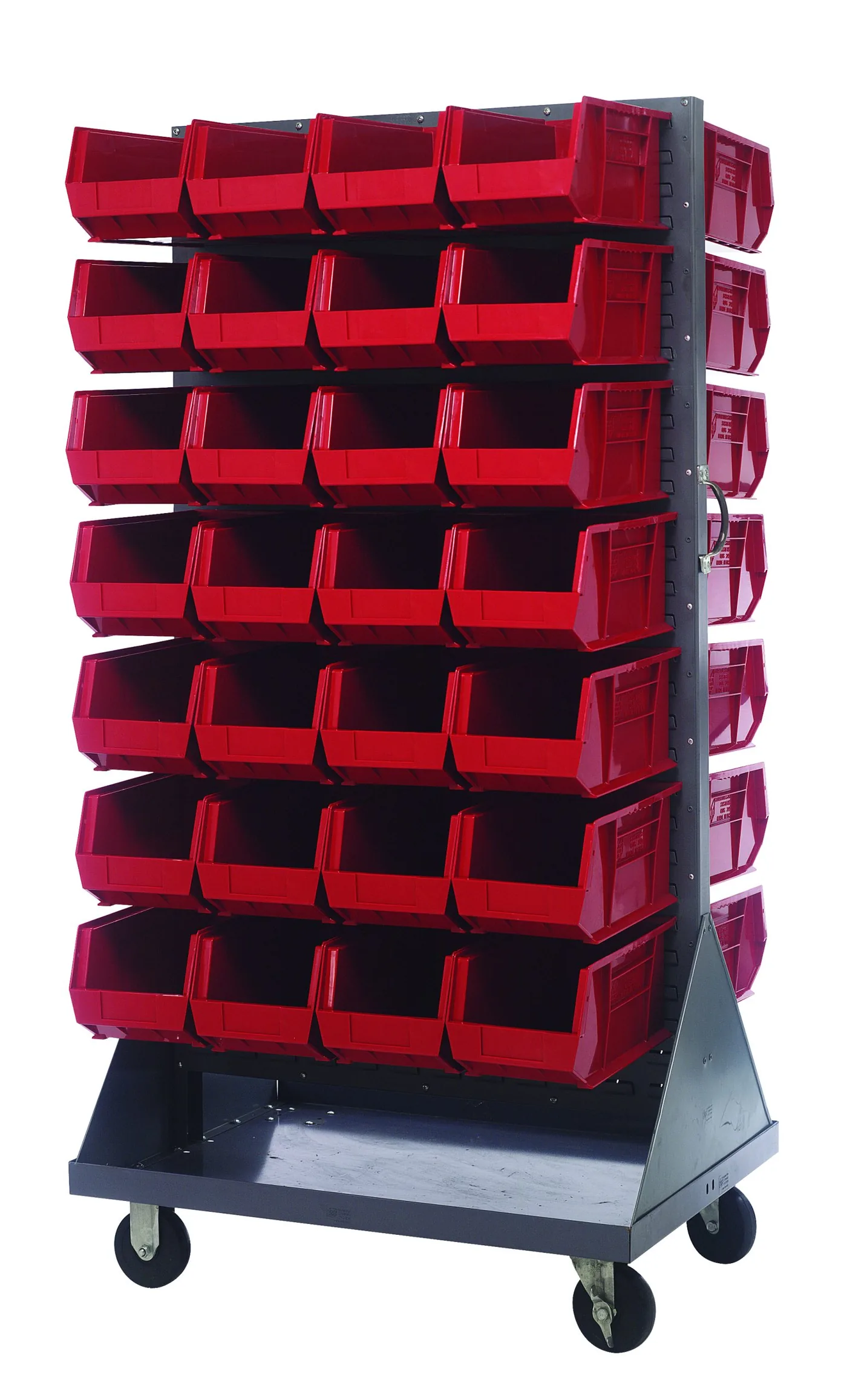
| Freestanding and mobile louvered racks | 36" wide x 25" or 30" deep x 72" high, double sided | Floor stand or heavy-duty casters, rated up to 1,200 lb | Line-side supply, service bays, parts that follow the job |
| Wall bin rails | 48" long x about 3" high steel rails | Screwed to a wall or riser in one or more rows | Long rows of one bin size, tight wall space, low cost |
| Freestanding rail racks | 36" long x 15" deep (single) or 20" deep (double) x 53" high | Galvanized steel floor frame; mobile kit for double-sided units | Island pick stations and work-cell supply without a wall |
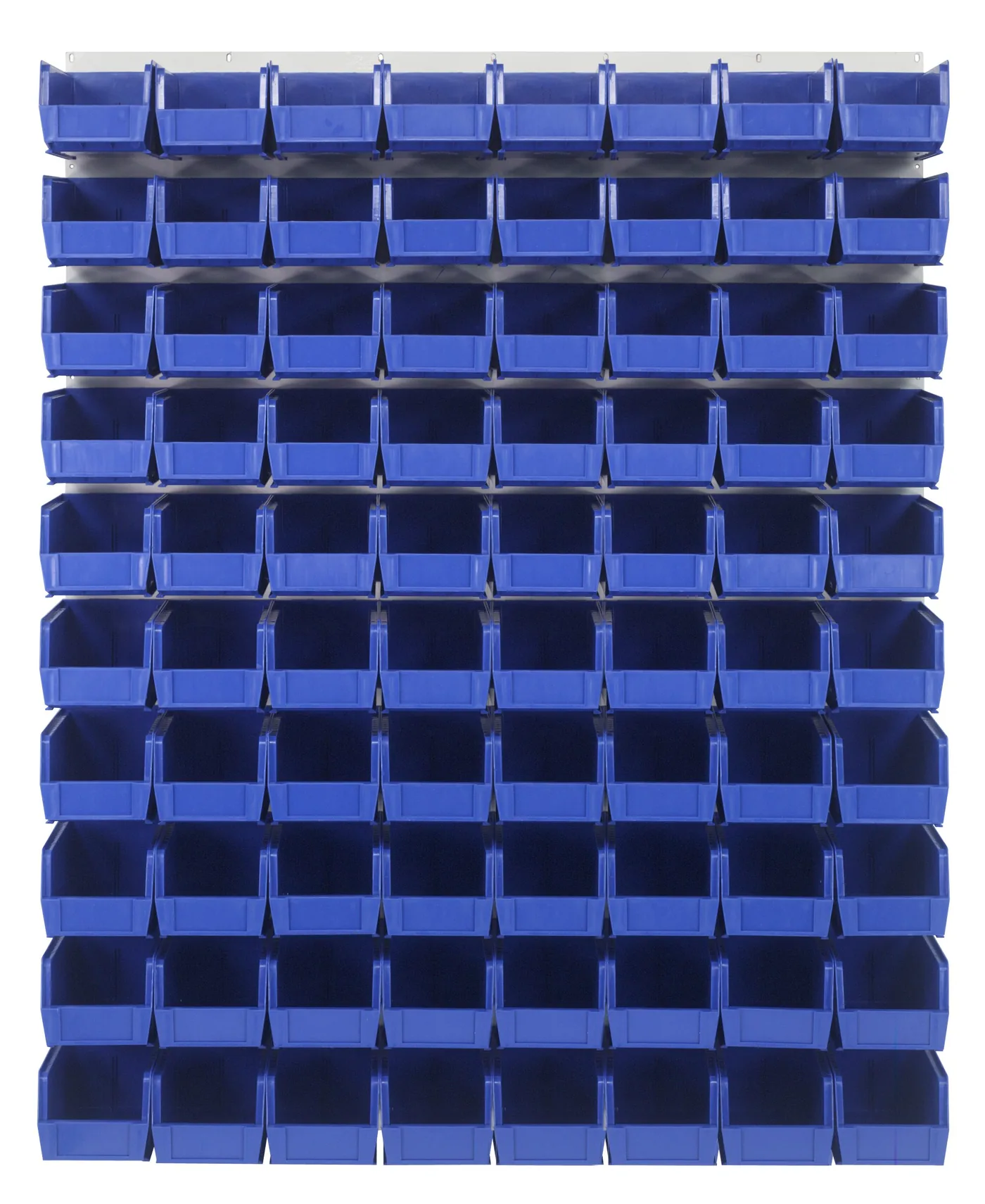
 Louvered wall panelThe building block. Rows of louvers accept every size of hang-and-stack bin, in gray or oyster white enamel.
 Mobile louvered rackParts that move with the work. Double-sided, on casters, with a handle and up to 1,200 lb capacity.
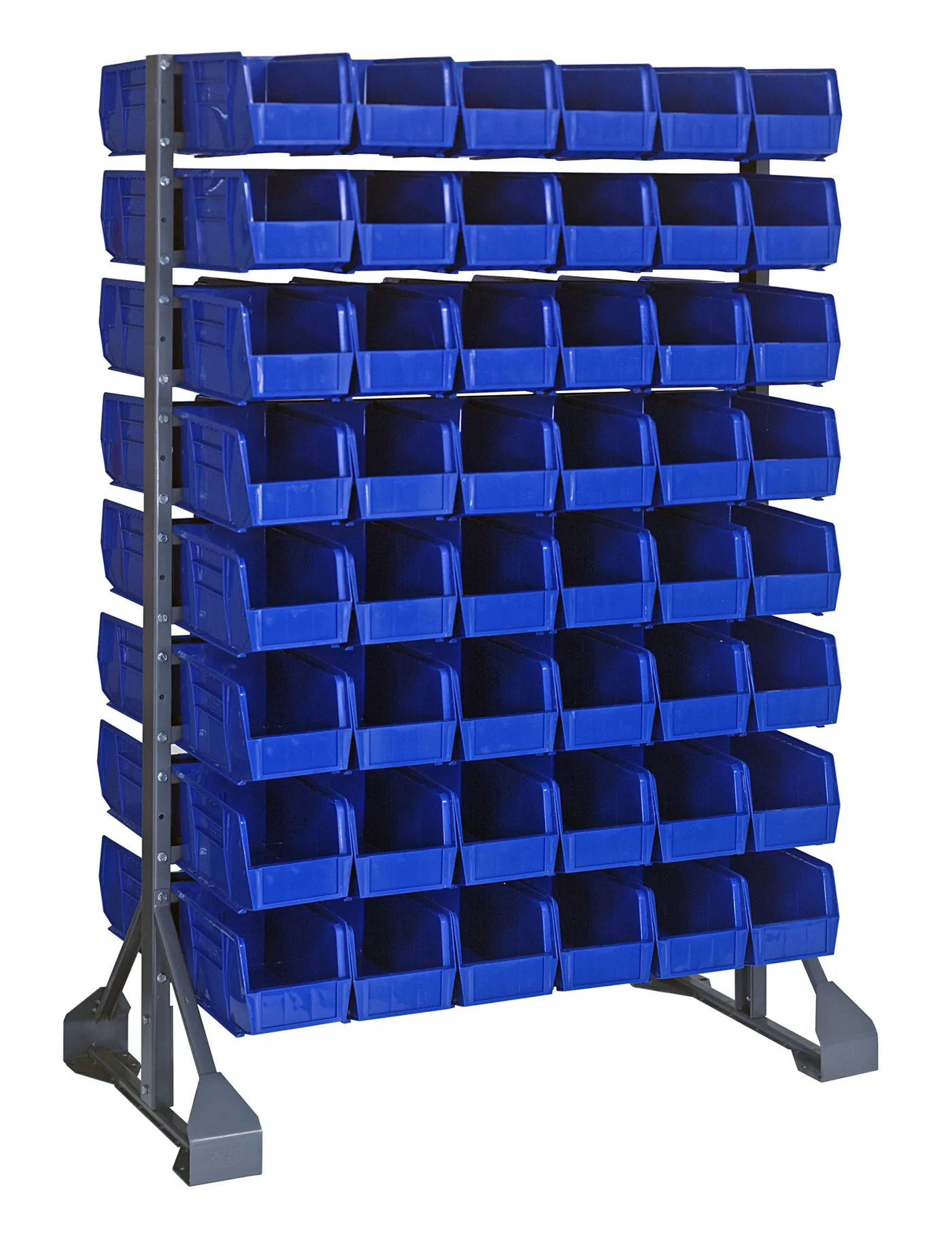 Double-sided rail rackA two-sided pick island. Bins hang on rails on both faces; a mobile kit is available.
 Wall bin railThe simplest option. A 48" rail screwed to the wall holds a straight row of bins.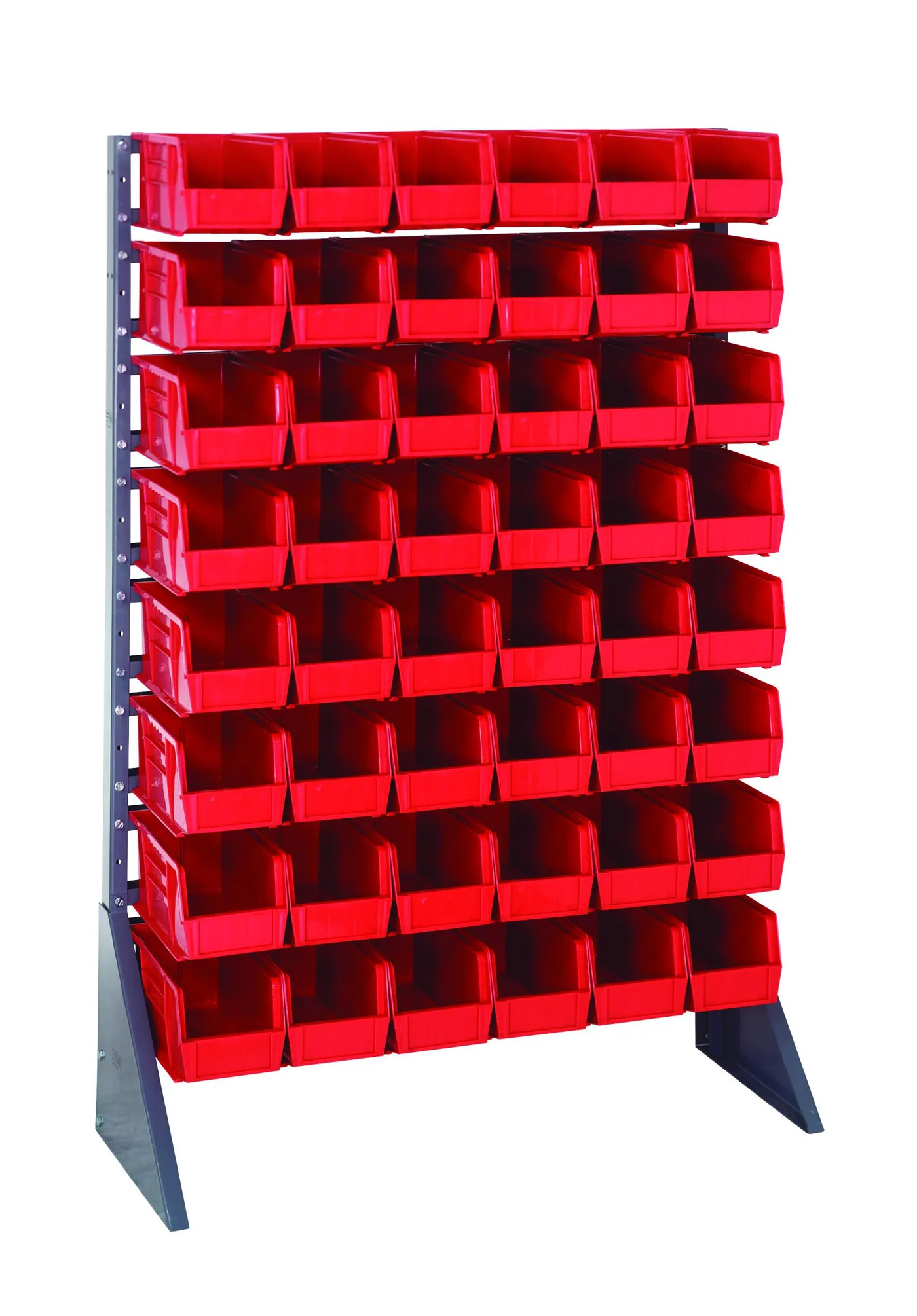
Single-sided rail racks stand against a wall or at the end of a line and carry their load on a galvanized steel frame instead of the wall itself, with published capacities around 600 lb for a 36" x 15" x 53" unit. That makes them a good fit for drywall partitions or leased space where fastening a loaded panel to the wall is not an option.
Double-sided rail racks and louvered racks work a pick face from both sides, so two operators or two cells can share one footprint. Put them on casters and the whole bin supply can be rolled to the job, then parked out of the way.
All formats accept the same bins, which keeps reordering simple: one bin family across the walls, benches and racks of the whole building.
Louvered Panels vs. Bin Rails vs. Bin Shelving
These systems are not competitors so much as tools for different spots in the same building. Most parts rooms and plants use two or three of them. Here is how to choose.
| Question | Louvered panels / racks | Bin rails / rail racks | Bin shelving |
|---|---|---|---|
| Floor space available? | None needed on a wall; small footprint on racks | None on a wall; small footprint on racks | Needs aisle and floor footprint |
| Bin size mix | Any mix on one panel, changed in seconds | Best with one bin size per rail | Shelf bins and hoppers by shelf |
| Part count | High count per square foot of wall | Medium; one row per rail | Highest total count in a stockroom |
| Where it lives | At the bench, machine, rack end or cart | At the bench or a pick island | In a stockroom or pick aisle |
| Reserve stock | Limited; bins are the stock | Limited | Bins plus boxed backstock on shelves |
| Security | Open | Open | Open, or locking bin cabinets |
Rule of thumb: keep the working stock for a station on louvered panels or rails at that station, and keep the reserve and the long tail of slow movers on bin shelving in the stockroom. Our inventory bin system guide covers the two-bin refill routine that connects the two, and our main bin shelving systems page covers the stockroom side in detail.
Where Louvered Panels and Bin Rails Fit Best
Assembly and kitting cells. A bench rack or a panel on a workstation riser puts every screw, clip and component inside the operator’s reach, in the order the job uses them. When the product changes, the bins move; the bench does not. See our assembly workstations and parts storage and kitting pages for the bench side of the cell.
Maintenance and repair shops. A louvered wall above an industrial workbench keeps fasteners, fittings and electrical connectors visible and off the work surface. Pair it with a rolling louvered rack that goes to the machine being repaired.
Electronics and controlled areas. Conductive bins and panels are available for static-sensitive parts; see our ESD shelving and electronics storage page.
- Pallet rack aisle ends: a panel on the end frame of a pallet rack row turns dead space into a pick face for small fast movers. Mount it to the rack only with hardware approved for that rack.
- Inside cabinets and doors: louvered door panels are how a bin cabinet holds a hundred or more bins behind a lock.
- Contractor shops and service trucks: panels can be fastened inside vans and on shop walls; our contractor bin shelving page covers van restocking.
- Warehouse pack and returns stations: tape, labels, inserts and small accessories on a panel at the station, with the main pick zone on warehouse bin shelving.
- Mobile supply between cells: one double-sided rolling rack can feed two lines, then be refilled in the stockroom.
Choosing Bin Sizes and Counts
Bin count per panel depends entirely on bin size. Packaged panels make the trade-off easy to see. On a single 48" long x 61" high panel, the catalog packages are:
| Bin depth (front to back) | Bins on one 48" x 61" panel | Typical contents |
|---|---|---|
| About 7-3/8" (small) | 165 | Screws, nuts, washers, terminals, small electronic parts |
| About 11" (medium) | 80 | Fittings, connectors, clips, hose ends, small tools |
| About 15" (large) | 35 | Larger fittings, filters, gaskets, boxed components |
Smaller panels follow the same pattern: an 18" x 19" panel holds 16 small bins or 9 medium bins, and a 36" x 61" panel holds 60 medium or 28 large bins. Packaged bins ship in one color per panel, and mixed layouts can be quoted.
List the parts for the station
Part numbers and how many of each the station uses per shift or per job.
Size bins to a refill, not a year
Each bin should hold a few days of use, so it is easy to see and refill.
Put fast movers at eye level
Highest-use bins between waist and shoulder height; heavy parts low.
Compare bin families, colors and sizes on our stacking and hang-and-stack bins page. For shelf-style bins that sit on bin shelving instead, see plastic shelf bins.
Mounting and Load Basics
Most wall-mounted louvered panels and wall rails ship without mounting hardware, because the right fastener depends on the wall. A loaded panel is a real load, so plan the attachment before the panel arrives.
- Know the wall: fasten into studs or blocking on framed walls, and use anchors rated for the load on masonry or concrete.
- Partition walls need a frame: panels on a partition wall system generally need a panel frame rather than direct fastening.
- Check three ratings: the bin, the panel or rail, and the wall or frame. The lowest one is your limit.
- No wall? Go freestanding: bench racks, rail racks and louvered floor racks carry the load on their own frame.
- Mobile units: load heavy bins low, lock the casters when parked and keep the rack on level floor.
- Leave room to grow: mount a little more panel than you need today and leave open louvers for new parts.
For the broader case for wall storage, our wall mounted bins guide walks through the benefits and common layouts. Some common sizes are in stock at select manufacturers, subject to confirmation at quote time.
Send the space and the parts
Wall or bench dimensions, photos and a parts list or rough bin count.
Panel, rail and bin plan
We choose formats, bin sizes and counts and mark mounting points and clearances.
One quote, delivered
Panels, racks, rails, bins and label holders on one quote, shipped nationwide.
Call 800-326-4403 or request a quote. Utah facilities can also work with our Salt Lake City team through the Utah bin shelving page.
Shop Louvered Panels and Bin Racks
Buy select items directly from our online store, or request a quote for volume, custom sizes and freight-rated orders.

Get a free quote
Tell us what you are storing, the room size and your timeline. A project specialist will follow up with layout options and pricing. Prefer to talk? Call (800) 326-4403.
Louvered Panel and Bin Rail FAQs
What is a louvered panel used for?
What is the difference between a louvered panel and a bin rail?
How many bins fit on a louvered panel?
Do louvered panels come with mounting hardware?
Can louvered racks be mobile?
Should I use louvered panels or bin shelving?
Ready to Put Parts Where the Work Is?
Send us your wall, bench or work cell and parts list for a free louvered panel and bin rail layout.