
School Lockers: Hallway, Junior High & High School Lockers
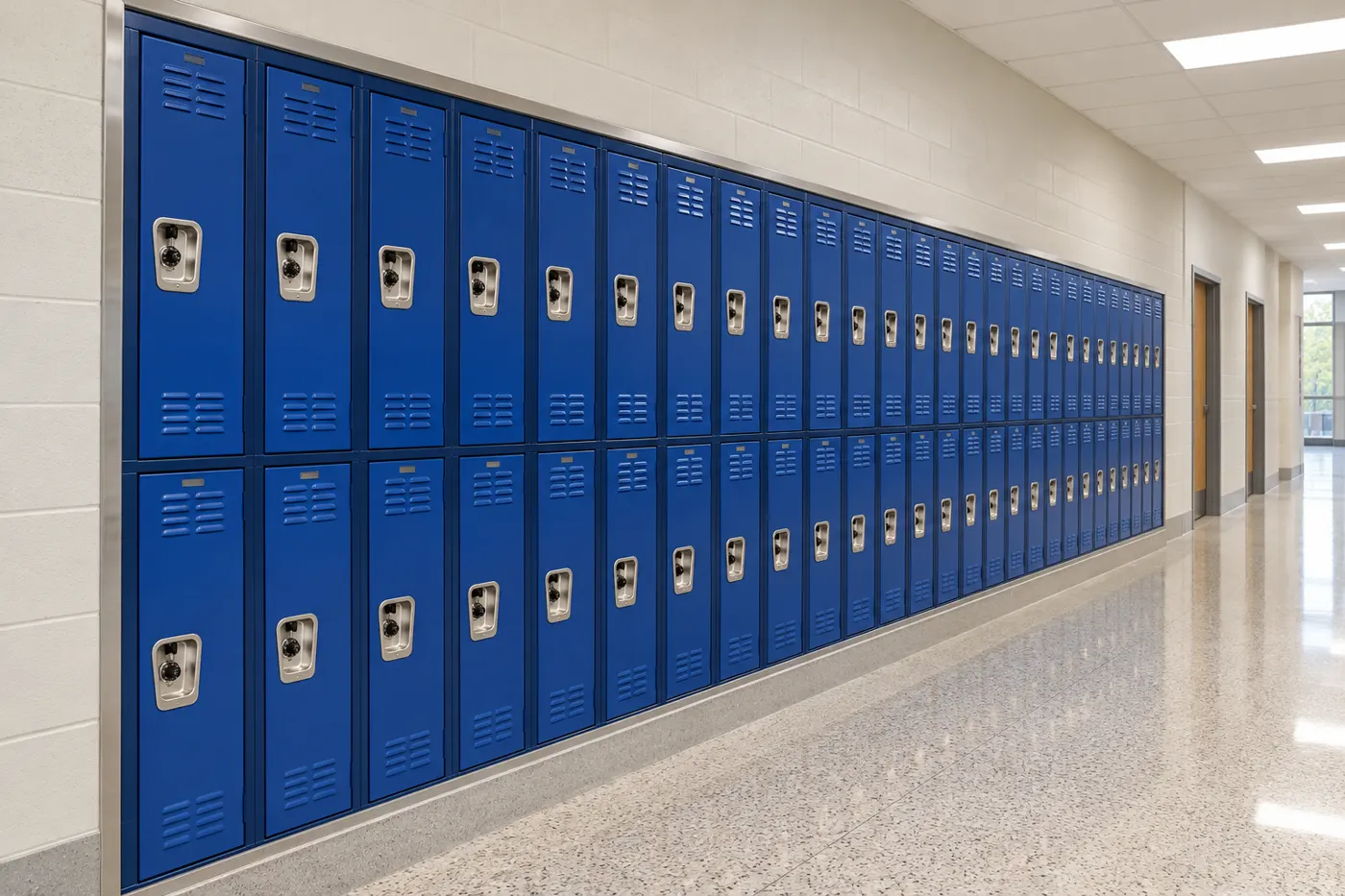
Steel school lockers for elementary, middle school and high school hallways, PE rooms and staff areas. Compare tiers and sizes by grade level, plan recessed or freestanding runs, choose locks and colors, and get a free layout and quote from a team that designs, supplies and installs locker projects.
K-12
Elementary to high school
1-6 tiers
Doors per column
12-24 in
Common locker widths
5% ADA
Accessible lockers per type
Shop Steel School Lockers by Tier
Order common Tennsco single-, double- and triple-tier lockers online for one hallway, a classroom or a replacement bank, or send us the floor plan for a full school locker quote with layout, trim and freight. Each card opens the shop category and the matching size guide.


What Makes a Good School Locker?
School lockers take more abuse than almost any other locker. Hundreds of students open and slam the same doors every day, kick the bottoms, hang on the frames and stuff backpacks, coats, instruments and sports bags into openings that were sized for a different generation. A locker that works in an office break room can rattle loose, dent and jam in a middle school hallway inside a few years.
A good school locker gets four things right: the tier and size fit what students at that grade actually carry, the construction (steel gauge, frame, hinges, latch) matches the traffic, the locks can be managed by your office, and the run is installed so it stays square and anchored for decades.


Material Handling USA plans and supplies steel lockers for school districts, charter and private schools, colleges and community centers. We work from your floor plan or a walk of the building, recommend the mix of tiers for each hallway, and quote the lockers with bases, trim, sloped tops, end panels, number plates and locks so the order is complete. Common Tennsco and Lyon sizes can be ordered online; larger or recessed projects are quoted with Penco, Lyon, Tennsco, Hallowell and other lines. Browse every locker style on our lockers page.
This guide covers hallway and corridor lockers for students. For team rooms and gyms see athletic lockers, and for staff areas see our employee lockers guide.
Looking for phone lockers or smart lockers?
Electronic lockers for phones, Chromebooks and pickup are a separate product with software and power. See school smart lockers. This page is about traditional steel student lockers.
School Locker Tiers and Sizes by Grade Level
Every steel locker is a column split into one or more doors (tiers). More tiers fit more students on the same wall, but each opening gets shorter. Start with what students store and how many students share a hallway, then pick width and depth.


| Grade level | Typical choice | Why | Watch for |
|---|---|---|---|
| Elementary (K-5) | Single-tier, often 60″ tall, or open cubbies | Coat and backpack fit; short reach | Reach height for small students; many schools use cubby lockers in classrooms |
| Junior high / middle school | Double-tier or triple-tier | Most students per foot of hallway | Backpack size; 12″ deep openings fill fast |
| High school | Double-tier or single-tier, 12″–15″ wide | Bigger bags, coats, instruments | Hallway width and passing-period crowding |
| PE / locker rooms | Triple-tier, box or ventilated lockers | Short-term storage per class period | Airflow; see athletic lockers |
| Staff and coaches | Single-tier or double-tier | Coats, bags, personal items | See employee lockers |
Size options. Manufacturers build school lockers in a range of widths and depths. Lyon lists 9″, 12″, 15″ and 18″ widths and 12″ to 24″ depths on its quiet lockers; Tennsco single-tier openings come 12″, 15″, 18″ or 24″ wide. The overall body is usually 60″ or 72″ tall, plus 6″ legs or a base, so a double-tier column gives two openings of roughly half that height. Exact combinations vary by line, so we confirm them on every quote. Full charts are on our locker sizes and specifications page.
Depth is the hidden constraint. A 12″-deep locker keeps a hallway open but struggles with today’s backpacks. 15″ deep is a common compromise for junior high and high school corridors; 18″ deep suits coats and bulky bags where the hallway allows it.

How many lockers fit on a hallway wall?
| Locker type (12″ wide columns) | Doors per column | Students per 30 ft of wall | Notes |
|---|---|---|---|
| Single-tier | 1 | about 30 | Most room per student |
| Double-tier | 2 | about 60 | Most common hallway choice |
| Triple-tier | 3 | about 90 | Shorter openings; check bag size |
| Box (4-6 tier) | 4-6 | 120-180 | Small items only; see box lockers |
Counts are simple column math (12 inches per column). Doors, fire extinguisher cabinets, drinking fountains, end panels and corner fillers take wall away, so we count the real runs from your floor plan before you order.
Construction: Knock-Down, Welded and Heavy-Duty School Lockers
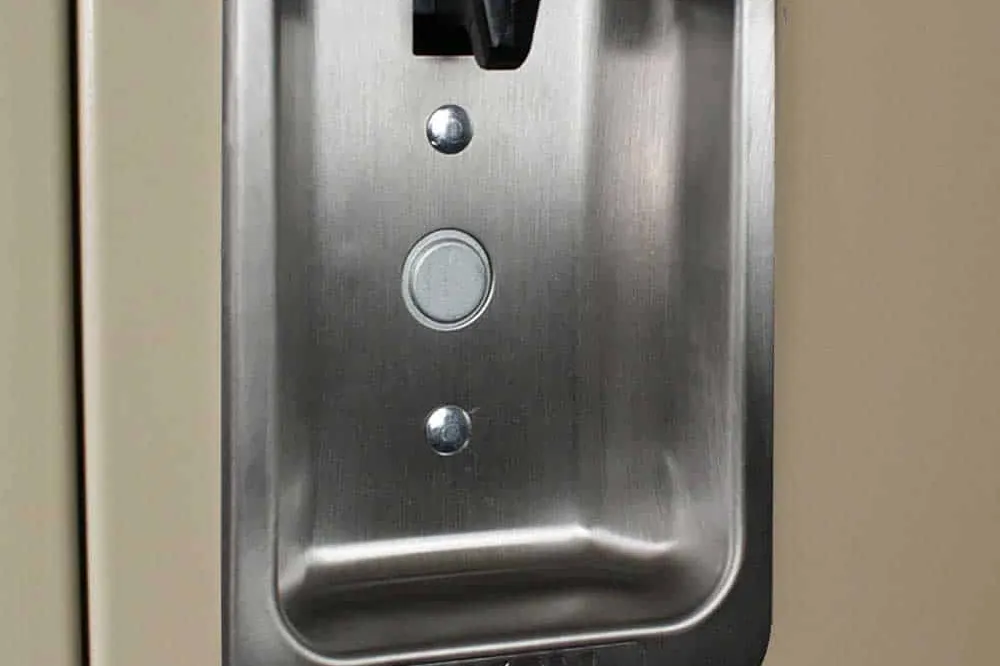
Latches and handles. Most school lockers use a recessed handle with a lift trigger and a padlock hasp, so nothing sticks out into the hallway to catch a backpack. Multi-point latching engages the frame in several places: Lyon specifies three latch points on single-tier doors and two on double- and triple-tier doors, and Tennsco uses a three-point latch on its single-tier doors. More latch points make a door harder to pry open.
Quiet operation. Rubber bumpers on the door frame, ribbed door stiffeners and quiet latches cut the clang of a hallway full of lockers. Tennsco’s welded locker specification calls for a 24-gauge ribbed stiffener welded inside each 16-gauge door for rigidity and noise damping.
- Louvers or perforations: standard louvers at the top and bottom of the door are enough for hallway lockers; ventilated or perforated doors belong in PE and team rooms.
- Sloped tops: stop students from piling books and trash on top of freestanding lockers and make cleaning easier.
- Closed bases or legs: 6″ legs make floor cleaning easy; a closed base or Z-base gives a finished look and keeps trash from collecting underneath.
- Number plates: doors come punched for number plates so the office can assign lockers.
- Colors: powder-coat colors let you match school colors or code hallways by grade; quick-ship programs usually stock only a few neutral colors.
Need finishing parts? Sloped tops, closed bases, end panels, fillers and number plates are on our locker accessories page.
School Locker Locks and Lock Management
The lock decision drives day-to-day work for your office more than any other spec. There are three common approaches:
| Lock type | How it works | Good for | Trade-offs |
|---|---|---|---|
| Built-in combination lock | Dial lock installed in the door; the office keeps a combination list and a control key | Most middle and high schools | Higher upfront cost; combinations change each year |
| Padlock on the handle hasp | Students or the school supply padlocks | Low budgets, PE rooms | Lost combinations and cut locks; less control |
| Built-in key lock | Keyed cylinder, often master keyed | Staff lockers, specialty rooms | Key management |
| Electronic or smart lock | Keypad, card or app access | Phone and device storage | See school smart lockers |
Built-in combination locks can be installed by the locker manufacturer at the factory or added in the field to new or existing lockers, and a control key lets staff open any lock in the system. If you are adding locks to older lockers, check the latch type first: Master Lock notes that single-point latch lockers moved from horizontal to rotating latches in 2008, and the lock model has to match. ADA-compliant lock models are also available for accessible lockers. Tell us your lock plan and we will make sure the doors are prepared for it before they ship.
Recessed vs. Freestanding Hallway Lockers

Recessed lockers sit inside an opening in the corridor wall, so the locker fronts are close to flush with the wall and the hallway stays wide. They need a built opening and a raised base (usually built by the general contractor), and recess trim closes the gap between the lockers and the wall. Penco’s recessed trim instructions put the ideal opening at the locker run plus 3″, with a minimum of plus 1-1/2″ and a maximum of plus 5″ before a filler and wall angle are needed.
Freestanding lockers stand against a wall on legs or a base and add sloped tops and finished end panels. They are faster to install and easier to move or replace, which is why most renovation and replacement projects use them.
- Measure the opening, not the plan. Old corridor openings are rarely square; we confirm width, height and depth at several points before ordering trim and fillers.
- Anchor every run. Lockers are bolted together and fastened to the wall or base so a bank cannot tip; follow the manufacturer’s anchoring and any requirements from your architect or building official.
- Plan for fire and life-safety items. Leave the clearances your code official requires at fire alarm devices, extinguisher cabinets and exits.
- Schedule around the school year. Summer is the install window for most districts; order early so lead time does not push work into the first week of school.
ADA Requirements for School Lockers
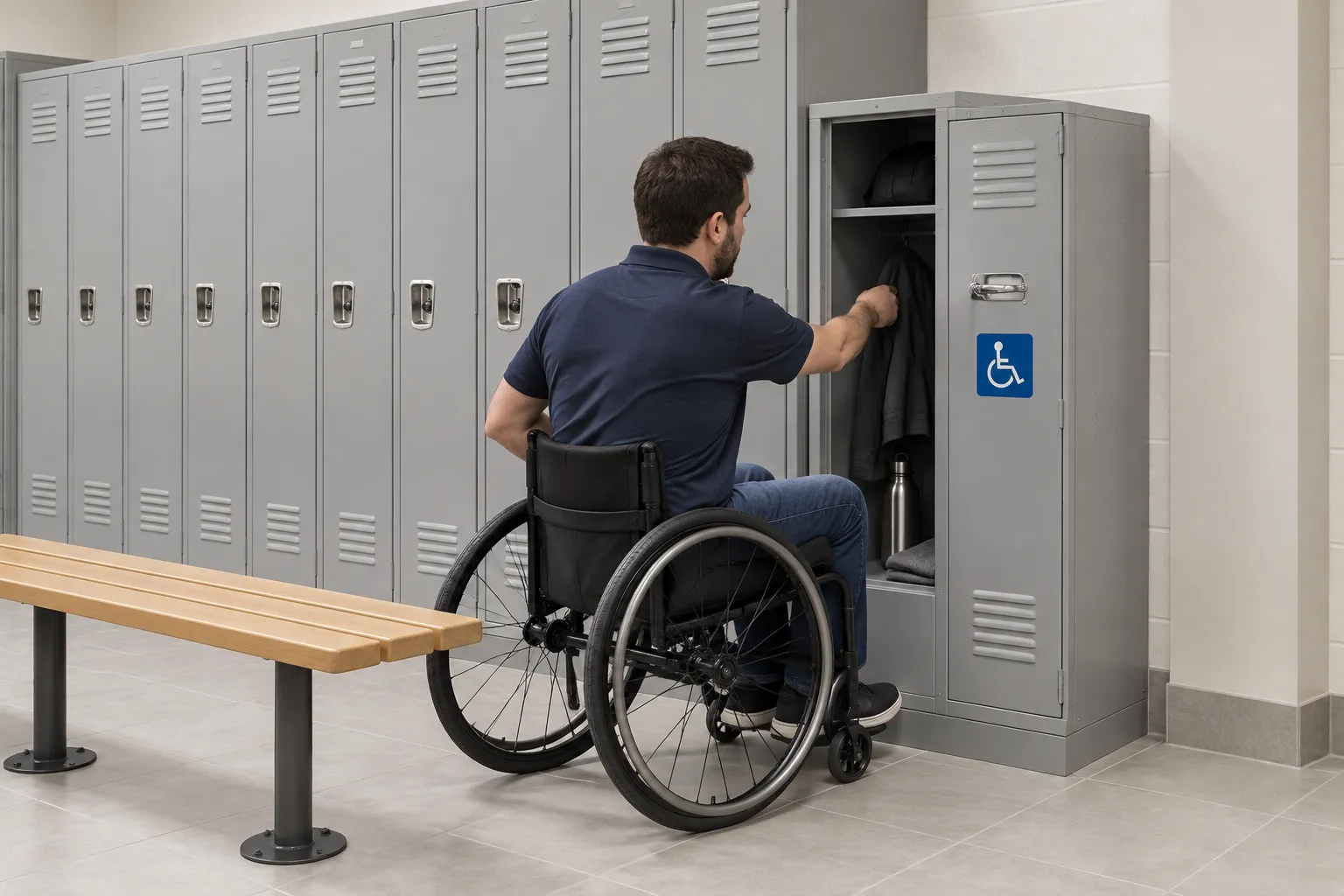
Under the 2010 ADA Standards (section 225.2.1), where lockers are provided, at least 5 percent, and no fewer than one of each type, must be accessible. The advisory notes that full-size lockers, half-size lockers and lockers designed for sports equipment count as different types, so a hallway of double-tier lockers and a PE room of triple-tier lockers each need their own accessible units.
An accessible locker keeps its storage and operable parts within reach: 48″ maximum and 15″ minimum above the floor for an unobstructed reach (section 308), with hardware that works with one hand and no more than 5 pounds of force (309.4). For locker rooms, an accessible bench is also required. Our ADA lockers guide covers reach ranges, shelves, hooks and locks in detail.
Designing for younger students
The ADA Standards include advisory reach ranges for elements designed mainly for children. For elementary hallways we plan locker heights, hooks and shelves with your architect so they work for the age group that actually uses them.
School Locker Applications
Most school projects mix several locker types. These are the spaces we plan most often, with the guide that covers each one.
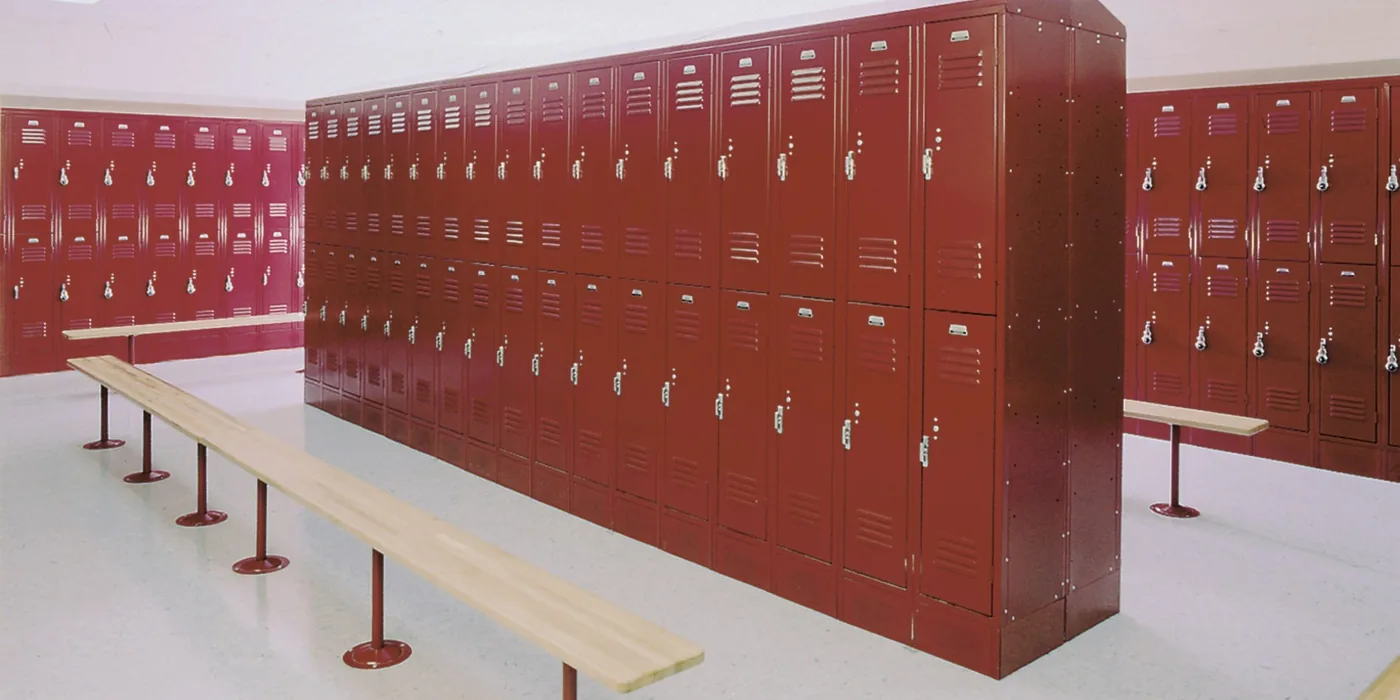
Locker rooms are a different spec. A PE locker room serves many students per day for short periods, and clothes come back damp. Rows of triple-tier or box lockers for class periods, a few full-height lockers for teams, benches with the right aisle width, and ventilated doors are typical. Our locker room benches guide covers seating and spacing.
Beyond lockers, schools also use our athletic storage systems for equipment rooms and our education storage solutions for libraries, records and maintenance shops.
School Locker Brands We Quote
| Brand | What schools use it for | Learn more |
|---|---|---|
| Penco | School lockers were Penco’s first product; its Invincible II, Guardian and Vanguard lines are its most popular for schools | Penco lockers |
| Lyon | All-welded and standard lockers for middle and high schools, plus ADA and benches | Lyon lockers |
| Tennsco | Single-, double-, triple-tier and box lockers in our online shop | Tennsco lockers |
| Hallowell | Corridor, kid and wood lockers from the List Industries family | Hallowell lockers |
| Dasco | Heavy-duty corridor lockers for high-traffic hallways | Dasco corridor lockers |
Catalog listings are not a stock guarantee. We confirm color, lead time and freight on every quote, and quick-ship programs usually cover a few standard colors and sizes. Buying in Utah? Our Utah lockers page covers local projects and installation.
How a School Locker Project Works
Send the plan
Floor plan or hallway measurements, enrollment by grade, and photos of existing lockers. Call (800) 326-4403.
Choose the mix
We match tiers, sizes, construction, locks and colors to each hallway and locker room.
Layout and quote
You get a layout with locker counts, recessed trim or sloped tops, bases, fillers, end panels, number plates and freight, plus installation if you want it.
Deliver and install
Lockers ship from the manufacturer; we coordinate delivery and install around your school calendar.
Replacing a few damaged lockers? Send the brand, size and a photo of the door and we will find matching units or replacement parts.
Get a free quote
Tell us what you are storing, the room size and your timeline. A project specialist will follow up with layout options and pricing. Prefer to talk? Call (800) 326-4403.
School Locker FAQs
What size are standard school lockers?
What lockers are best for junior high or middle school?
Which lockers do high schools use?
Should school lockers be recessed or freestanding?
How many school lockers must be ADA accessible?
Built-in combination locks or padlocks?
Can I buy school lockers online?
Do you install school lockers?
Plan Your School Locker Project
Send your floor plan or hallway measurements for a free locker layout and quote.