
3PL Warehouse Pallet Racking for a Multi-Client Operation: QVS Marketing
A third-party logistics warehouse has to store somebody else’s inventory profile — and then re-store it when the contract changes. Here is how we plan commercial 3PL warehousing storage solutions that can be reconfigured instead of replaced.
2026
Year QVS Marketing worked with us on pallet rack
3PL
Third-party logistics warehousing
Multi-client
Several inventory profiles under one roof
Reconfigurable
The design goal that separates 3PL rack from DC rack
Plan your layout before you buy
Configure upright height, beam width, bay count, and load levels in our free 3D Pallet Rack Designer, then get an instant bill of materials and request a quote.
The project
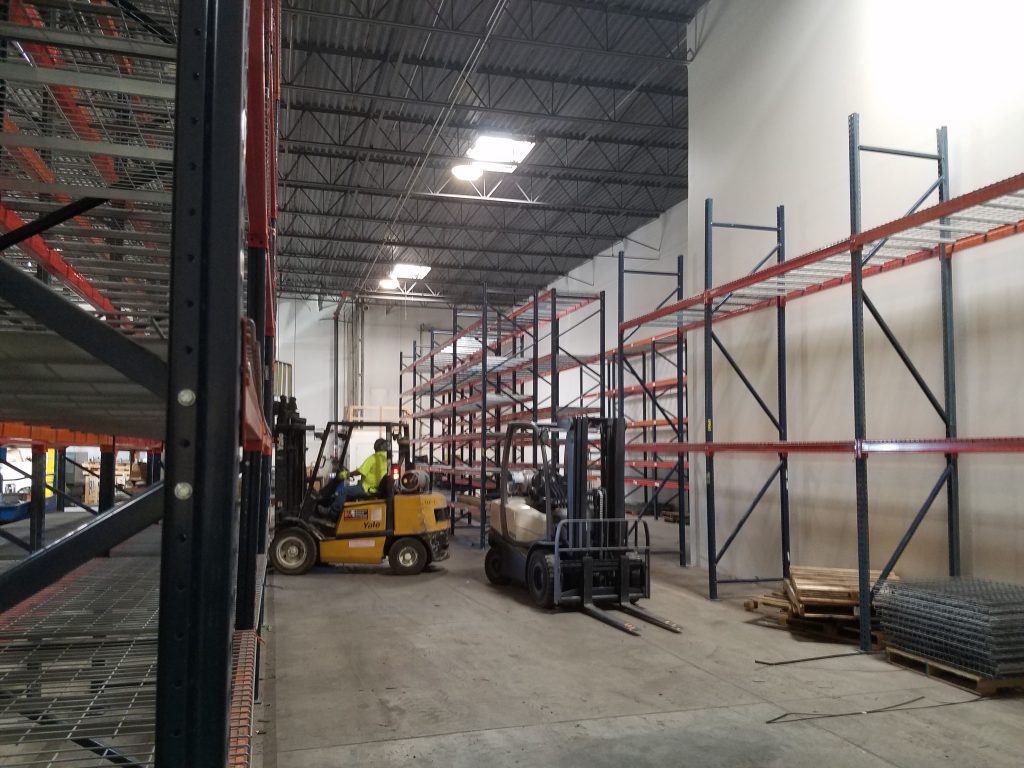
QVS Marketing is a third-party logistics and warehousing operation. Material Handling USA supplied pallet rack for the company in 2026.
Third-party logistics is the hardest storage brief we get, and the reason is simple: a 3PL does not own the inventory that determines its layout. A distribution centre designs racking around a product mix it controls for years. A 3PL designs warehouse pallet racking around a client roster that can change with a single contract — a new customer arrives with 40 pallets of a fast-moving consumer good, an existing one triples in volume, another leaves with three months’ notice, and the building has to absorb all of it without a rebuild.
This page uses that project as the starting point for how we approach racking a multi-client 3PL warehouse. The client, the year and the product category are the only project specifics we publish; the rest is general planning guidance applicable to any 3PL or public warehouse.
What we publish
We publish the client, the year we worked together and the product category supplied. We never publish facility layouts, room dimensions, storage quantities, client names of our customers’ customers, contract values or anything else specific to a site.

Designing for a mix you do not control
Every 3PL operator eventually meets the same four pressures at once, and racking has to answer all of them.
Space is revenue. Unused cube is money left on the floor, so density is attractive — but density that traps a client’s pallets behind another client’s pallets destroys the service level you are being paid for.
Clients are separated for a reason. Inventory accuracy, billing by pallet position, and sometimes contractual or regulatory separation all mean one client’s goods should occupy identifiable positions, not simply the next empty slot.
Turnover varies enormously. The same building can hold a slow seasonal product that moves twice a year and a fast consumer good that turns weekly, and the right rack for those two is not the same rack.
Change is constant. The layout you commission is not the layout you will run in three years. Rack that can be reconfigured — and a plan for how to do it — is worth more than a perfectly optimised system that can only be one thing.
Profile every client before drawing a layout
The work that makes a 3PL layout durable happens before any rack is quoted: profiling each client’s inventory the same way, so the building can be planned around patterns rather than around personalities.
Write the profile down and keep it
The profile is not just a design input. When the client roster changes, a documented profile for every account is what lets you reassign rows quickly instead of rediscovering the building from scratch.
Choosing the mix: selective, push-back, flow, double-deep
Almost no 3PL building is one system. The economical answer is usually a backbone of single-deep selective pallet racking — the most flexible, most reassignable rack there is — with density systems added where a specific, stable client profile justifies them.
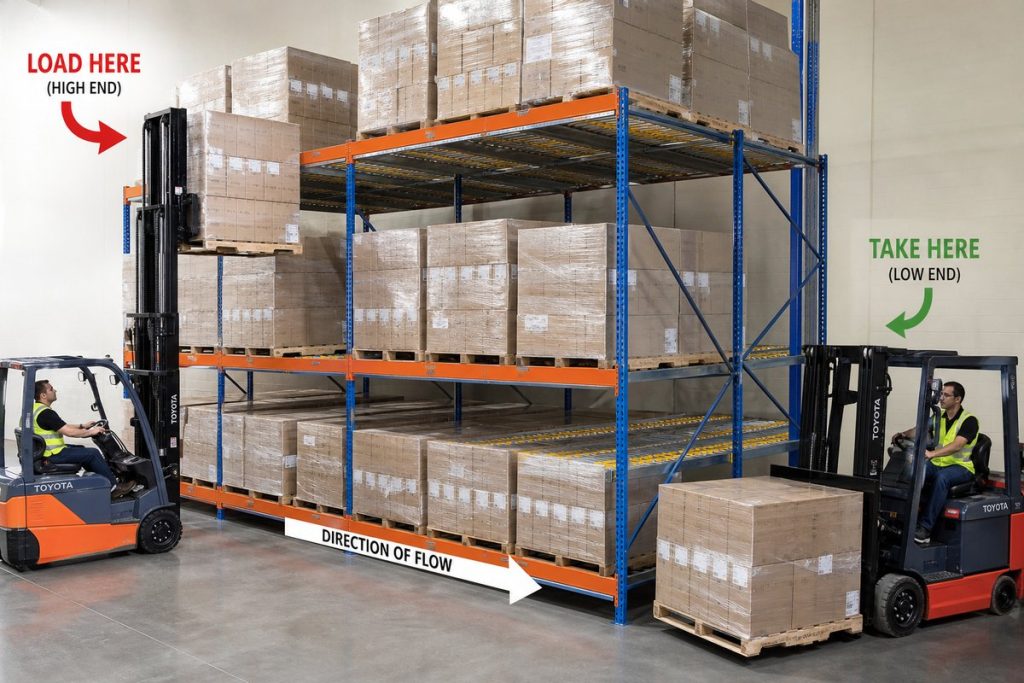
Push-back pallet racking is the density system that suits 3PLs best, because it stores two to six pallets deep while still loading and unloading from one aisle, and because a lane can hold a different SKU than the lane beside it without any operating discipline beyond “one SKU per lane”. It is last-in, first-out, so it fits clients whose product is not date-critical.
Pallet flow rack answers the opposite case: strict FIFO, high volume, load from the back and pick from the front. It is the right call for date-coded goods, and the wrong call for clients with inconsistent pallets.
Double-deep rack is a middle option when a deep-reach truck already exists, and narrow-aisle configurations are how you buy cube in an existing building without moving walls — at the cost of committing to specific truck types.

| System | Fits the 3PL client who… | Rotation | Reassignment effort |
|---|---|---|---|
| Selective | Has many SKUs and few pallets each, or is brand new to you | Any | Trivial — relabel and go |
| Push-back | Has stable, non-date-critical products at 2–6 pallets per SKU | LIFO | Moderate — carts and rails are lane-specific |
| Pallet flow | Requires strict FIFO on high-volume, date-coded goods | FIFO | High — lanes are engineered to a pallet |
| Double-deep | Has moderate SKU counts and you already run a deep-reach truck | LIFO | Low — but honeycombing wastes positions |
| Drive-in | Ships very few SKUs at very high pallet counts and never changes | LIFO | High — and risky for a 3PL |

Be careful with drive-in in a 3PL
Drive-in rack is the least forgiving system a third-party warehouse can install. It only pays when a single SKU fills whole lanes, and the client who justified it is exactly the client who may not renew. Where density is genuinely needed, push-back usually survives a change of roster far better.
Zoning a shared building
Once the systems are chosen, the layout question is where each client lives. A few principles hold up across almost every multi-client warehouse.
Zone by velocity first, by client second. The fastest-moving pallets should sit closest to the dock doors and at the most reachable levels regardless of whose they are; travel distance is the largest controllable cost in the building.
Give each client a contiguous, addressable block. Scattering an account through the building saves a few positions and costs you inventory accuracy, cycle-count time and billing clarity.
Keep a flex zone. A block of plain selective rack held deliberately in reserve is what lets you say yes to a new client in week one rather than month three. It is the cheapest insurance in the building.
Design the addressing before the labels are ordered. A location scheme that encodes aisle, bay, level and position, and that matches the WMS, will still make sense after three rounds of client turnover. One built around today’s client names will not.
Reconfiguration, used rack and the cost of change
Because a 3PL layout will change, the way rack is bought should anticipate it.
Standardise on one profile. Sticking to a single teardrop upright profile and a small set of beam lengths and capacities means components move between rows instead of becoming orphans in a corner. Mixed profiles from three suppliers are a headache that compounds every year.
Buy beams in the lengths you will reuse. Odd bay widths save a little floor space and cost flexibility forever.
Consider used rack deliberately, not opportunistically. Good used pallet racking can be excellent value for a flex zone or an overflow row, provided the profile matches, the capacity data is known and the components are inspected. Rack with unknown provenance and no capacity information is not a bargain — it is a liability you have to engineer around later.
Plan the reconfiguration itself. Moving beam levels changes the rack’s design configuration and its posted capacity. Reconfiguration means updating capacity information, re-checking anchorage and, above a certain scale, going back to the engineer — which is a good reason to use an experienced rack installation crew rather than a Saturday shift.

Damage, protection and the shared-building problem
A 3PL warehouse takes more rack damage per pallet position than an owner-operated DC, for two structural reasons: traffic is higher and mixed, and the operators working the aisles change more often.
Protection is the cheap half of the answer. Column guards, end-of-row protectors and bollards at dock approaches, aisle ends and corners absorb the hits that would otherwise become a damaged upright and an unloaded row. Row spacers keep frames square; beam safety clips keep beams from being dislodged by a fork.
Process is the other half. Every operator, including a client’s own driver or a temp, should know that any contact with rack is reported immediately, that the affected bay is unloaded, and that it stays out of service until it has been evaluated through a documented rack inspection and repair route. OSHA’s materials-handling rule, 29 CFR 1910.176(b), requires stored material to be stable and secure against collapse, and rack design follows ANSI MH16.1 from the Rack Manufacturers Institute at MHI. Neither is satisfied by a bay that was hit last month and never looked at.
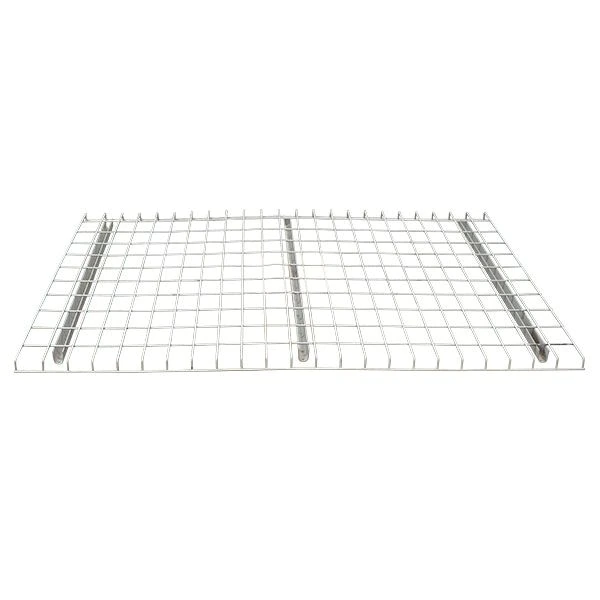
Shop Pallet Rack Accessories Online
Protect and finish your pallet rack installation with these in-stock accessories, or request a quote for custom-sized rack, freight and volume pricing.

3PL warehouse racking FAQs
What racking works best in a 3PL warehouse?
Is push-back or drive-in better for third-party logistics?
How do you separate different clients’ inventory on pallet rack?
How much rack should a 3PL keep in reserve?
Can pallet rack be reconfigured for a new client?
Is used pallet racking a good idea for a 3PL?
How do you control rack damage in a busy multi-client warehouse?
Planning racking for a logistics or fulfillment operation?
We design, supply and install 3PL and distribution racking and e-commerce fulfillment rack systems across Utah and the Intermountain West.
Utah pallet rack project: This case study supports our Utah pallet rack design and installation guide and, at the top level, our main pallet rack systems hub.
Racking That Survives a Change of Client
Material Handling USA designs, supplies and installs pallet rack for third-party logistics, public warehousing and distribution operations across Utah and the Intermountain West.
Ready to configure your pallet rack system?
Use our guided BuildQuote tool to choose the right configuration, review your parts and submit it for checkout or a formal quote.