
Mixed-Depth Boltless Shelving for a Public Library System: Weber County Library, Ogden, UT
How a Utah county library system planned back-of-house storage in three shelf depths at its main library, then added deeper, lower shelving at a branch five months later using the same parts.
Ogden, UT
Project location
Library
Public sector
3 depths
24, 36, 48 inch
2 buildings
Orders in 2018
The Project: Storage Behind the Stacks
Weber County Library runs the public library system for Ogden and the rest of Weber County, with its main library in Ogden and branches around the county. What patrons see is the public shelving: book stacks, periodical displays and children’s areas. What they do not see is everything behind the staff door. A library system handles a constant flow of material that is not on the public shelves yet, or not any more: new deliveries waiting to be processed, donated books being sorted, items pulled for repair, program and event supplies, seasonal displays and boxed stock.
In April 2018 the library bought boltless shelving for back-of-house storage at the Main Library in Ogden. In September of the same year it came back for a second order, this time for the North Branch in North Ogden. Chris Rodgers, our director of sales, quoted both, and both were delivered by freight from the manufacturer.
The library was not a new customer. Its project files with our Salt Lake City team go back to 2010, when we quoted installed Estey steel periodical shelving for its public areas. Public-floor library shelving and back-room storage shelving are different products for different jobs, and this case study is about the second kind.
This project is one of the Utah public-sector jobs behind our boltless shelving in Salt Lake City service page, alongside City Hall and Public Works shelving for the City of Draper and installed shelving for Ogden Housing Authority. The product family is covered in depth on our boltless shelving hub, part of our wider shelving solutions range, and library applications are summarized on our library storage shelving page.
A note on what we know
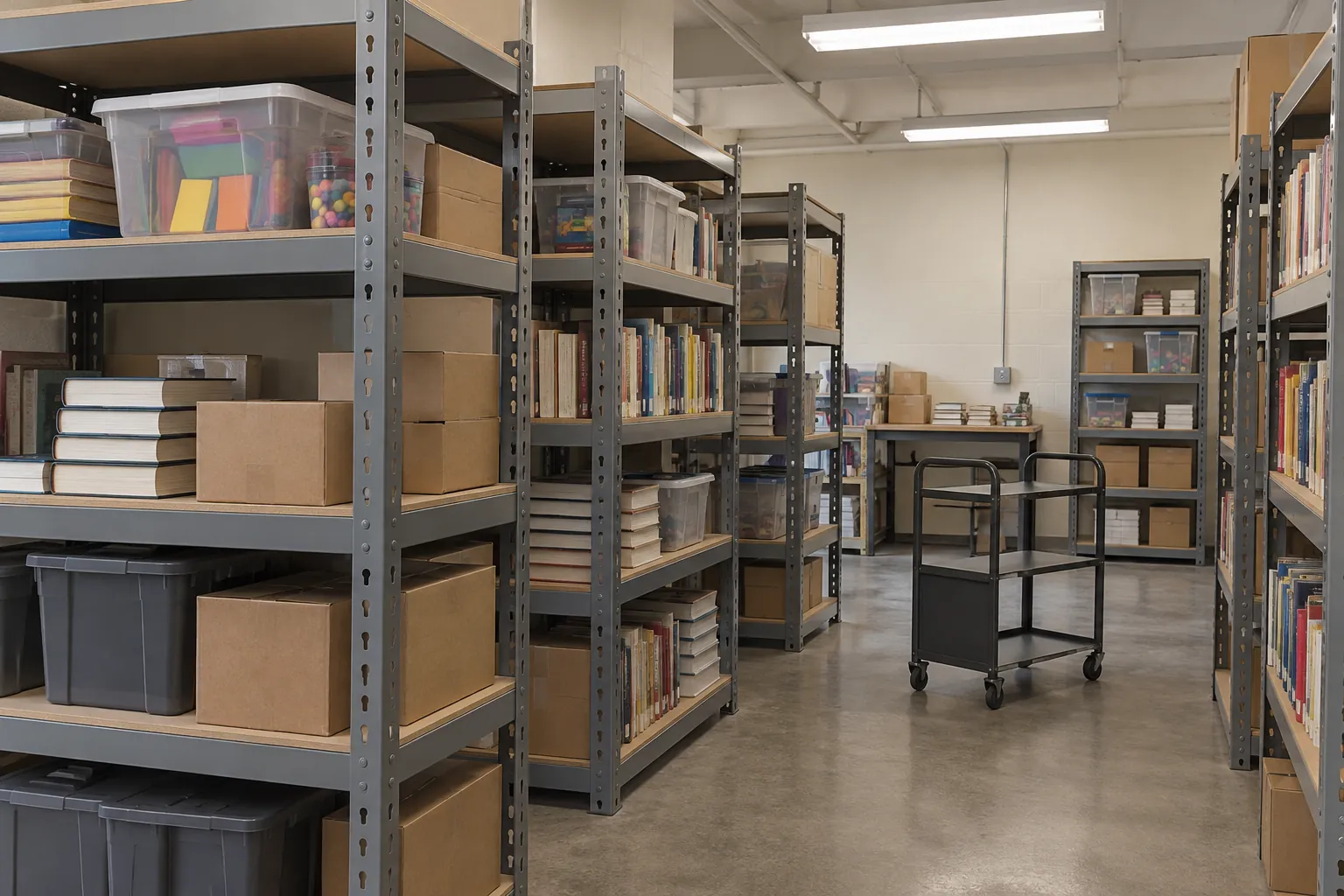
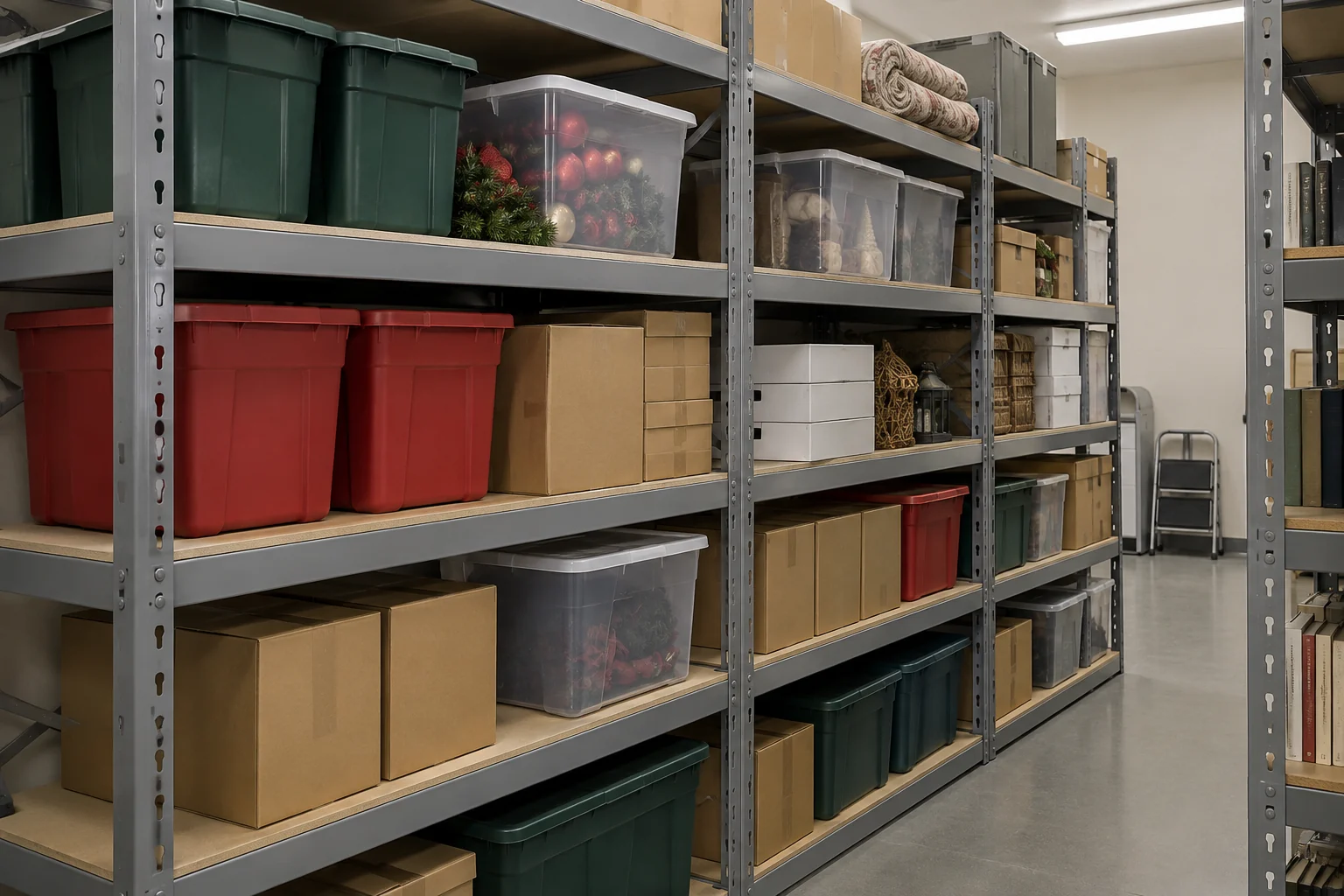
We supplied the shelving; we do not know exactly what the library keeps on each shelf, and we are not publishing room layouts, addresses or how many units went where. The photos on this page are illustrations, not photos of library buildings. Everything said about the shelving itself (sizes, components, order sequence, purchasing and delivery) comes from the project’s quotes, invoices and manufacturer purchase orders.
One Order, Three Shelf Depths
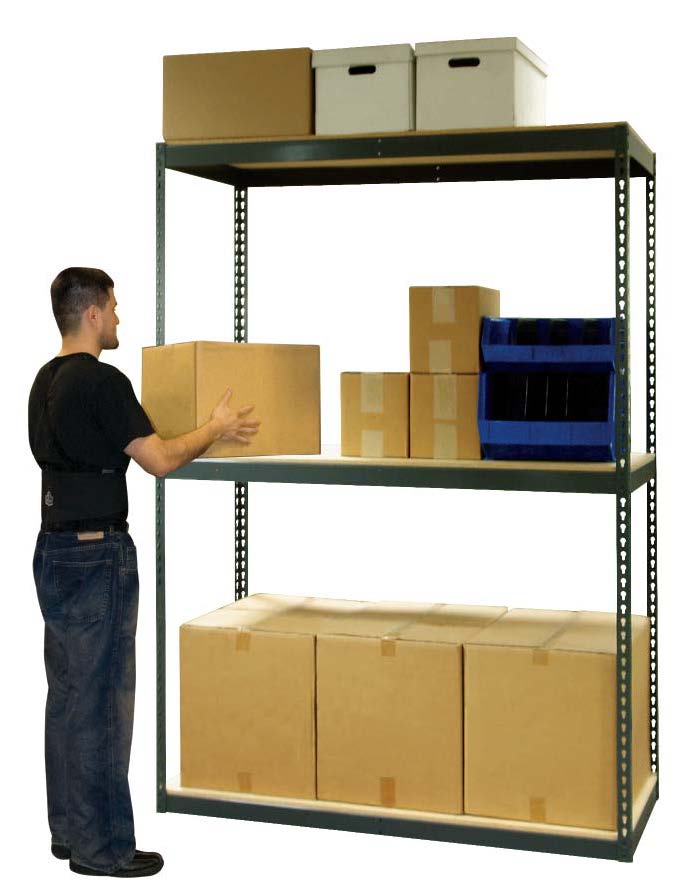
Most shelving orders pick one depth and repeat it. The Main Library order did the opposite. Every unit was eight feet high with five particle board shelf levels, but the order mixed three depths and three widths, so each storage job could get a shelf sized to the things it holds.
| Shelf depth | Widths ordered | What a shelf this deep suits |
|---|---|---|
| 24 inch | 48 inch | Books standing upright, binders, small cartons and supplies along a wall or a narrow aisle. |
| 36 inch | 48 and 60 inch | Standard record and moving cartons, stacked books, plastic bins two deep. |
| 48 inch | 60 and 72 inch | Large lidded tubs, bulky display pieces, boxed deliveries and anything that needs a deep, wide landing spot. |

Choosing depth by contents rather than by habit matters more in a library than almost anywhere else. A 24 inch shelf is plenty for a row of books, and a deeper one just hides whatever slides to the back. Bulky items are the opposite: a 48 inch deep shelf takes a full size storage tub or a large carton without overhang, where a shallow shelf would leave it sticking into the aisle.
Mixing depths in one order costs nothing in compatibility. Every unit in the order used the same manufacturer’s Series 200 angle posts and double rivet beams. The beams come in a range of lengths, and depth is simply set by which beam length goes on the ends of each level: 24, 36 or 48 inches. The width is set by the beams on the front and back: 48, 60 or 72 inches. So a three depth, three width order is still one parts family, built the same way, with the same mallet.
There is a planning benefit too. Deep shelves use more floor area per unit, so putting them only where bulky items live keeps aisles wider elsewhere. A storage room laid out with shallow units along the walls and deep units where there is room to load them usually holds more, and is easier to work in, than a room filled with one depth.
Pick the depth from the biggest thing on the shelf
Measure the largest item each shelf will hold, add a couple of inches, and round up to the next standard depth. If two jobs share a room, it is fine to mix depths in the same order and even in the same run.
Deck Supports: One or Two per Level
Particle board is a good shelf surface for a library: solid, smooth, quiet and kind to book covers. But a particle board deck only rests on the beams around its edges. On a deep or wide shelf, the middle of the board needs help, and that is the job of the deck support.
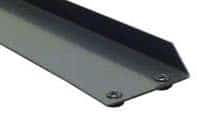
A deck support is a light steel bar that bolts between the front and back beams under the deck, running from front to back, so it is the same length as the shelf depth. The library’s purchase orders include deck supports in all three lengths, 24, 36 and 48 inches, matched to each unit’s depth.
The orders also show how many each level got, and the rule is a useful one to copy. Levels 48 inches wide had one deck support in the middle. Levels 60 and 72 inches wide had two, splitting the span into thirds. The 48 inch deep, 72 inch wide shelves, the biggest decks in the order, carried two supports under every level.
Getting this right at order time is cheap. Deck supports cost little and add only minutes to assembly. Leaving them out on a wide shelf is how particle board decks sag, and a sagging deck under a row of heavy books is hard to fix later without unloading the whole unit. The load each level can carry is set by the beams and the span, so the right figure for your contents should always be confirmed on the quote. Our guide to single rivet vs double rivet boltless shelving beams lists the manufacturer’s published capacities by beam length.
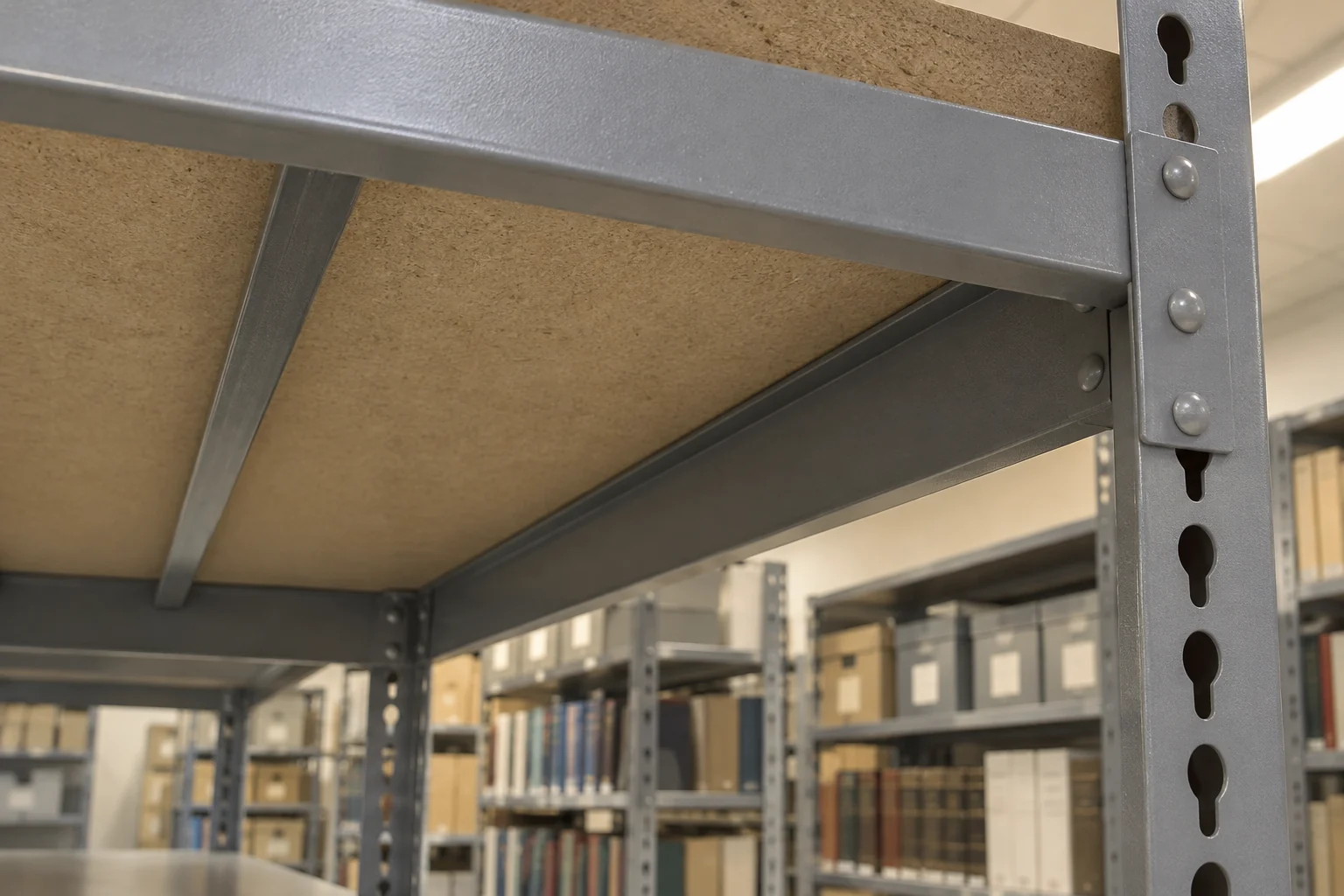
| Component on the orders | What it does |
|---|---|
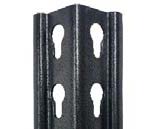
| Series 200 angle posts, 8 foot and 7 foot | Uprights with keyhole slots up the full height, so levels can be set anywhere. |
| Double rivet beams, 48, 60 and 72 inch | Front and back beams that set the width of each level. |
| Double rivet beams, 24, 36 and 48 inch | End beams that set the depth and square the unit. |
| Deck supports, 24, 36 and 48 inch | Steel bars under each deck, front to back; one per level on 48 inch widths, two on 60 and 72 inch widths. |
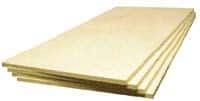
| Particle board decks | One solid deck per level, cut to the full width and depth of the shelf. |
For other deck choices, our boltless shelving decking options page compares particle board, wire and steel. Wider units are covered on our wide span boltless shelving page, and replacement beams, posts, decks and supports are listed on our boltless shelving accessories page.
Freestanding Units Instead of Connected Runs

Boltless shelving can be built two ways. In a connected run, neighbouring sections share posts, so a row of units uses fewer uprights. In a freestanding layout, every unit stands on its own four posts. The library’s post count matches the second approach: every unit on both orders had its own four angle posts.
Freestanding units make particular sense when the order mixes sizes. A 72 inch wide, 48 inch deep unit cannot share a post with a 48 inch wide, 24 inch deep unit beside it in any useful way, because the beams on the shared side would not line up. Separate units also give a library room to reorganize later. Any unit can be emptied, picked up and moved to another room or another branch without taking apart its neighbours, which suits a system whose storage needs shift with collections, programs and renovations.
The trade-off is a few more posts, and stability. Neither order included foot plates for anchoring, so the units were planned freestanding. Tall freestanding shelving in a public building should be loaded heaviest at the bottom, kept level, and anchored to the wall or floor wherever the building official or facility manager asks for it. Our City of Draper case study shows how foot plates and tie plates are added to the same posts when a room calls for anchoring.
Utah and tall shelving
Much of the Wasatch Front sits near the Wasatch Fault. Ask your facilities team whether tall shelving in staff areas must be anchored before you order, so the hardware ships with the shelving. Our seismic planning guide for Utah shelving covers the questions to ask.
The North Branch Follow-On: Deeper and Lower
Five months after the Main Library order, the library ordered shelving for its North Branch in North Ogden. The branch order was smaller and simpler: one unit size only, 60 inches wide and 48 inches deep, with five particle board levels and two deck supports per level. The deep, wide shelf was the same size the library had already used at the Main Library.
One thing changed. The branch units were 84 inches high on seven foot posts instead of 96 inches on eight foot posts. A lower unit is a common choice for a branch back room. Branch storage rooms are often smaller, ceilings and soffits can be lower, and with no warehouse ladder on hand, a top shelf staff can reach from the floor or a step stool gets used far more than one that needs a ladder. With five levels on a seven foot post the shelf openings are still generous for tubs and cartons.
Because the posts, beams, decks and supports all came from the same series, the branch shelving is fully compatible with the Main Library’s. Beams and decks of the same size can move between buildings, and the 60 by 48 inch decks are the same part in both.

| Main Library, April 2018 | North Branch, September 2018 | |
|---|---|---|
| Unit height | 96 inch (8 foot posts) | 84 inch (7 foot posts) |
| Widths | 48, 60 and 72 inch | 60 inch |
| Depths | 24, 36 and 48 inch | 48 inch |
| Levels per unit | Five, particle board | Five, particle board |
| Deck supports | One or two per level, by width | Two per level |
| Delivery | LTL freight | LTL freight with liftgate |
Buying for a County Library System
Both orders followed the same simple pattern, which is worth copying for any public library. Each quote was a one-page proposal listing the unit sizes, five shelf levels, the particle board deck and freight, with delivery expected in about ten days. Both were priced under the State of Utah cooperative contract in place at the time, which county libraries, cities and school districts in Utah can use. The library headquarters handled the purchasing and billing, while each order shipped straight to the building that needed it.
Public agencies across Utah buy this way. For another library supply chain project, see how the Utah State Library racked its distribution warehouse. For public-floor library storage, see mobile shelving for library book stacks and library smart lockers for holds pickup, and for county offices our government storage shelving page. In Weber County, our Ogden mobile shelving page covers high density storage.
Delivery to Buildings Without a Dock

Both orders shipped from the manufacturer, Jaken, on LTL freight trucks. Boltless shelving travels as pallets of bundled posts and beams plus stacks of decks, and a pallet for a full order is heavy. A warehouse with a loading dock can unload it in minutes. A public library usually cannot.
The North Branch invoice shows the answer: liftgate service was added to the delivery. A liftgate truck lowers the pallet from the trailer bed to the ground, where staff can break it down or move it with a pallet jack. It is a small extra charge, and it is far cheaper than a driver arriving at a building with no dock and no way to get the load off.
Neither order included installation. Boltless shelving assembles with a rubber mallet, and the only hand tools needed are for bolting in the deck supports. A library facilities crew can build a unit in a short time once the first one is done.
Check the building
Is there a dock, a forklift or a level path from the curb to the storage room?
Ask for a liftgate
If not, ask for liftgate delivery on the quote rather than on delivery day.
Name a receiver
Have someone at the branch who can sign for the pallets and count pieces.
Stage near the room
Break the pallet down close to where the shelving will stand; decks are heavy.
Build and level
Assemble each unit, fit the deck supports, level it and load the heaviest items low.
Need it installed?
If your staff cannot assemble the shelving, installation can be added to the quote. See our boltless shelving installation page and our Utah shelving installation service, or read the Ogden Housing Authority case study for a fully installed project in the same county.
Planning Checklist for Library Back-Room Shelving
Library directors and facilities managers planning staff-area storage face the same decisions Weber County Library made. These steps cover most of them.
- List what will be stored: books, cartons, tubs, display pieces, supplies. Size each shelf depth to its biggest item.
- Mix depths where it helps; shallow units along walls and narrow aisles, deep units where bulky items are loaded.
- Use one parts series across every building so beams, decks and supports stay interchangeable.
- Order deck supports with every level: one on 48 inch widths, two on 60 and 72 inch widths.
- Choose unit height by reach; seven foot units suit small branch rooms where staff work without ladders.
- Decide whether units stand alone or join in runs, and whether any must be anchored.
- Ask for liftgate delivery for any building without a dock.
- Keep exits and sprinkler clearances clear, and load books and heavy cartons on the lower levels.
For other library and archive projects, see synagogue library book storage shelving and archive box storage for Kirton McConkie, or Granite School District for another Utah public buyer. For Utah projects, start with our Salt Lake City boltless shelving page or the statewide Utah boltless shelving overview, read the boltless shelving buying guide and the rivet shelving overview, or, if you already know what you need, order boltless shelving directly.
What we verified for this case study
This page is built from the project’s own records: the two Zoho deals, the customer quotes and invoices, the manufacturer purchase orders and the library’s earlier project file. Email correspondence from 2018 is not archived, so no staff quotes or design discussion are included, and the library’s reasons are described from what it ordered rather than from what it said. Order values, unit and part quantities, layouts, street addresses, purchase order and contract numbers and all contact names are deliberately not published.
Shop Boltless Shelving Components Online
Buy select items directly from our online store, or request a quote for volume, custom sizes and freight-rated orders.
Frequently Asked Questions
What is boltless shelving?
What is rivet shelving?
What shelf depth should a library use for back-room storage?
How many deck supports does a particle board boltless shelf need?
Can different sizes of boltless shelving be mixed in one order?
Is 84 inch or 96 inch boltless shelving better?
Do you supply boltless shelving to libraries in Weber County and northern Utah?
Planning Storage Shelving for a Utah Library?
Tell us what each room stores and how your buildings receive freight. We will size each shelf depth, plan units for every branch and quote it landed, ready for your purchasing process.