
Library Distribution Warehouse Pallet Racking: Utah State Library in Salt Lake City
Replacing the pallet racking in a working state library warehouse that ships braille and audio reading materials, playback equipment and supplies to libraries across the western U.S. — with selective rack, wire decks and row spacers, installed in phases around daily shipping.
State library / public agency
Client sector
Salt Lake City, Utah
Facility location
Selective rack + wire decks
System supplied
2024
Teardown and install
Plan your layout before you buy
Configure upright height, beam width, bay count, and load levels in our free 3D Pallet Rack Designer, then get an instant bill of materials and request a quote.
The project
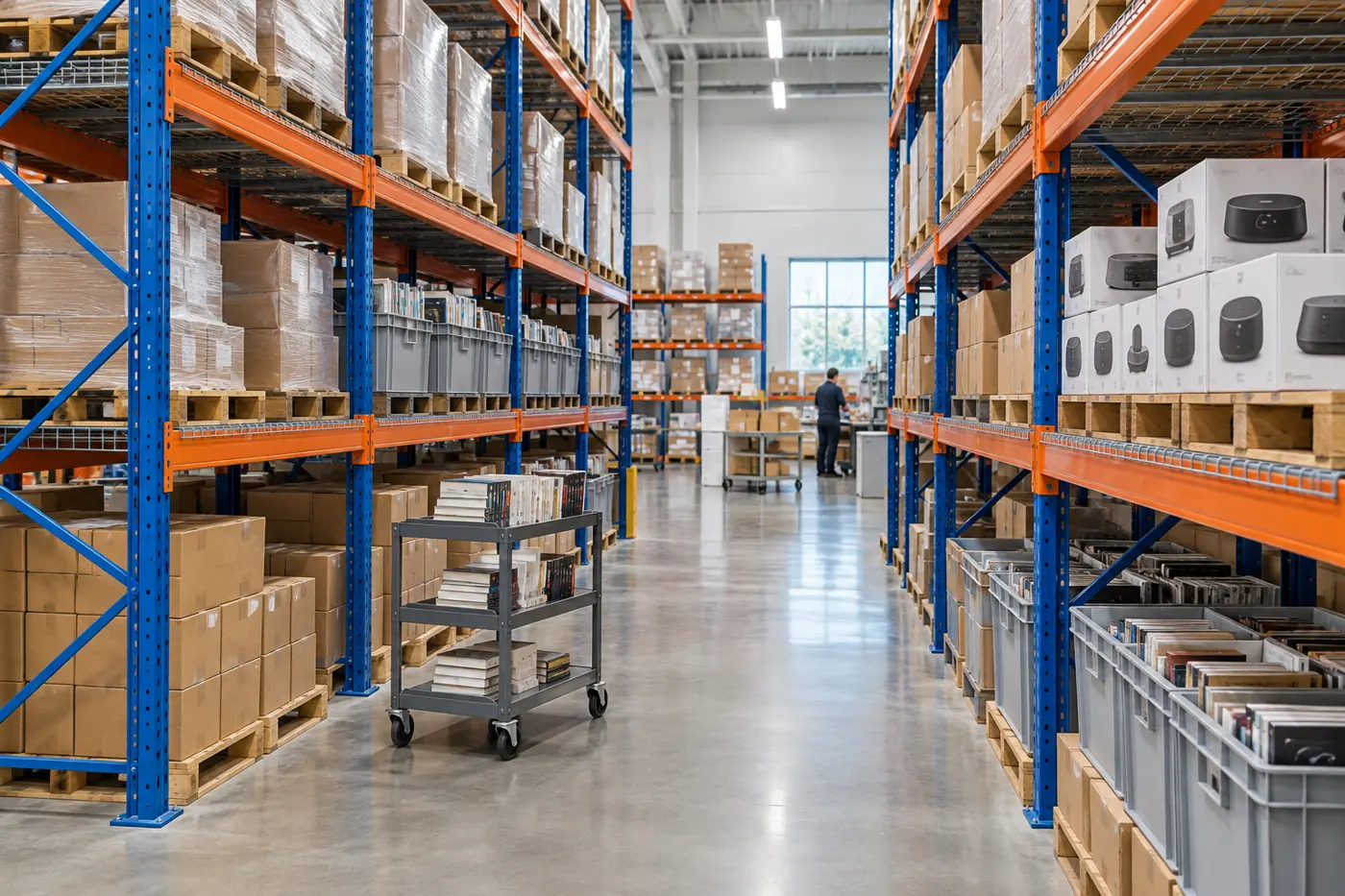
The Utah State Library Division runs Multistate Center West from its warehouse in Salt Lake City. The center is one of two multistate centers in the Library of Congress’s National Library Service for the Blind and Print Disabled network. It supports libraries for the blind and print disabled west of the Mississippi, supplying special-format reading material, audio playback equipment, supplies and accessories. Multistate centers receive, store, shelve, duplicate and distribute those materials for the regional libraries they serve, so this building runs as a real distribution warehouse, not a set of reading-room stacks.
This project belongs to our regional program. See Utah pallet rack for the design, supply and installation service that Utah public-agency and warehouse projects like this sit under. That program in turn supports our main pallet rack systems resource.
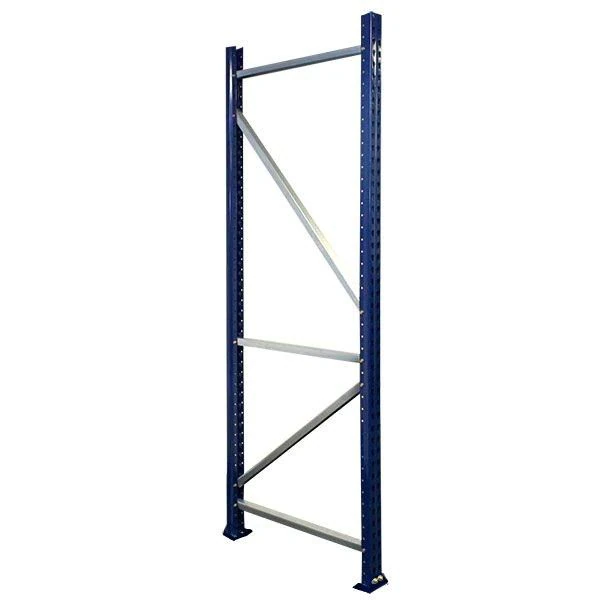
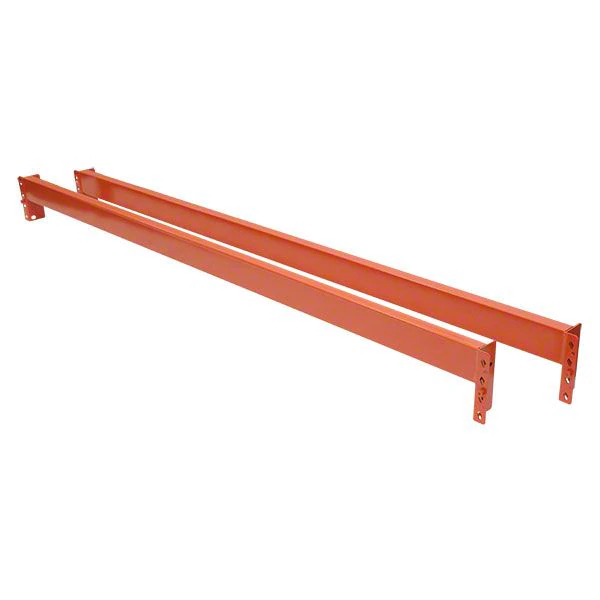
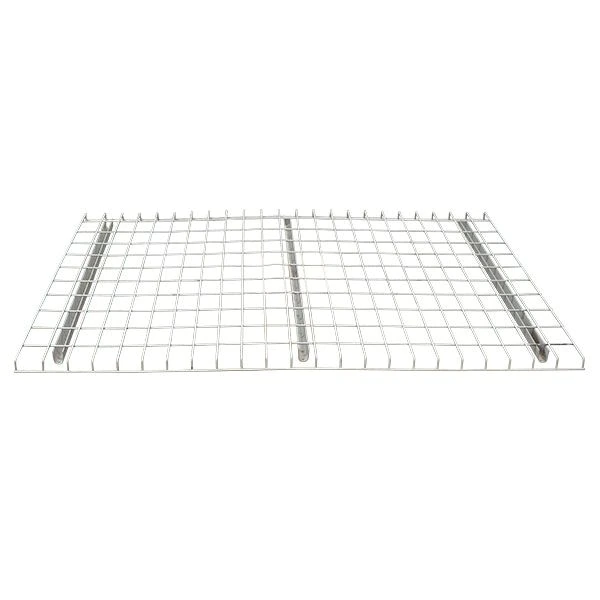
In April 2024 the library approved a project to replace the pallet racking on part of its warehouse floor. The scope had two parts: tear down existing rack sections, then install a new selective pallet racking system built from 42-inch-deep teardrop upright frames, 3-inch step beams at 96-inch bay widths, 42-inch by 46-inch wire decks on every level, and 12-inch row spacers that tie the rows together back to back. We sourced the rack from our partner United Material Handling.
The schedule was set by the warehouse, not the rack. The library wanted the new material only after mid-May, and its own staff came in over a weekend to clear a section of floor for the work. We held the rack in storage until the site was ready, delivered at the end of May, and our installation crew put the system in during early summer 2024. The following spring the library asked us to quote the removal of some older, light-duty bolted book shelving from the warehouse floor as well.
It’s a useful case for anyone running a library, archive, records or publishing warehouse, and for any public agency that has to replace storage without stopping daily shipping.
What a library distribution warehouse stores
A lending-library distribution center has a different inventory profile from a retail or manufacturing warehouse. The typical categories look like this:
Braille volumes. Embossed braille takes far more paper than print, so a single title can run to several thick volumes. Braille is bulky, heavy for its size and easily crushed, which matters for how it is boxed and stacked.
Audio book media. Recorded books circulate on small cartridges in reusable mailing containers. The items are light, but there are a lot of them, and they move in and out constantly.
Playback equipment. Players and accessories arrive in cartons, go out to patrons, and come back for checking, cleaning or repair.
Supplies. Mailing containers, packaging and accessories are ordered in bulk and drawn down steadily.
Put together, that means many item types, mostly cartons and totes rather than uniform pallets, and a steady reverse flow of returns.

That last point, returns, shapes the building more than people expect. Circulating material comes back to be checked in, sorted and put away again, so a library distribution warehouse needs somewhere to stage returns close to the rack and close to the dock.
Planning around the returns loop
Outbound and inbound flows share the same aisles in a lending warehouse. A few layout habits keep them from colliding:
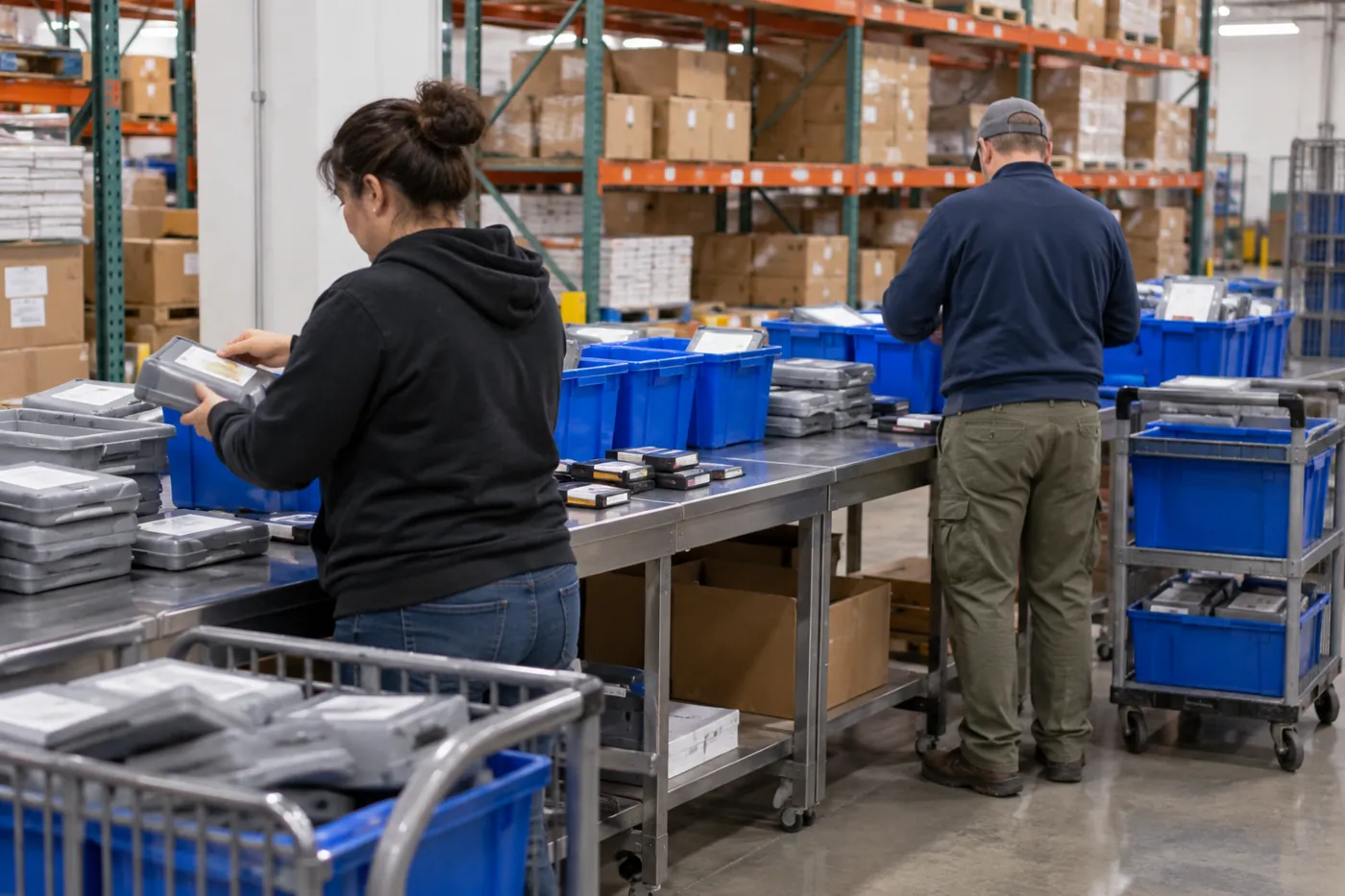
Keep the processing table near the lowest levels. Staff sorting returned media should be a short walk from ground and waist-height rack levels, where the most active stock lives.
Reserve upper levels for bulk. Cartons of supplies and backstock that move by the case belong higher, where a lift truck or order picker brings them down on a schedule.
Give totes and carts a parking spot. Loaded carts left in an aisle are the most common obstacle in these buildings. Plan a spot for them.
Label for people, not just scanners. Clear location labels at every bay and level help temporary and seasonal staff put things back in the right place.
Why selective pallet rack with wire decks for a library warehouse
There are plenty of rack types, and a high-volume book distributor might use flow rack, shelving mezzanines or narrow-aisle rack. For a public library distribution center, standard selective rack with wire decks is usually the right fit, and it is what the library chose here.
| Need in a library warehouse | What selective rack with wire decks does |
|---|---|
| Many titles and item types, each needed on its own | Every bay level is reachable from the aisle, with no digging behind other loads |
| Cartons, totes and loose items as well as pallets | Wire decks turn each beam level into a full shelf, so nothing slips between the beams |
| Staff picking by hand at low levels, lift trucks up high | Levels adjust on the upright in small steps, so pick levels and bulk levels can differ |
| Sprinklered building with paper and plastic stock | Open mesh lets light and sprinkler water pass through, unlike solid decks |
| Changing mix of titles and equipment over the years | Beam levels can be moved and bays added later with matching parts |
Where other rack types fit. Drive-in and push-back rack store many pallets of the same item deep in a lane. That suits a food or beverage warehouse, but a library warehouse holds lots of different titles and almost never has deep stacks of one thing. Carton flow can make sense for a small set of fast-moving items at a packing station. Cantilever and library storage shelving belong in reading rooms and stacks, not in a forklift warehouse.
Teardrop connections. The system here uses teardrop-style uprights. Beams hook into teardrop-shaped slots and lock with a safety pin, so levels can be moved without tools and the parts stay compatible with a large range of standard components. Compare the approach in our Utah Valley University campus warehouse and Canyon School District warehouse projects, two other Utah public-sector buildings that store a wide mix of items.

Back-to-back rows and row spacers
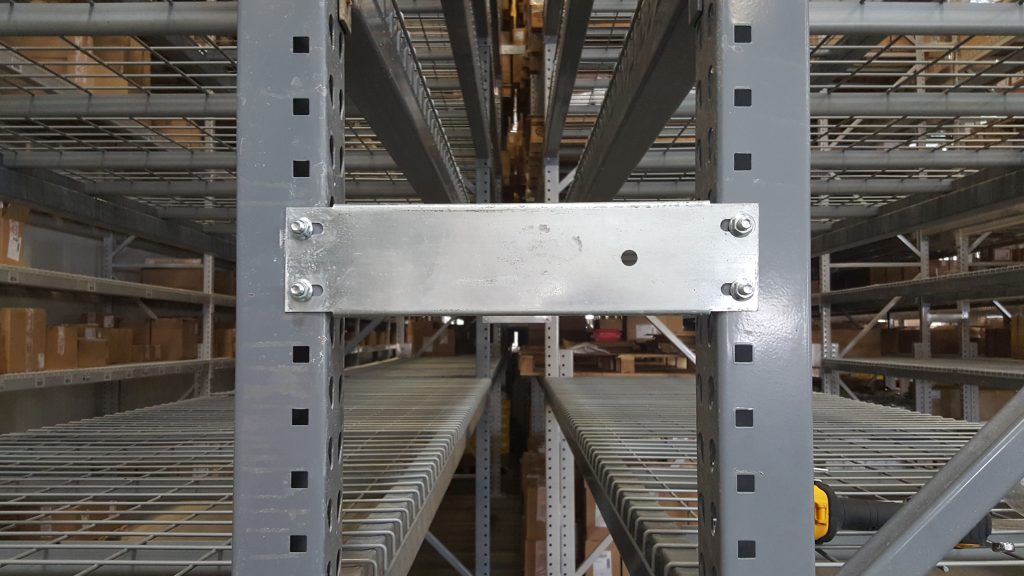
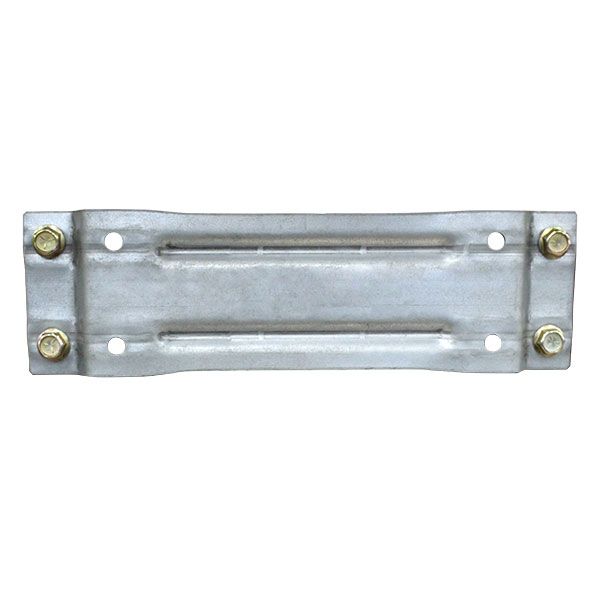
Most warehouse rack is set up in back-to-back pairs: two rows of frames standing behind one another, with an aisle on each outside face. The project here used 12-inch row spacers to tie those pairs together.
What a row spacer does. A pallet rack row spacer is a short steel tie bolted between the columns of two back-to-back frames. It sets and holds the gap between the rows, keeps the rows parallel and square as they are installed, and makes the pair act more like a single stiffer unit. Spacers are normally fitted at more than one height on each frame pair.
Why the gap matters. The space between back-to-back rows is the longitudinal flue. Fire codes and sprinkler designs depend on flue spaces staying open so heat can rise and sprinkler water can reach the lower levels. The spacer length is chosen with that flue in mind, and loads must not be pushed into it. Our flue space and warehouse fire safety guide explains transverse and longitudinal flues in detail.
Ordering tip. Spacers come in set lengths. Confirm the flue your sprinkler design calls for before ordering, and order enough for every frame pair at each specified height.
Replacing pallet rack in an operating warehouse
The hardest part of this kind of project is not the rack. It is doing the work in a building that still has to ship every day. Here is the sequence we follow on a replace-in-place job like this one:
Confirm scope and parts
List what comes down and what goes up, bay by bay, and confirm frame depth, beam length and deck size against the building before anything is ordered.
Set the date around operations
The customer picks the window. Here the library wanted material only after mid-May, so the order was approved first and scheduled to suit.
Clear the floor
Stock comes off the old rack and moves elsewhere. The library’s own staff did this over a weekend so shipping could continue during the week.
Hold and deliver
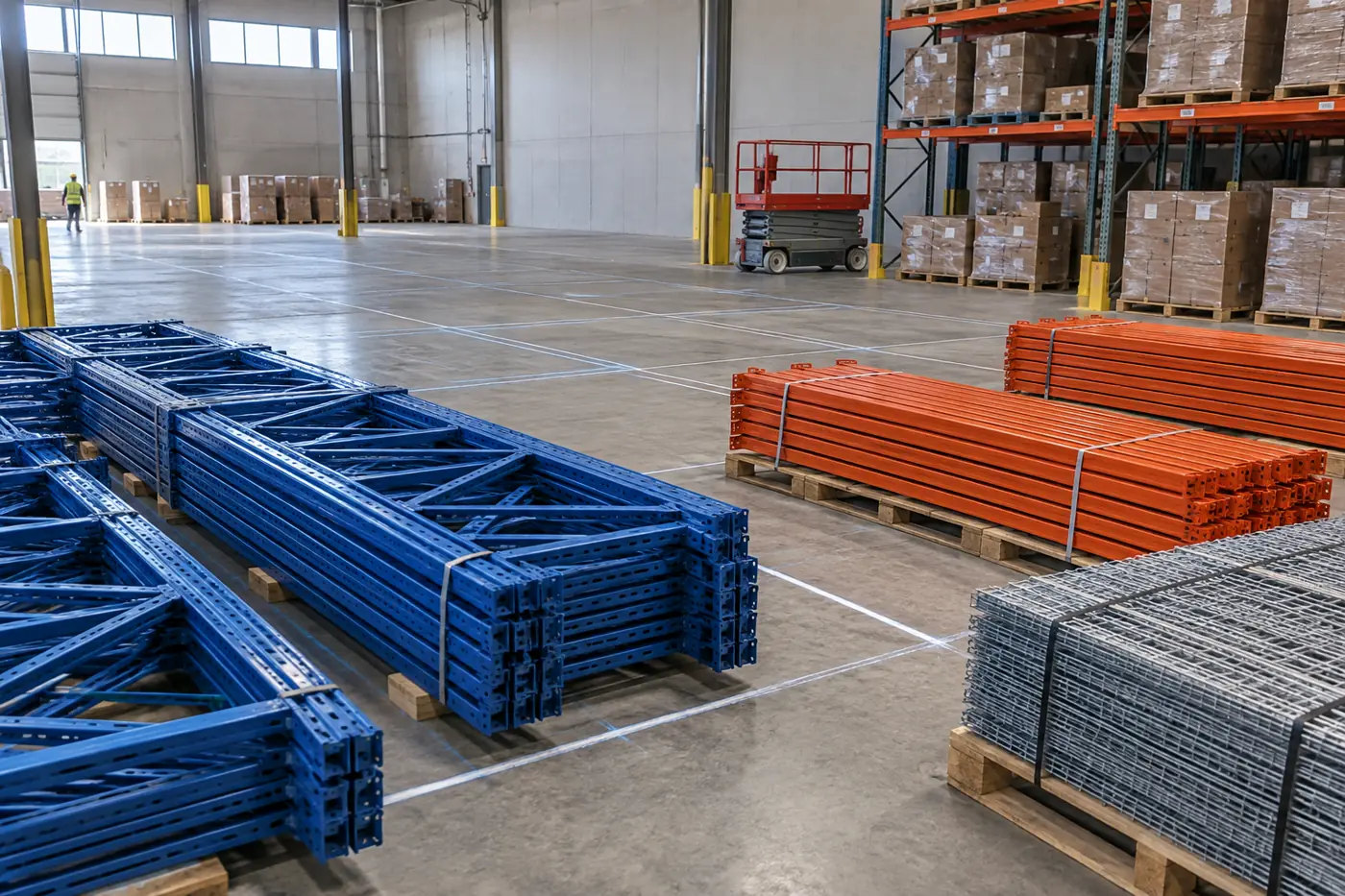
If the site isn’t ready when the rack is, we store it and deliver when the floor is clear, so bundles of steel never sit in working aisles.
Tear down, then install
The crew removes the old sections, lays out the new rows, stands and anchors frames, fits spacers, sets beams and pins, and drops in the decks.
Inspect and hand back
Check plumb, anchors, pins and decks, post capacity information, and return the area to the warehouse team.
What to do with the old rack
Take-down racking still has value if it is in good condition, but it needs an honest inspection first. Bent columns, cracked welds and damaged beam connectors should be scrapped, not reused. Mixed or unknown brands are hard to rate. Our used vs. new pallet rack guide covers when reuse makes sense, and our pallet rack relocation, teardown and reinstall page covers moving a system you plan to keep.
Light-duty shelving is a separate job. Bolted book shelving and other light storage often stands next to pallet rack in older warehouses, and it can be anchored to the slab too. Treat its removal as its own scope, with anchor removal and floor patching included.
Loads: paper is heavier than it looks
People tend to underestimate how much a level of books or paper weighs. A carton of bound volumes is dense, and a full bay level of paper can weigh far more than the same level of equipment cartons. Plan capacity the same way you would for any dense product:
- Beam ratings are per pair, per level, for evenly spread loads. A 3-inch beam suits carton and tote storage well, but check the rating for the actual bay width and load. It says nothing about the levels above.
- Decks have their own capacity. A wire deck carries a rated uniform load. The level is limited by whichever is lower, the beams or the decks.
- Spread concentrated loads. Heavy cartons stacked in one spot on a deck create a point load. Spread heavy items across the level, or put them on a pallet.
- Frames carry everything together. Upright capacity depends on the total load on all levels and on the spacing between beams. Moving beams to fit taller cartons can change it, so recheck whenever the level layout changes.
- Keep the heaviest stock low. Braille and paper backstock belongs on lower levels. Lighter media and supplies can go higher.
- Post the numbers. Capacity information at each bay tells staff and drivers what a level can hold. Our guide to pallet racking weight capacity goes further.
Wire decks in a paper warehouse
Wire decking earns its place here for three reasons. It gives cartons and totes a continuous surface, it stops loose items from dropping between beams onto staff below, and it keeps the level open for sprinkler water. Decks drop into the step on the beam and should be seated fully and evenly before loading. Choose the deck depth to match the frame, a 42-inch frame takes a 42-inch deck, and check the mesh pattern if small items will sit directly on it.
Beam-to-upright connection. Each beam end hooks into the upright and should be locked with its safety pin or clip, so a bump from a cart or lift truck can’t lift the beam out.

Buying pallet rack as a public agency
State and local agencies buy storage under rules a private warehouse doesn’t face. From projects like this one, and our county road and bridge department and medical supply distribution work, a few practices keep a public rack project moving:
- Ask for an itemized quote. Listing frames, beams, decks, spacers, anchors, freight and installation separately makes approval and later add-ons simpler.
- Separate take-down from new install. Teardown, disposal and installation are different scopes. Pricing them separately helps when budgets or approvals arrive in stages.
- Build approval time into the schedule. Order approval, delivery and the date the floor is actually clear are rarely the same week. Agree on storage or a delivery window up front.
- Know your purchasing path. Some agencies buy through cooperative or state contracts. See our state contract options and our broader government storage solutions.
- Keep a record of what was installed. Brand, frame depth, beam profile and deck size make future add-ons and inspections much easier.
Code, seismic and permits in Salt Lake City
Seismic design. Salt Lake City sits in a high seismic region. Storage rack is designed for seismic loads under the adopted building code, and Utah moved to the 2024 International Building Code with ASCE 7-22 on July 1, 2026. Every frame is anchored to the slab, and base plates and anchors are part of that design. See our pallet rack seismic compliance guidance and our notes on pallet rack anchor bolts.
Permits. Salt Lake City requires a building permit for racking over 5 ft 9 in tall, which covers nearly all pallet rack, and taller installations need engineered plans. Our Hogan Construction permit and engineering project walks through that process on a Utah job. Requirements differ by city, so confirm with the local building department.
Fire protection. Paper, cartons and plastic media are combustible. Rack height, flue spaces and the stored commodity all interact with the sprinkler design, so talk to your fire protection engineer before raising beam levels or adding rows.
Floors. Older warehouse slabs can be thin or cracked, and removing old rack leaves anchor holes behind. Check the slab where new frames will land and patch old anchor holes that fall in aisles.
The Rack Manufacturers Institute publishes ANSI/RMI MH16.1, the design standard for industrial steel storage racks, and OSHA general-industry rules cover safe stacking, housekeeping and material handling in daily operation.
Installation and safety
A replace-in-place install shares the building with staff, so safety planning covers the crew and everyone around them:
Cordon the work zone. Keep staff, carts and lift trucks out of the area where frames are being stood and beams set.
Lay out before anchoring. Snap row lines and check frame spacing and the flue gap against the drawing before the first anchor goes in.
Anchor every frame. Use the specified anchors and embedment, with shims only as the manufacturer allows. Our pallet rack installation page covers the full sequence.
Pin every beam, seat every deck. Safety pins in every connector and decks fully seated before any level is loaded.
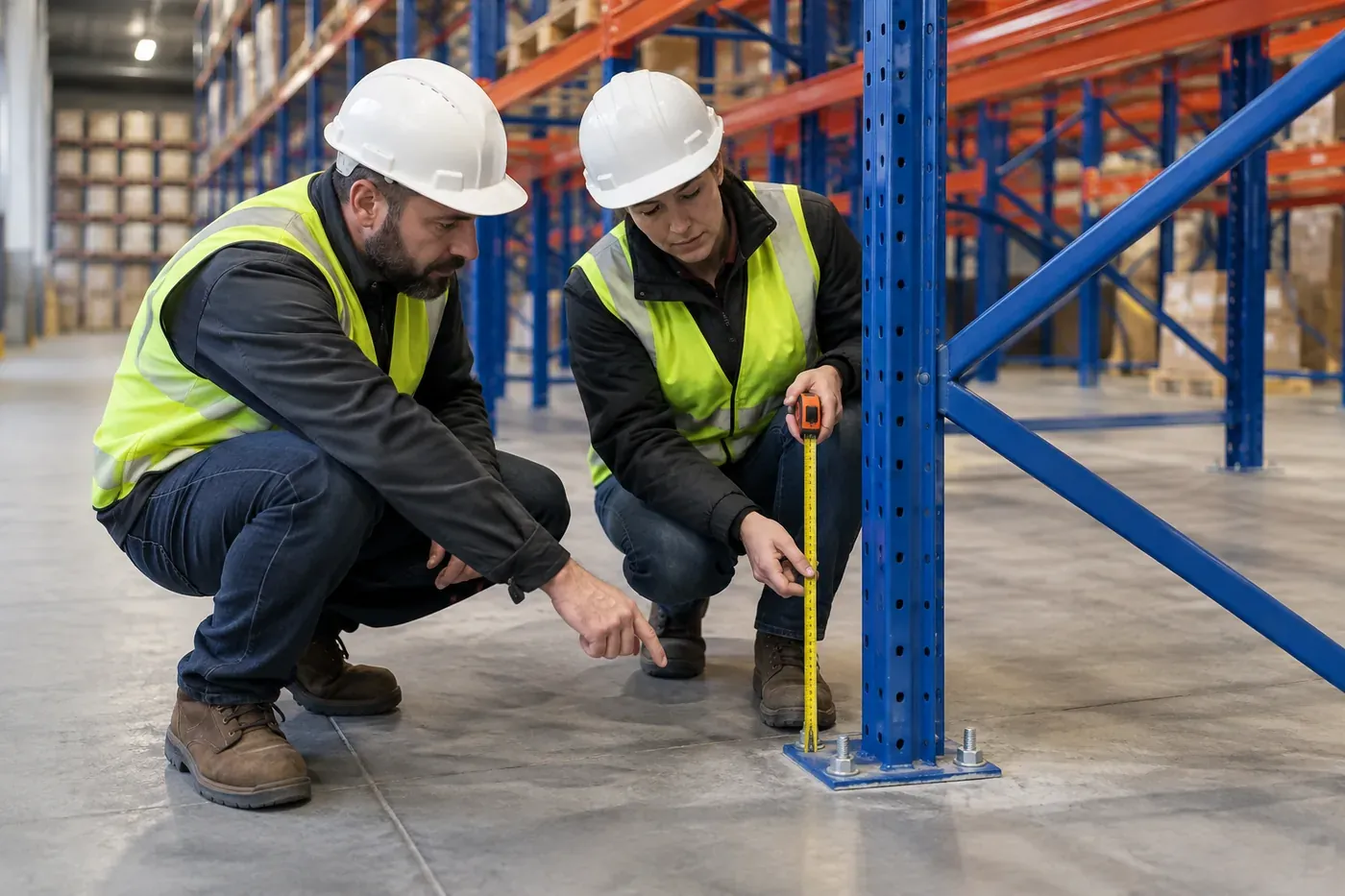
- Fit column protectors and end-of-aisle guards where rack faces cart and lift-truck traffic, especially near the dock and the returns area.
- Keep flue spaces clear. Don’t push cartons into the gap between back-to-back rows.
- Keep egress routes and access to fire equipment open when the new rows go in.
- Inspect after install and on a set schedule afterward. See our rack inspection and repair guidance.
Serving Salt Lake City and Utah public agencies
Material Handling USA has been an industry leader in storage and material handling since 1997. We design, supply and install pallet rack for warehouses, plants and public agencies across Utah. See our pallet racking Salt Lake City page for local service, or our Utah pallet rack page for statewide projects. For Utah projects call 801-328-8788.
What we publish. We name clients and describe the planning behind a project, along with the product types supplied. For public agencies we do not publish facility layouts, room dimensions, quantities, contract values, staff contacts or any security or operational details of the building.
Shop Pallet Rack Uprights, Beams, Decks & Row Spacers Online
Buy select items directly from our online store, or request a quote for volume, custom sizes and freight-rated orders.
Frequently asked questions
What kind of pallet racking works best for a library distribution warehouse?
What is a pallet rack row spacer?
Can pallet racking be replaced while a warehouse stays open?
How much weight can a pallet rack level of books hold?
Do I need wire decking on pallet rack for cartons?
Do I need a permit for pallet racking in Salt Lake City?
Can we reuse the old racking we take down?
How should a public agency buy pallet racking?
Replacing or adding racking in a working warehouse?
We design, supply and install selective pallet racking, wire decks and row spacers for Utah agencies, libraries and warehouses, and plan the install around your operations. Free design consultation.