
Lockable Storage Cage
Pre-engineered welded wire mesh cage kits you can order in standard sizes, with a choice of locking hardware, for tools, inventory, tenant belongings or evidence that need to stay visible, ventilated and secure.
Supplied and installed nationwide from Salt Lake City — call (800) 326-4403.
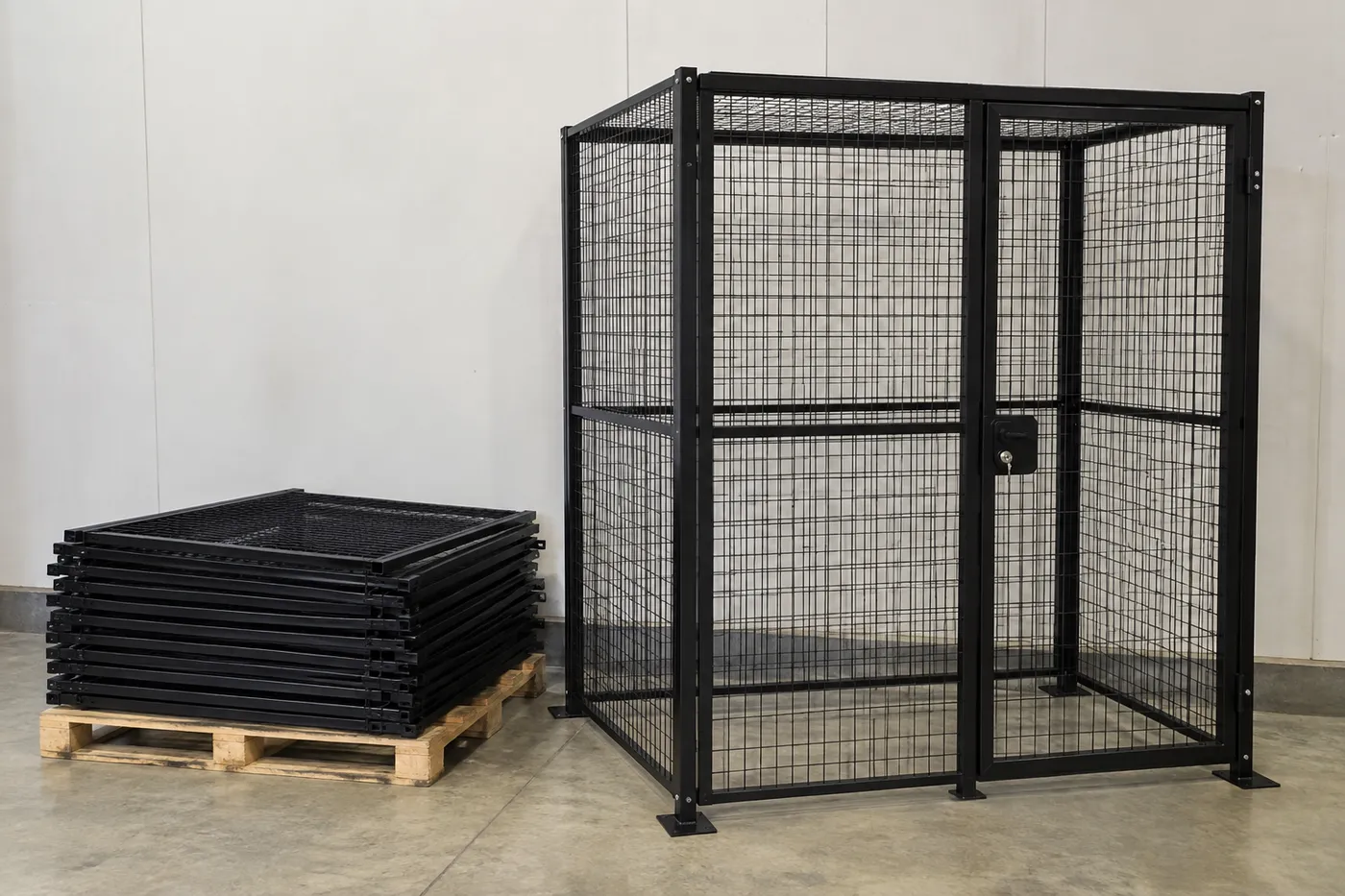
3×3 to 10×10 ft
Common standard kit sizes
3 or 4 sided
With or without a mesh ceiling
4 lock types
Padlock, keyed, combination or keypad
Bolts to the floor
Every kit ships with anchoring hardware
What Is a Lockable Storage Cage?
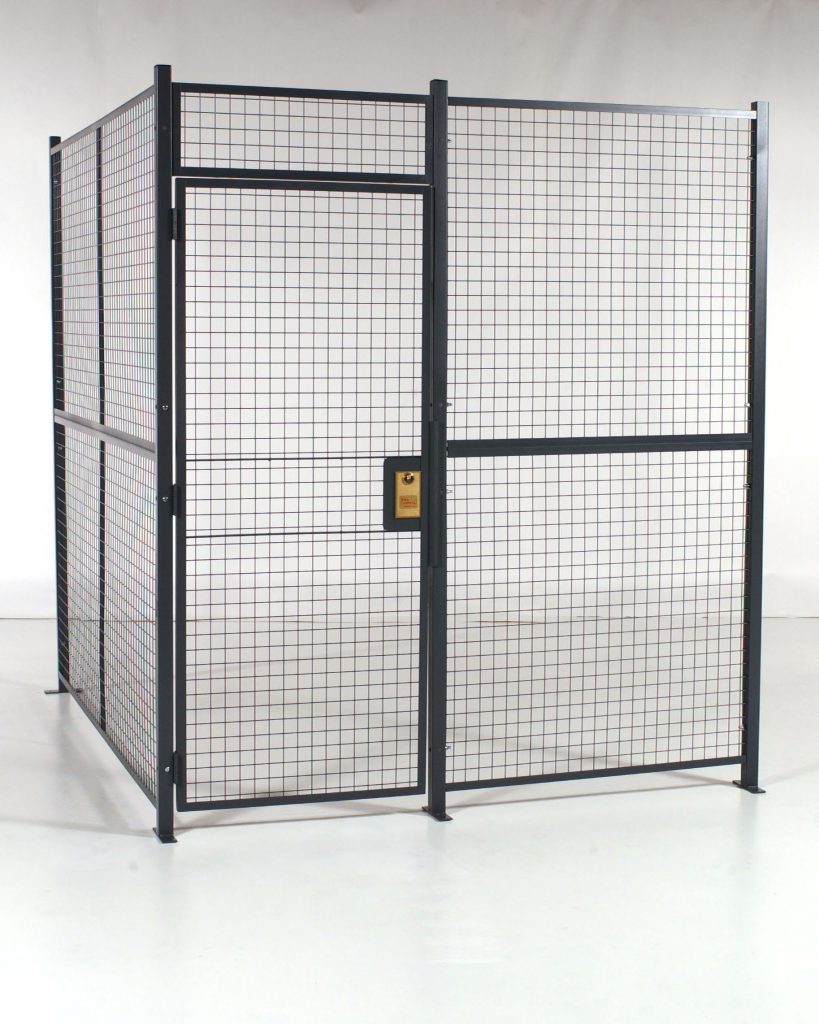
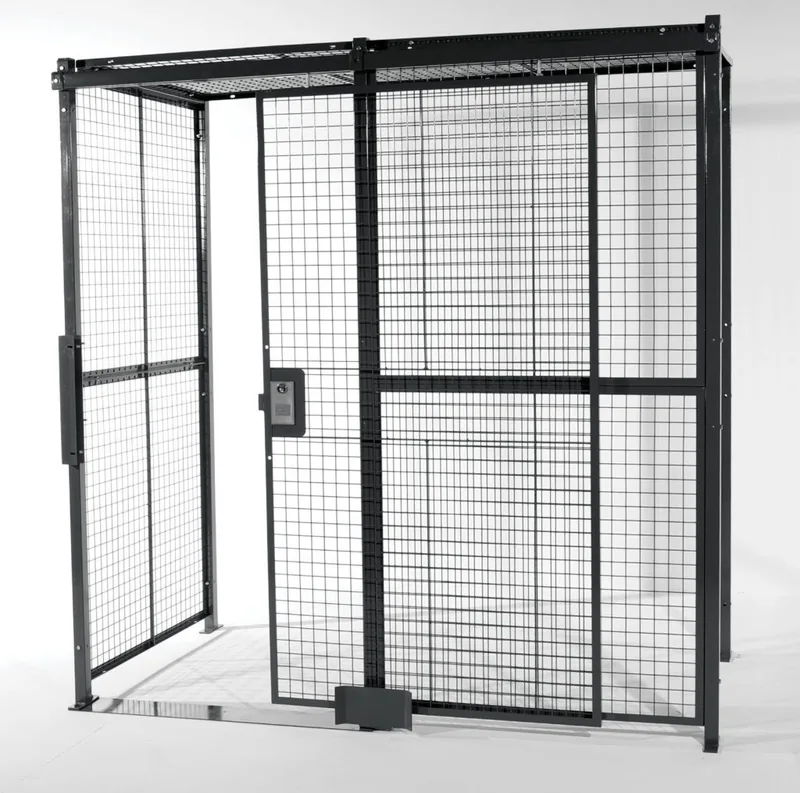
A lockable storage cage is a welded wire mesh enclosure, sold as a standard-size kit, that closes and locks like a room but stays open to view and air on every side. The frame is square steel tube; the walls and roof (when it has one) are framed mesh panels; the door is hinged or sliding and fitted with the lock of your choice. Because the whole thing is mesh rather than solid panels, a supervisor, an inspector or a facility manager can tell at a glance what is inside and whether the door is secured, without opening it.
That combination — a locking door plus full visibility and airflow — is what separates a lockable storage cage from a solid metal cabinet or a windowless storage room, and it is why the format is so common for tools, spare parts, seasonal inventory, tenant belongings and other items that need to be secured but also checked, counted or ventilated. It also differs from a full custom-engineered security cage system, which is built to the footprint of a specific room: a lockable storage cage is a pre-configured kit in a handful of standard sizes that ships ready to bolt together, usually within a shorter lead time and at a lower cost than a fully custom enclosure.
What’s in a typical kit
- Square steel tube corner and door posts, pre-drilled base plates
- Framed welded wire mesh wall panels (and a mesh ceiling if ordered)
- One hinged or sliding door with a mounting plate for the lock
- Panel bolts, floor anchors and basic assembly hardware
- A powder-coated or galvanized finish

Standard Sizes and Configurations
Most manufacturers offer lockable storage cages in a set of standard footprints so kits can be quoted and shipped quickly, with custom dimensions available when a standard size does not fit the space:
| Footprint | Typical use | Notes |
|---|---|---|
| 3×3 to 5×5 ft | A single employee’s tools, a small parts kit, a personal locker-style unit | Often shipped as a single 3-sided or 4-sided unit against a wall |
| 6×6 to 8×8 ft | Shared tool storage, small parts cribs, a compact evidence or asset cage | The most common size range for a standalone lockable cage |
| 10×10 ft and larger | Multi-shelf inventory, several employees’ equipment, a small crib | Usually engineered with intermediate posts and, past a point, seismic bracing |
Two configuration choices affect both price and how the cage is used:
- 3-sided vs. 4-sided. A 3-sided cage uses an existing wall as its fourth side, which is less expensive and faster to install where the cage sits in a corner or against a solid wall. A 4-sided, freestanding cage can go anywhere on the floor and can be relocated later.
- With or without a ceiling. A mesh ceiling closes the top so nothing can be lifted or dropped over the walls, and it also stiffens the whole unit. Without a ceiling, a cage costs less but relies on wall height alone to control access.
For a cage that does not fit a standard footprint, see our security cage sizing guide, or request a custom layout through custom security cages.
Locking Options for a Storage Cage Door
The lock is usually the one part of the kit a buyer customizes. Common options, roughly in order of cost and control:
- Hasp and padlock — the simplest option; any padlock the site already uses works
- Keyed cam lock or mortise lock — built into the door, no external hasp to defeat
- Combination lock — no keys to track, but the code has to be managed and changed
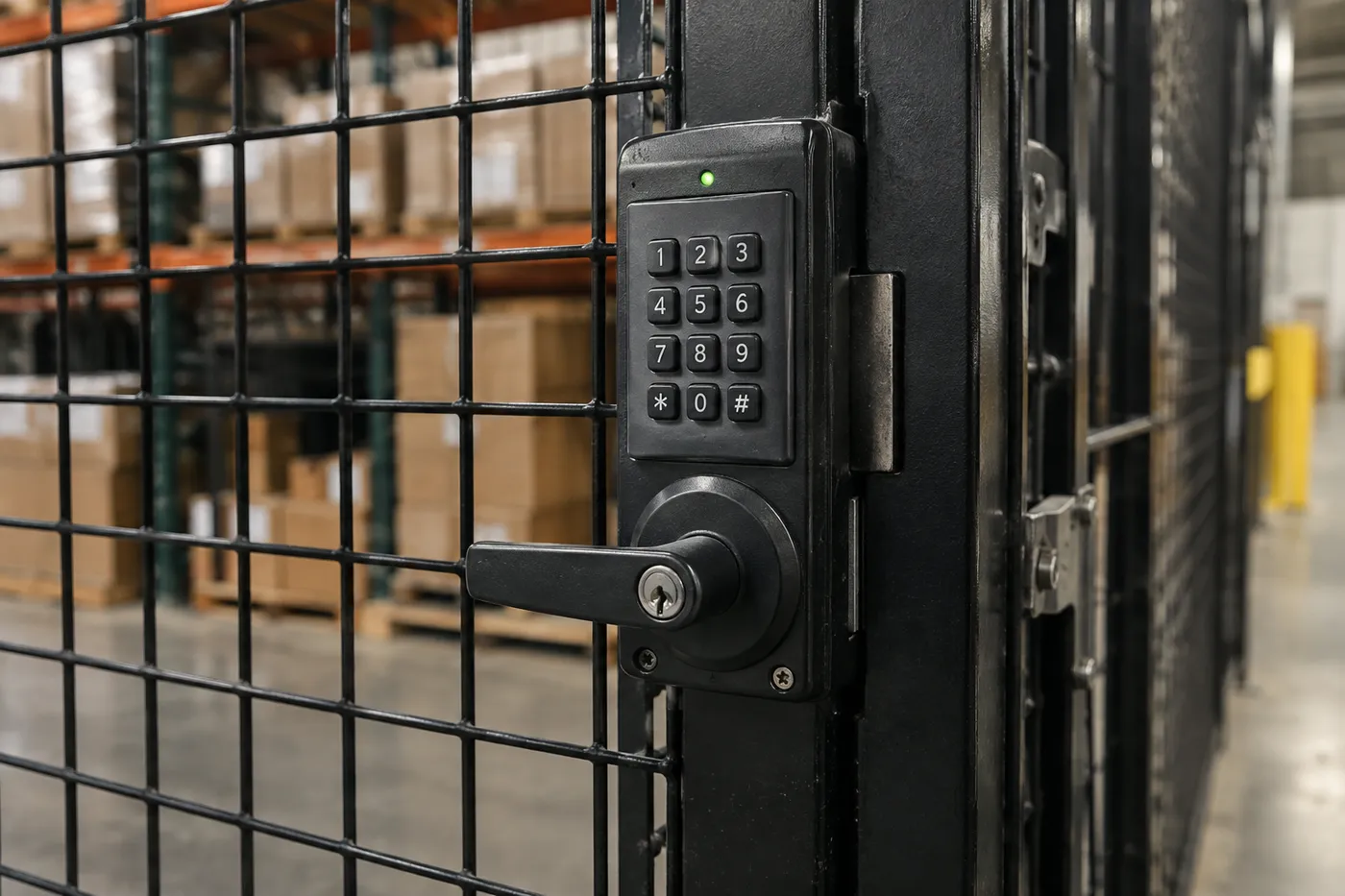
- Digital keypad lock — individual codes, easy to change when staff turn over
- Keyed-alike cylinders — one key opens every cage in a facility that uses the option
- Card or fob access — ties the cage into an existing building access system
The lock only matters if the door and frame around it are solid: a hinge that can be popped or a mesh panel that flexes away from the frame defeats even a good lock. See security cage doors and security cage locks & access control for how door hardware, hinges and access-control integration are specified in more depth than a standard kit typically needs.
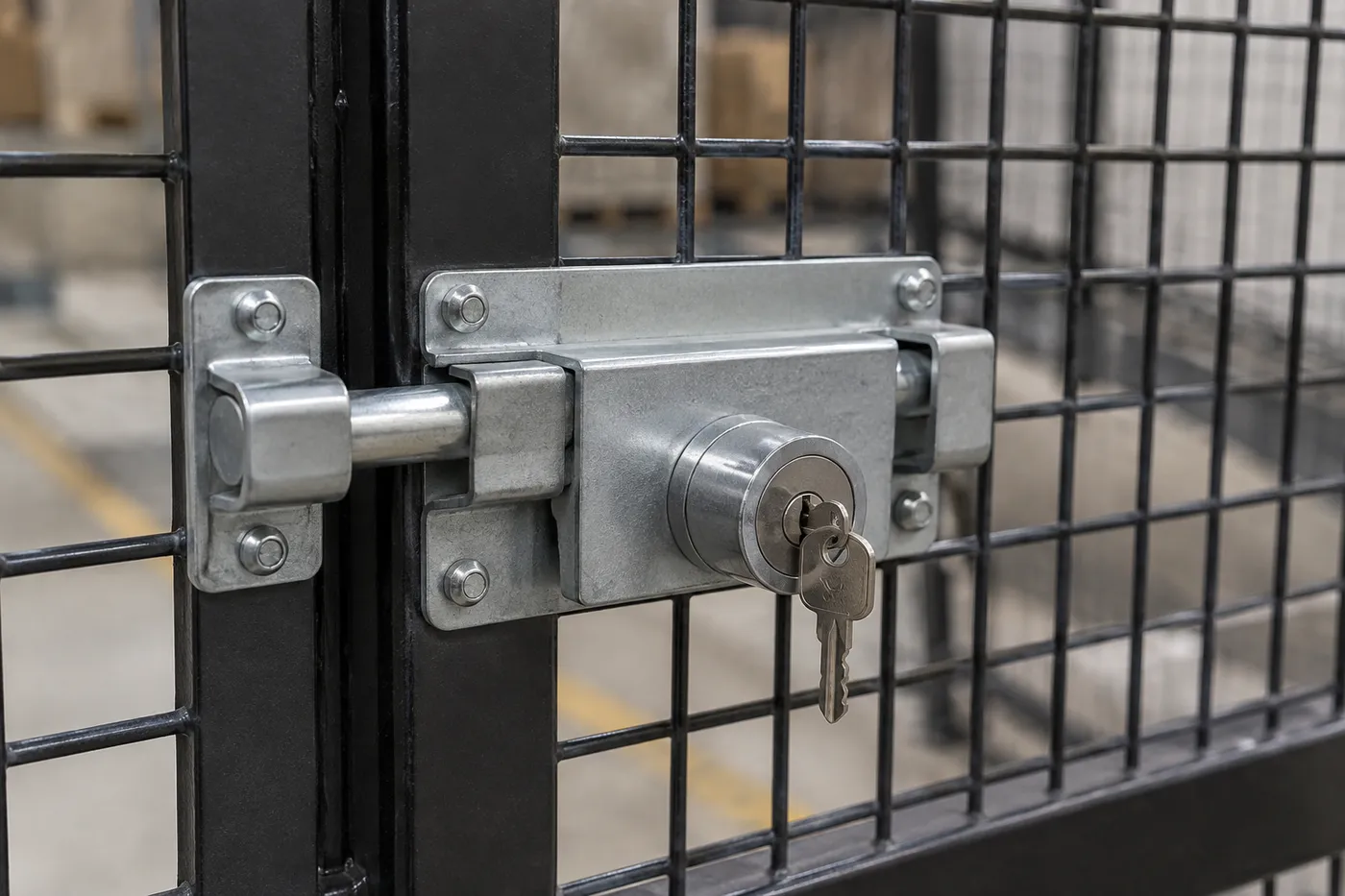
Choosing a lock in practice
For a single-tenant tool crib or personal cage, a keyed cam lock or a good padlock is usually enough. Once several people or several tenants share a bank of cages, keypad or keyed-alike hardware saves the hassle of tracking loose keys and re-keying after staff or tenant turnover. Facilities that already run card access on doors often extend that same system to cage doors so there is one access log instead of two.
Keypad and electronic options
A keypad or fob reader mounted on the cage frame lets you issue and revoke individual access without changing a physical lock. That matters most for cages that several people need into on different schedules — a shared parts crib, a multi-tenant storage room, or a cage that has to log who opened it and when.
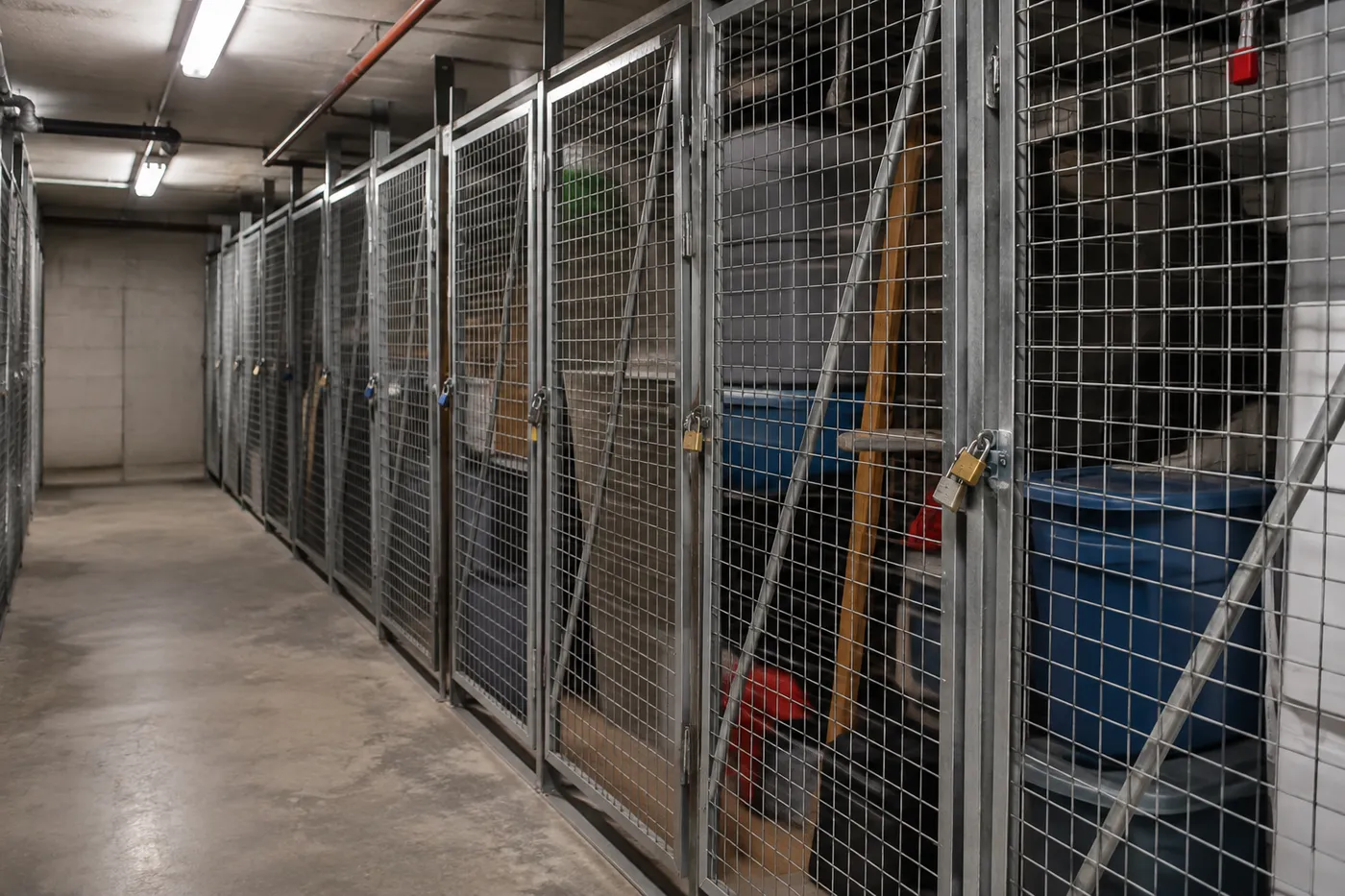
Individually-Assigned and Multi-Tenant Lockable Cages
One of the most common uses for a standard lockable storage cage is not one large enclosure but a row of small ones, each assigned to a different person, department or tenant and locked with its own key, code or padlock. That layout shows up in a few recurring settings:
Numbering and access records
Assigned cages are almost always numbered or labeled to match a unit, tenant or department, and it is worth deciding up front whether each cage gets its own key or code (better for accountability) or a shared master key with individual padlocks tenants supply themselves (simpler to administer). Either way, keep a written record of who holds which key or code and update it when tenants or staff change.
Materials and Durability
Frame and mesh quality is what separates a cage that holds up in daily use from one that loosens and rattles within a year:
- Welded steel tube frame — stiffer at the corners than bolted angle iron
- Welded (not woven) wire mesh panels, framed on all four edges
- Powder-coated finish for indoor use; galvanized or powder-coat-over-galvanized outdoors
- A base plate on every post, punched for floor anchors
- Mesh opening size should be smaller than the smallest item stored, to keep it from being passed through the wire
- Hinges rated for the door’s weight and expected daily cycles
- Weight capacity ratings vary by model — check them against what will actually be stored
- A sweep gap at the floor is normal; ask for a closed base if that gap is a problem
See wire mesh panel options for mesh gauge and opening-size choices when the standard panel does not fit what you are storing, and our anchoring and seismic bracing guide for how every kit, standard or custom, gets fastened to the floor.
Standard Kit or Custom-Built Enclosure?
A standard lockable storage cage kit is the right call for most single-room, single-purpose storage needs. A fully custom enclosure earns its extra lead time and cost when the space, the access pattern or the code requirements do not fit a standard footprint.
| Standard lockable cage kit | Custom-built security cage | |
|---|---|---|
| Sizing | Standard footprints (3×3 up to roughly 10×10 ft) | Built to the exact room, column spacing and ceiling height |
| Lead time | Typically the shortest lead time in the lineup | Longer — engineered and fabricated to a specific drawing |
| Cost | Lower cost per square foot | Higher, reflecting custom engineering and fabrication |
| Best for | A single room, a tool crib, tenant storage, a personal or shared unit | Irregular footprints, tall or long runs needing bracing, multiple doors and service windows, code-driven layouts |
Not sure which fits your project? Our security cage cost guide breaks down pricing factors for both, and either option can be requested from the same quote form.
A note on chain-link-style lockers
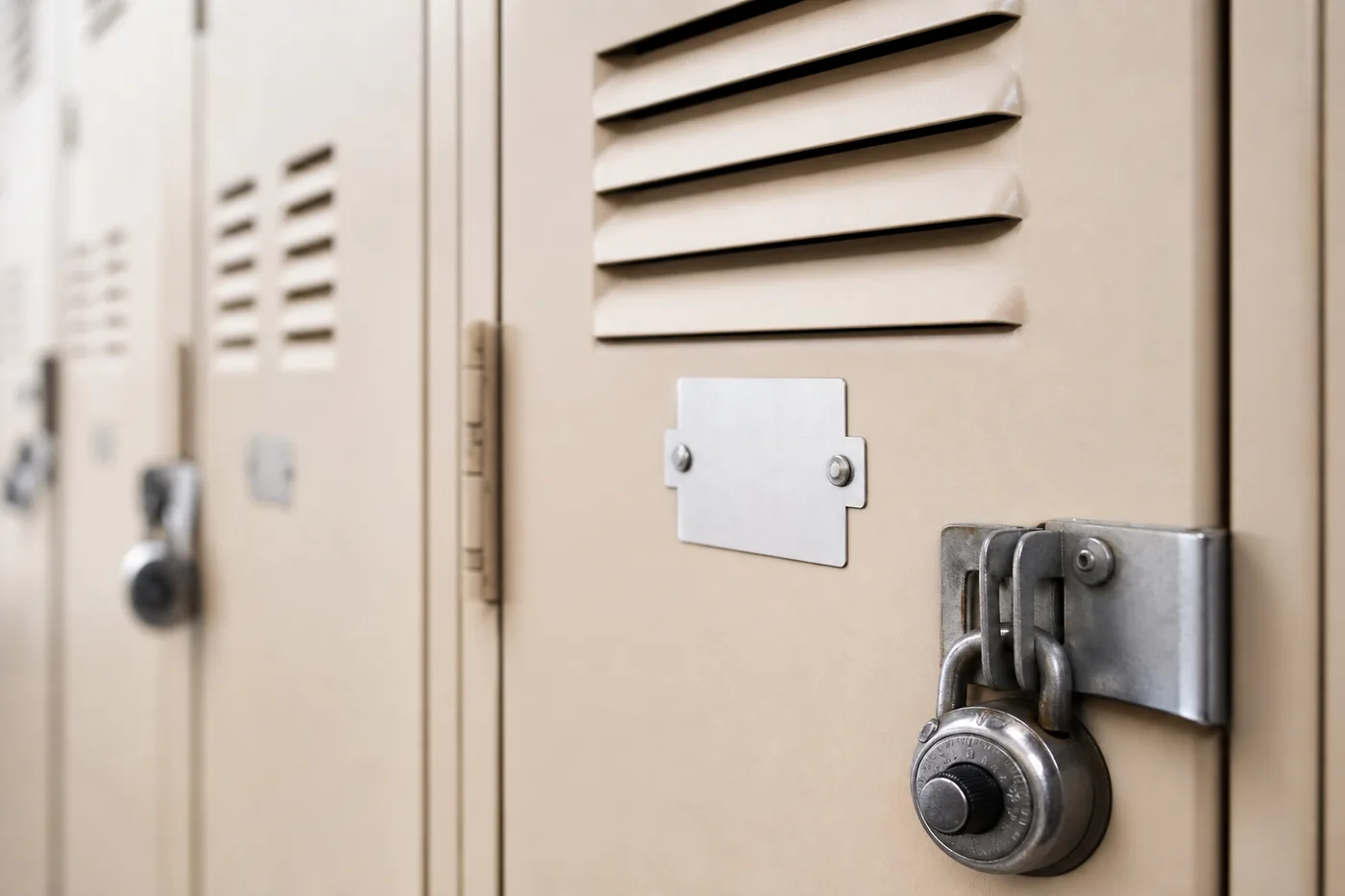
Some buyers compare a welded wire mesh lockable cage to a chain-link fence-style storage locker. The two look similar at a glance, but the mesh, the frame and the finish differ enough to matter for security and appearance — see our chain link storage cage page and our chain link vs. wire mesh comparison for the differences before you decide between the two.
Where Lockable Storage Cages Are Used
Installing a Lockable Storage Cage Kit
Confirm the floor and site
Concrete slab, clear height, sprinkler clearance and any nearby obstructions are checked before the layout is finalized.
Set and plumb the posts
Corner and door posts are positioned, shimmed level and marked for anchoring before any panel goes up.
Anchor the base plates
Every post is bolted to the floor through its base plate — a kit is never simply set in place unanchored.
Hang panels and the door
Mesh wall panels bolt between the posts; the door is hung and squared last so it swings and latches cleanly.
Fit and test the lock
The chosen lock is installed and tested, and keys or codes are handed off before the crew leaves.
Most standard kits go up in well under a day once the floor is ready. For taller runs, multi-cage banks or sites with post-tensioned or uneven slabs, see our full security cage installation page and the anchoring and seismic bracing guide.
Do’s and Don’ts of Using a Lockable Storage Cage
- Do anchor every post to the floor, even on a “temporary” installation
- Do keep the mesh opening size smaller than the smallest item stored
- Do inspect locks, hinges and mesh panels on a regular schedule
- Do keep a written record of who holds keys or codes
- Don’t load a cage beyond its published weight rating
- Don’t store flammable or hazardous materials without checking code and manufacturer guidance
- Don’t hang shelving or equipment on mesh panels unless the manufacturer approves it
- Don’t ignore a bent panel, loose anchor or dragging door — repair it before it fails
What to Send Us for a Lockable Storage Cage Quote
A few details up front get you an accurate price and lead time on the first pass:
- Footprint or available space (length, width, clear height)
- 3-sided (against a wall) or 4-sided (freestanding)
- Ceiling: open top or fully enclosed
- Door type and preferred lock (padlock, keyed, combination, keypad)
- Indoor or outdoor installation
- Whether it will be one cage or a row of individually-assigned units
- Anything unusual about the floor (raised floor, coating, unknown slab type)
- Target install date
Request a lockable storage cage quote, or start from our full security cages page to compare every enclosure type we offer.
Shop Lockable Storage Cage Kits Online
Standard-size welded wire cage kits, priced online and shipped ready to bolt together. Need a size, door count or lock type that isn't listed, or a fully custom enclosure? Request a quote instead.
Lockable Storage Cage FAQs
What is a lockable storage cage?
What sizes do lockable storage cages come in?
What locking options are available?
Can several lockable cages be assigned to different people or tenants?
Do lockable storage cages need to be anchored to the floor?
Can a lockable storage cage go outdoors?
How is a standard lockable cage different from a custom security cage?
How much weight can a lockable storage cage hold?
Need a lockable storage cage sized right the first time?
Send your available space, door and lock preference, and whether you need one cage or a row of individually-assigned units. We’ll return a layout and a price — supplied and installed nationwide from Salt Lake City.