
Country Club Maintenance Facility Security Cage: Starmount Forest
How a private club protects turf equipment, small engines, irrigation parts, fuel-adjacent supplies and member property in a grounds building that a seasonal crew shares — without turning the shop into a bottleneck at sunrise.
2023
Year Material Handling USA supplied security cage and wire partition product to the club
18 holes
Championship golf course the grounds department maintains, plus courts, pool and fitness facilities
Seasonal crew
Grounds staffing that turns over every year — the core access-control problem
Sunrise
When the whole crew needs tools at once, and when a badly placed cage gets propped open
The project
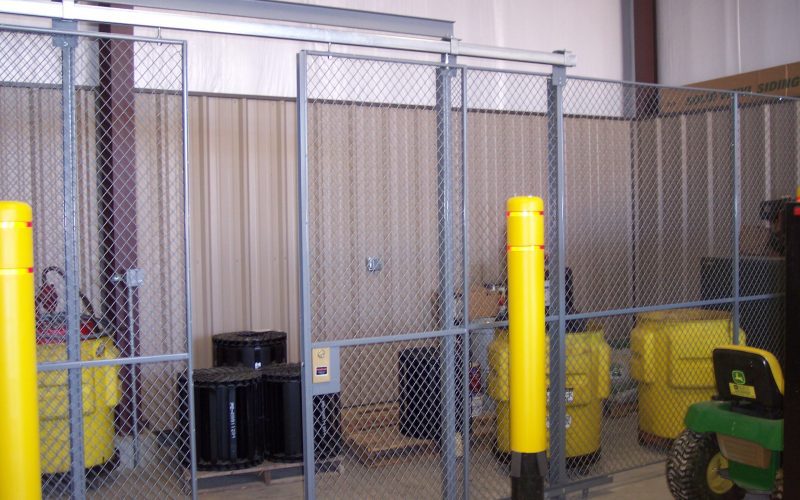
Starmount Forest Country Club in Greensboro, North Carolina is a private club with an 18-hole championship golf course, a large indoor racquet sports centre added in 2008, outdoor courts, a resort-style pool and a fitness facility. A club of that mix runs what is effectively a small public works department: a grounds and equipment shop, an irrigation and small-parts inventory, seasonal facility equipment, and a clubhouse operation on top of it.
Material Handling USA supplied welded wire security cage and partition product to the club in 2023. Club grounds buildings are a genuinely distinct application. Unlike a warehouse, the building is shared by a crew that turns over seasonally, most of the valuable contents leave and return every single day, and the people using it are working against a clock set by tee times rather than by shipping cut-offs.
This page sits under our security cage and wire partition hub and describes the general design problem a club faces, and how MH-USA approaches it. It contains no facility layout, no dimensions, no inventory detail and no security specifics for this customer.
Why club grounds buildings lose things
Almost nothing goes missing from a club maintenance shop in a dramatic way. It leaks.
Everything is portable and everything is generic. Blowers, trimmers, chainsaws, cordless tools, batteries, hand tools and irrigation fittings are worth real money, fit in a truck bed, and carry no mark that would embarrass anyone holding them. A club can lose the price of a mower over a season one trimmer at a time and never see a single incident report.
The crew changes every year. Seasonal grounds staffing is normal and healthy, but it means the access list resets annually, keys circulate, and institutional memory about where things belong is thin by design. Control has to live in the building, not in the crew.
The shop is on the way to everything. Grounds buildings are typically open at the ends, adjacent to a cart yard or a service drive, and visited by vendors, contractors and delivery drivers. Perimeter security is weak precisely because operations need it to be.
The real cost is not the tool. It is the morning a crew loses because the piece of equipment that should be on the charger is not, and the course still has to be mowed before the first group goes off.

What a club puts behind mesh
Several small enclosures beat one large locked room, because the access lists genuinely differ between grounds, mechanics, facilities and clubhouse staff:
Interior fit-out — shelving, bins, a workbench and a key board — is the same kit used in any tool crib, sized for grounds material rather than production tooling.
What a cage should not be used for
This is worth stating plainly, because it is the question clubs ask first and the one where the wrong answer creates real liability.
A wire mesh cage is not a pesticide or fertilizer storage facility. Golf industry best management practice, published state by state through the superintendents’ associations, is that crop protection products belong in a dedicated lockable concrete or metal structure — an IPM control centre — with an impervious sealed floor, secondary containment, dedicated ventilation, its own emergency planning, and separation from fertilizer and fuel storage. Mesh provides none of those things. It does not contain a spill, does not separate incompatible materials and does not control vapour.
What a cage does correctly in that part of the operation is everything around the chemical building: the application equipment, calibration tools, personal protective equipment stock, spill kits, records and empty container staging. Federal pesticide worker protection requirements and hazard communication under 29 CFR 1910.1200 apply to that material regardless of what it is stored behind, so keeping PPE stock controlled and stocked is a genuine compliance benefit rather than just a security one. EPA’s pesticide worker safety guidance is the primary source to design against.
The same logic applies to fuel. Bulk fuel and flammable liquid storage is a code-defined problem for the authority having jurisdiction, not a mesh problem. Cage the pumps, tools and dispensing equipment, not the liquid.
Designing for the sunrise shift
The design test for a club grounds enclosure is what happens in the first thirty minutes of the day, when the whole crew is being assigned and equipped at once. A cage that cannot serve that window will be defeated — propped, taped, key copied — usually before the second month.
- Issue through a window, not a room. A service window or dutch door lets the assistant superintendent or mechanic hand out equipment while the enclosure stays closed. This is the single highest-value feature in the application.
- Charge inside the cage. Battery banks and chargers belong behind mesh with power run to them. It removes the most common excuse for leaving a door open overnight and keeps expensive batteries in one accountable place.
- Put it on the path the crew already walks. Between the crew room and the equipment bay, not in the far corner past the wash pad. Any detour will be routed around within a week.
- Tier the key lists. Grounds crew, mechanic, facilities and clubhouse are four different lists. Two or three enclosures with short lists control far more than one enclosure with twenty keyholders. Lock options run from padlock hasps through keyed cylinders to access-control-ready hardware, which matters when the roster resets every spring.
- Keep the aisles clear. The morning rush is exactly when a blocked passageway becomes a hazard; OSHA’s storage and passageway requirements at 29 CFR 1910.176 apply in a maintenance shop as much as in a warehouse.
Where shop machinery sits in the same building, mesh does a second job as a guard rather than a lock — see wire mesh machine guarding.
Member property and seasonal storage
Clubs hold property that belongs to other people, and that changes the calculation. Golf bags, clubs, racquets, personal carts and stored equipment carry a duty of care and, more practically, a member relationship that a single loss will damage far out of proportion to the dollar value.
- Separate member property from operational storage entirely. Different enclosure, different key list, ideally a different room. Staff who need mowers do not need access to bag storage.
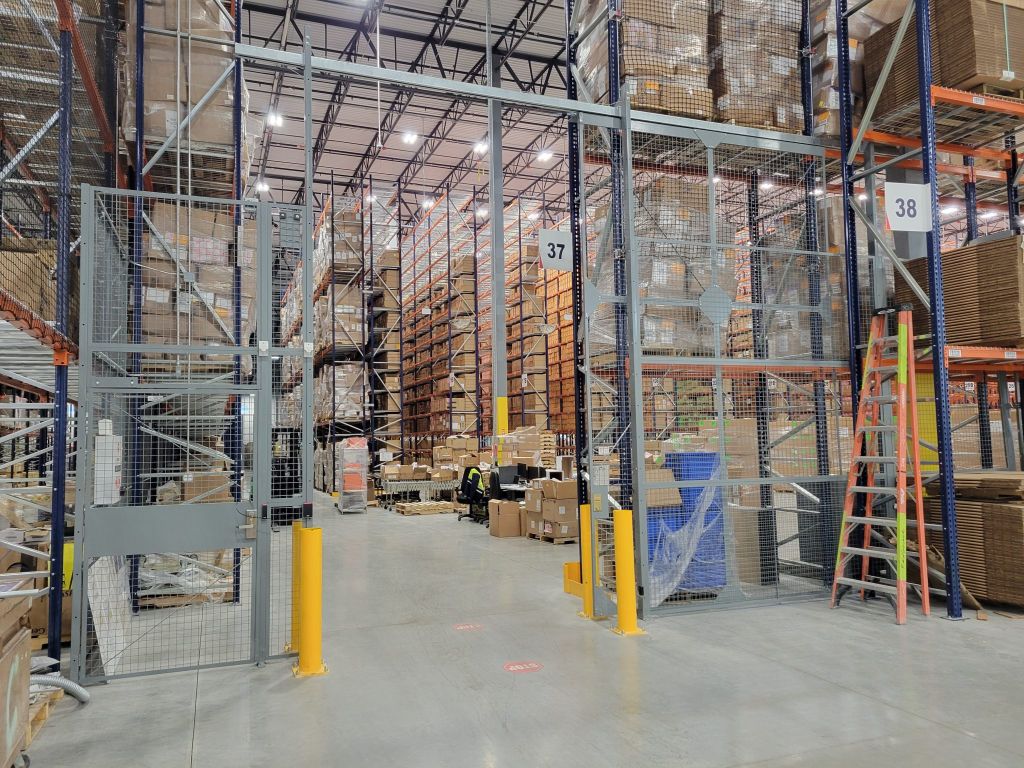
- Visibility is a feature, not a weakness. Members like to see that their property is behind a barrier and that the area is orderly. Mesh gives that; a solid locked room gives an unverifiable promise and hides the condition of the space.
- Individual compartments where it is worth it. Sectioned enclosures with their own doors are the right answer for high-value personal equipment, and they scale without rebuilding the room.
- Seasonal turnover needs modularity. Pool furniture in winter, course accessories in summer, event equipment year-round. Bolted wire mesh partitions can be resized or moved when the storage mix changes; a framed room cannot.
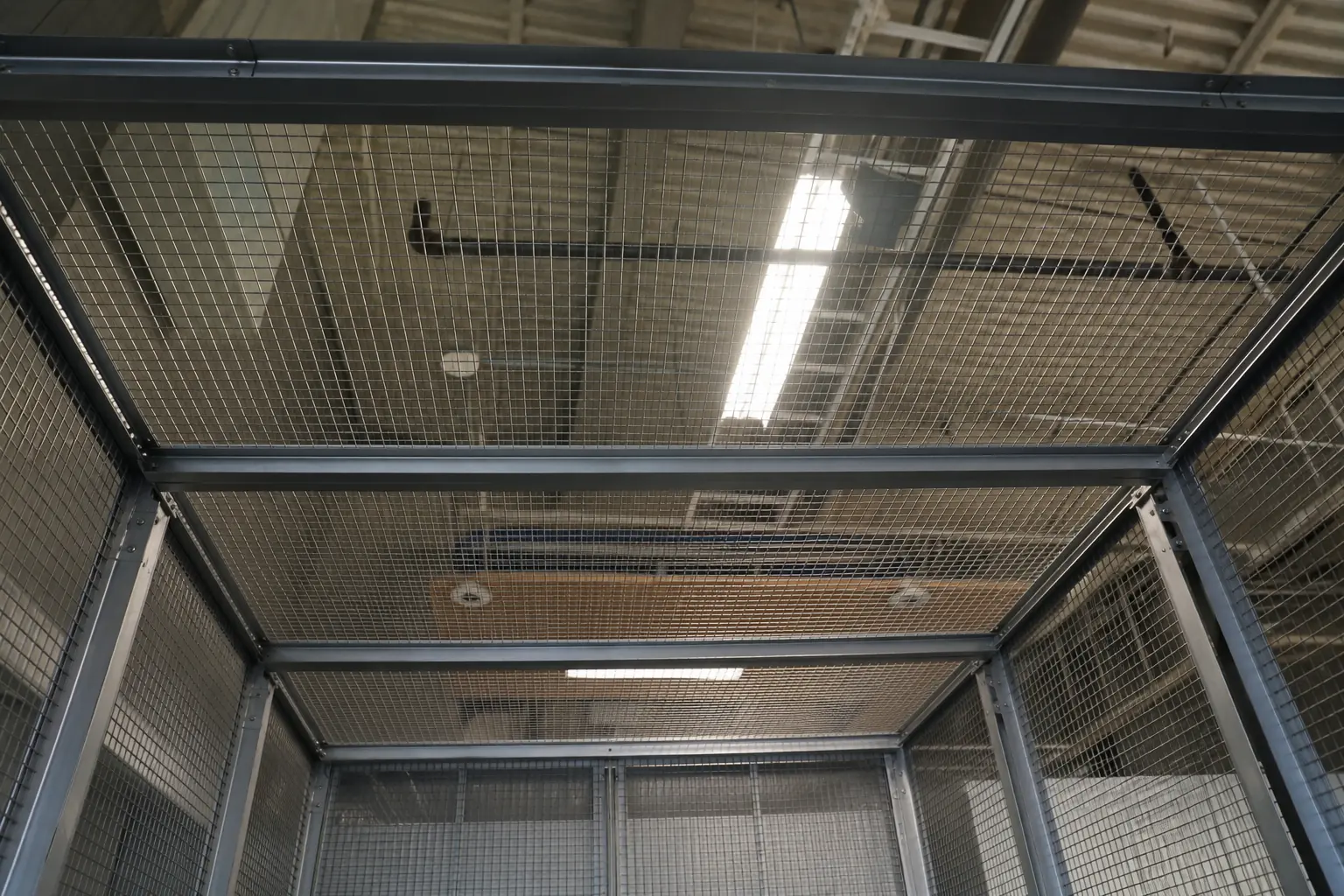
- Do not enclose to the ceiling by default. Where reach-over is realistic a mesh top is needed — but sprinkler coverage, lighting and access panels have to be resolved first. See cage ceiling options.
Clubhouse back-of-house storage — beverage, linen, engineering and IT — is a closely related problem with its own constraints; our hotel back-of-house case study covers that side in detail.
Specification: panels, doors and access
The specification for a club is driven by abuse tolerance, ventilation and appearance, in that order:
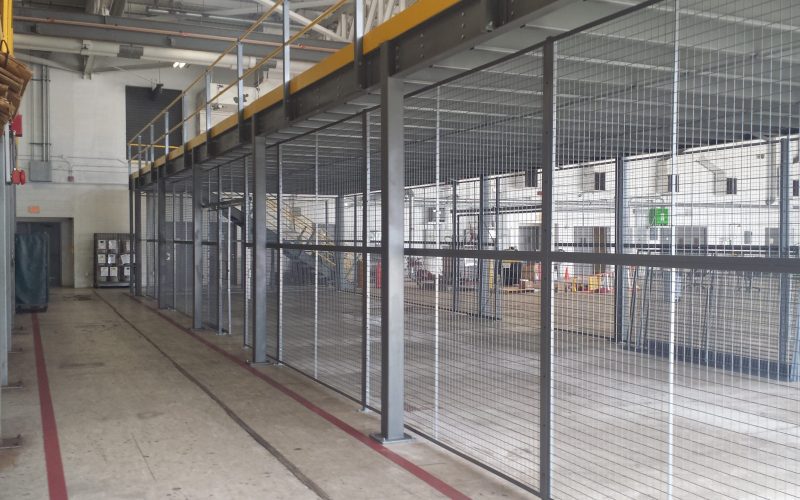
- Welded wire panels in steel frames. Visible, ventilated, and repairable panel by panel. Far more tolerant of cart, mower and hose contact than drywall, which in a grounds building is not a theoretical concern. Mesh opening and wire diameter are chosen for the control level required — see wire mesh panel options.
- Ventilation matters more here than in a warehouse. Grounds buildings hold engines, batteries and damp equipment. An open mesh barrier lets the building’s ventilation do its job; a framed room creates a pocket that has to be conditioned separately.
- Doors sized for what actually goes in. A walk-behind mower, a utility vehicle or a pallet of seed needs a wide opening. Sliding doors avoid swing clearance where the aisle is tight. Options are on security cage doors.
- Finish for the environment. Interior powder-coated panels are fine inside a dry shop. Anything at the cart yard, wash pad or an open-sided bay needs a galvanized or high-durability finish — see outdoor security cages.
- Economical barriers where the value is low. For bulk, low-risk material a chain link storage cage is often the better economic choice. Reserve welded wire for the equipment that would actually hurt to lose.
Installing in a building that never closes
A club cannot shut its grounds operation for a week, and the work has to stay out of members’ sight lines. Installation is sequenced accordingly.
Field-verify before ordering
Measured openings, ceiling and obstruction clearances, floor condition, drainage and the largest machine that has to get through the door. Our cage sizing guide lists what to record.
Work the shoulder season
Grounds buildings have a genuine low season and clubs have a calendar. Scheduling installation against the tournament and event calendar removes most of the disruption for free.
Complete one enclosure at a time
Equipment is relocated once, not repeatedly. Each enclosure is finished and back in service before the next area is opened up, so the crew always has somewhere to lock things at the end of a day.
Hand over the process with the panels
Key list, who issues, where chargers live, what happens when the seasonal roster changes in spring. An enclosure handed over without an agreed process reverts to an open room in a month. Walk it on a schedule using the cage maintenance and inspection guide.
Installation detail is on the security cage installation page. Material Handling USA designs, supplies and installs grounds, clubhouse and facility enclosures nationwide — start at the security cages hub, or tell us which bay you are trying to control.
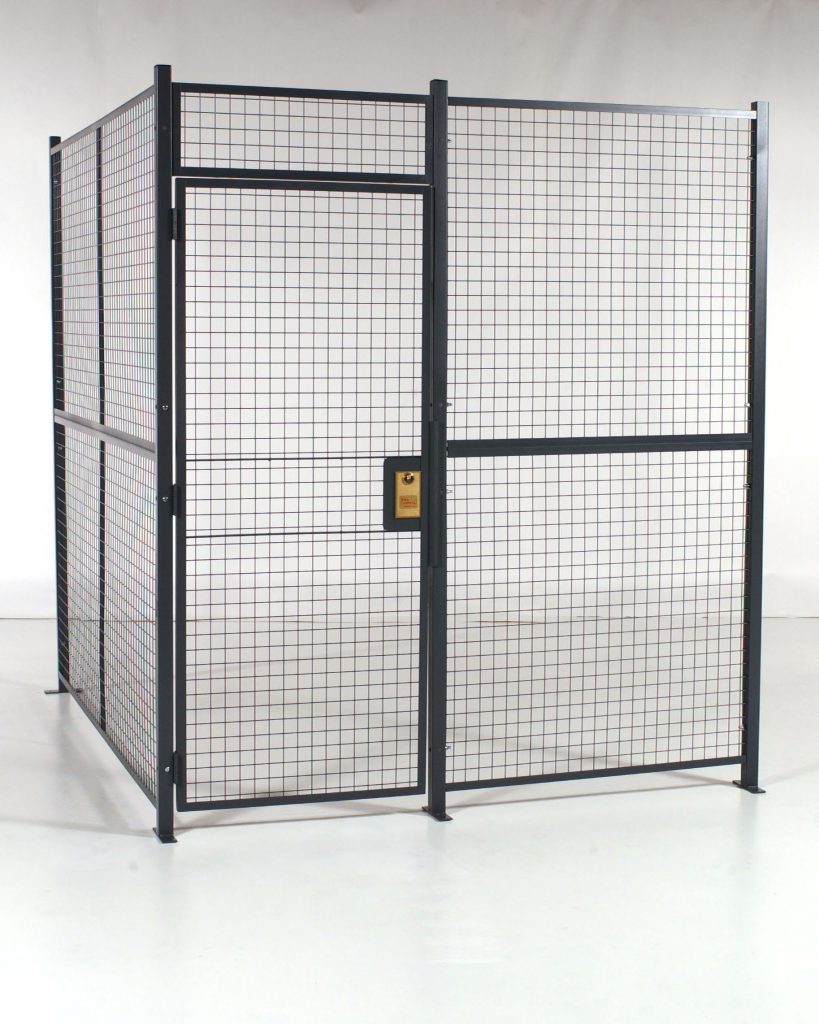
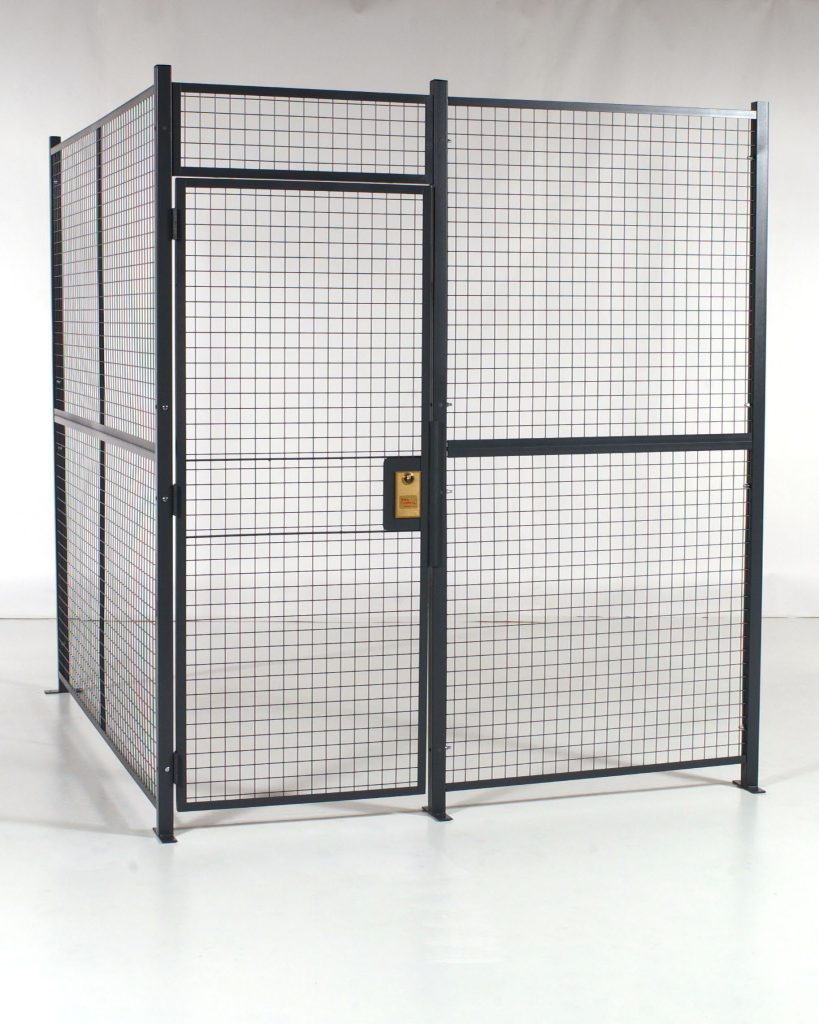
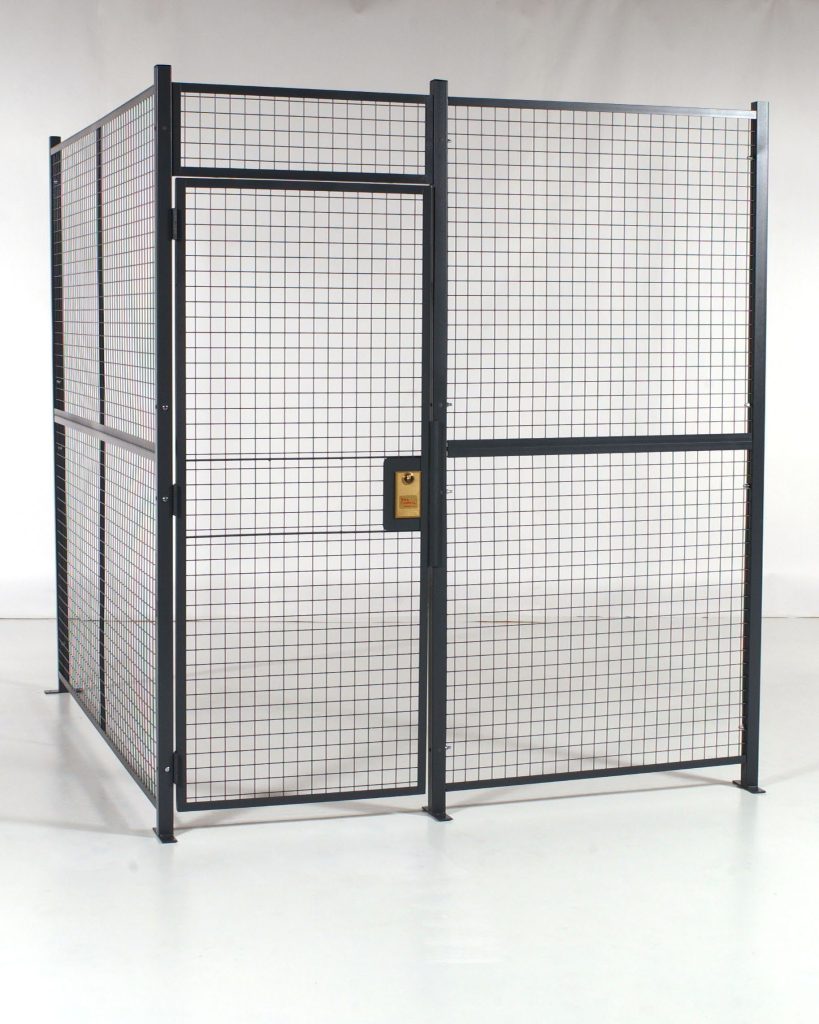
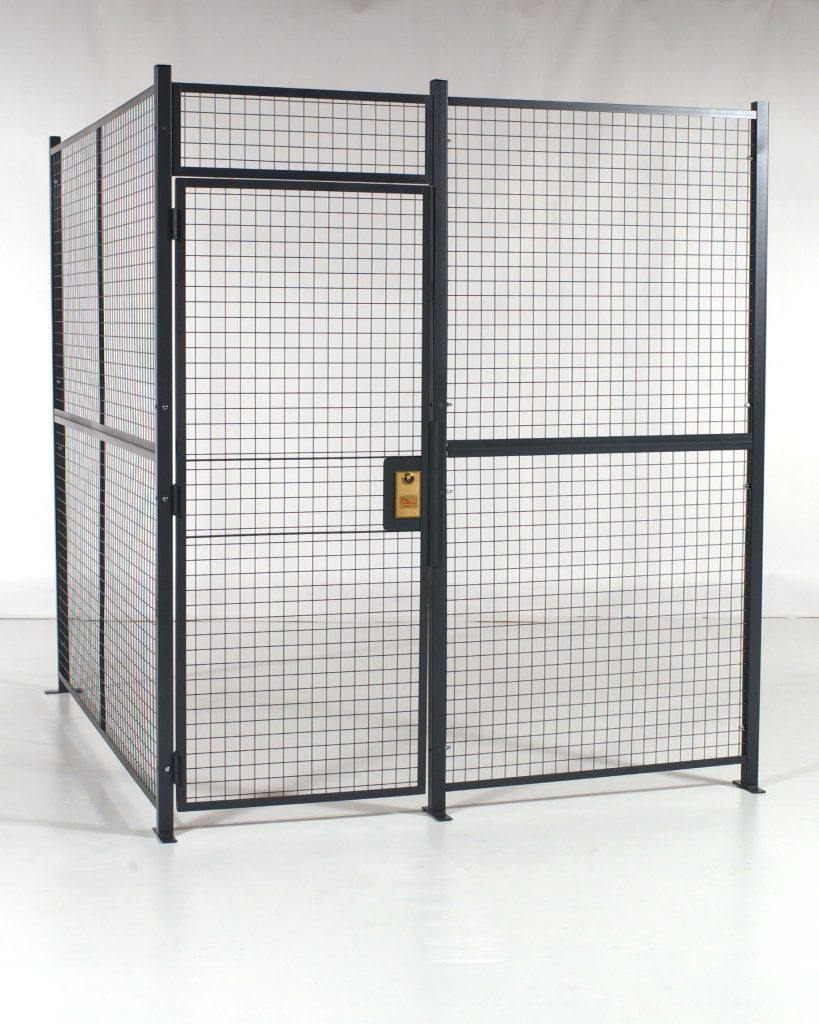
Shop Pre-Configured Wire Mesh Cage Kits Online
Standard-size welded wire cage kits, priced online, for smaller storage needs. Every kit still needs to be anchored to sound concrete — for tall, braced or engineered enclosures, request a quote with your building location and floor details.
Frequently asked questions
Can we store pesticides and fertilizer in a wire mesh cage?
What actually stops small-engine and tool loss at a club?
Won’t a locked crib slow the crew down at sunrise?
How should member golf bag and equipment storage be handled?
Does a cage need a mesh top?
Welded wire or chain link for club storage?
How do we handle a seasonal crew turning over every year?
Can enclosures be moved later?
Control the grounds building without slowing the crew down
Material Handling USA designs, supplies and installs welded wire security cages, tool cribs and member storage enclosures for golf clubs, country clubs and recreation facilities nationwide.