
Hotel Back-of-House Security Cage: Hyatt Park City
How a Park City, Utah hotel property uses welded wire enclosures to control access to the back-of-house inventory that quietly disappears — and how to plan caged storage in a basement, dock or engineering space that was never designed for it.

2024
Year Material Handling USA supplied security cage and wire partition product to Hyatt Park City
Park City, UT
Mountain resort market with heavy seasonal staffing turnover
Back of house
Docks, storerooms, engineering shops and basement corridors — where hotel shrink happens
Modular panels
Bolted welded wire systems that fit rooms with columns, pipes and low ceilings
The project
Material Handling USA supplied security cage and wire mesh partition product to a Hyatt hotel property in Park City, Utah in 2024. Park City is a resort market: occupancy swings hard with the season, staffing turns over with it, and a hotel’s back-of-house has to absorb both without losing control of the inventory that keeps rooms sellable.
Hospitality is one of the least-discussed applications for security cages and one of the most natural. Hotels are open buildings by design. Guests, contractors, event vendors, delivery drivers and seasonal staff all move through spaces that also hold liquor, linen, electronics, tools and building equipment. Almost none of that back-of-house area was designed with a secured room in it, which is exactly why a modular welded wire enclosure works so well: it turns an existing corridor, dock corner or basement bay into a controlled-access space without construction.
This page pairs that verified project with practical planning guidance for any hotel or resort. The full product range is on our security cages and wire mesh partitions hub, and the configuration most hotels end up with belongs to the welded wire partition family.
What we publish
We publish only what we can verify: the client, the year we worked together, and the product category supplied. We never publish a property’s room dimensions, floor plans, order value, lock specifications, camera or alarm detail, or where anything is stored. Everything on this page other than those verified facts is general planning guidance, not a description of this property.
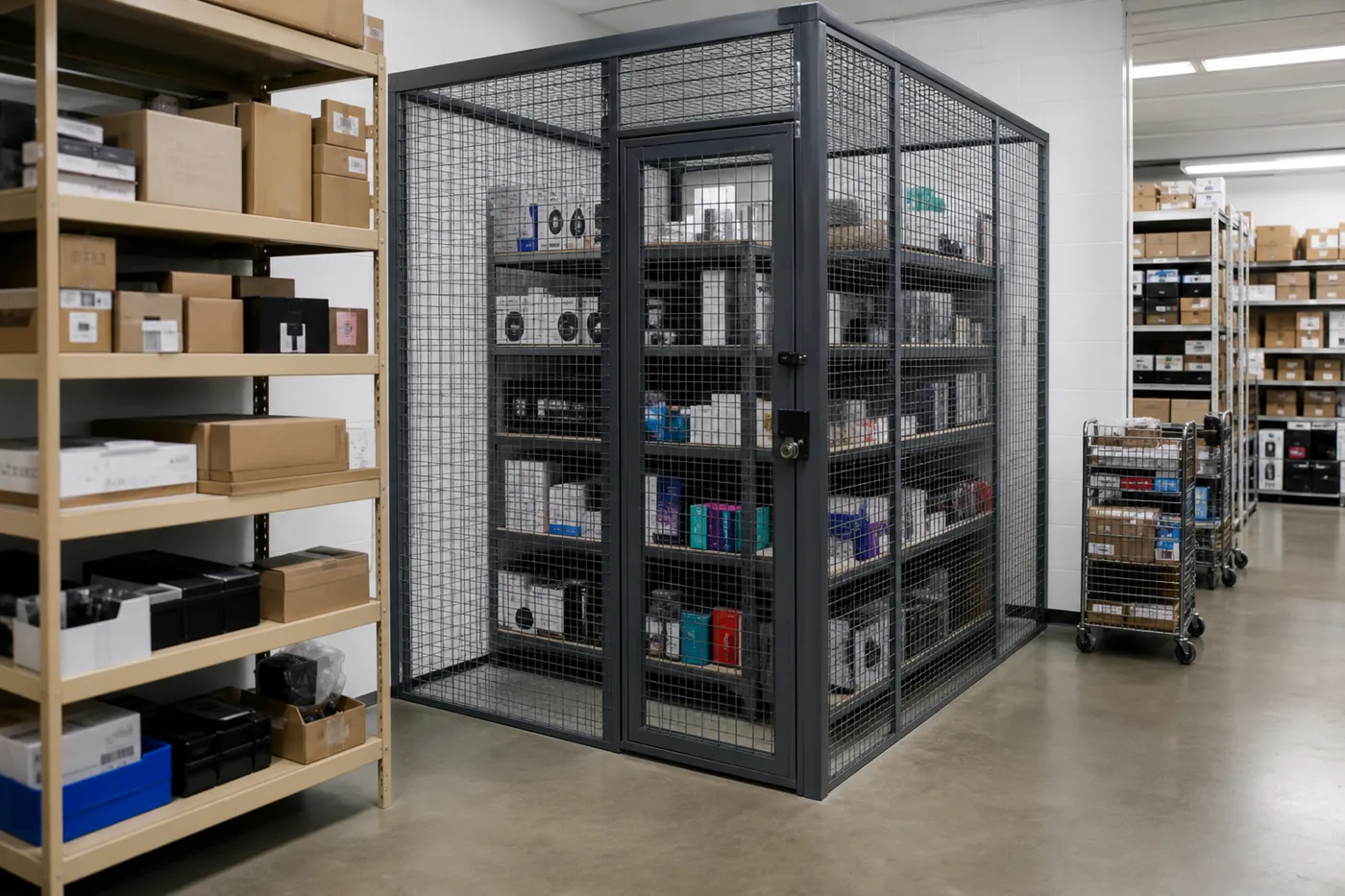
Where hotel back-of-house losses actually happen
Hotel shrink is rarely dramatic. It is a case of wine, a box of remote controls, a cordless drill, a pallet of amenity stock, a robotic vacuum. Individually small; annually significant; and almost always occurring in spaces where nobody can say afterwards who was there.
Three structural features of hotel operations make this hard. First, the population moving through the back of house is large and constantly changing — seasonal staff, agency housekeeping, event crews, contractors, vendor drivers. Second, the storage spaces are shared: linen, food and beverage, engineering and IT often occupy one basement level with no doors between functions. Third, the busiest nights are the nights when everything is propped open because the operation cannot wait.
Caging does not fix a staffing problem, and it is not a safe. What it does is separate functions physically so that access to a category can be limited to the people who own that category, and so a question about a missing case has a small, answerable list behind it. In a market like Park City, where peak-season crews arrive and leave within a single winter, that separation is worth more than any individual lock.
Six back-of-house areas hotels commonly cage
Almost every hotel we work with ends up caging some subset of these six. Each has a different driver, and each pushes the design in a different direction.

Designing a cage for a building that already exists
New warehouses get square, clear, sprinklered space. Hotels get whatever is left under the ballroom. Back-of-house cage design is therefore mostly a problem of working around what is already there.
Low and irregular ceilings
Basement service levels run low, and they run full of ductwork, conduit, sprinkler branch lines and drainage. Cage height has to be set against the lowest obstruction on the panel line, not the room’s nominal ceiling. Where a full-height panel will not clear, the usual answer is a shorter panel run with a welded wire top, which also keeps the enclosure secure from above — see security cage ceilings and top panels.
Columns, pipes and out-of-square rooms
Modular panel systems come in fixed widths, and a room that is not square will leave gaps at the ends of a run. Filler panels and field-cut closure pieces handle this routinely; what you should not accept is a gap left open at a column because it was easier. Rooms with genuinely awkward geometry are what custom security cage configurations exist for.
Finishes and noise
Back-of-house in a hotel is not a warehouse. Panels get seen by staff every shift and sometimes by guests through an open service door, and cage doors slamming under a guestroom stack is a real complaint. Powder-coat colour selection, door closers and hardware choice all matter more here than in an industrial building.
Cart and equipment clearance
Housekeeping carts, banquet dollies and pallet jacks set the door width, not the person walking through. Measure the widest thing that has to enter, add clearance, then choose the door type from the cage door options. Our sizing guide covers converting a measured space into a panel schedule, and the cage configurator tool is a quick way to test a footprint.
| Back-of-house condition | Design response |
|---|---|
| Low ceiling with ducts and sprinkler branches | Set panel height to the lowest obstruction; add a welded wire top rather than forcing full height |
| Columns and out-of-square walls | Filler panels and closure pieces; never leave an open gap at a column |
| Housekeeping and banquet carts | Door width sized to the widest cart plus clearance; sliding door where apron space is tight |
| Shared corridor with mixed departments | Separate small enclosures per function rather than one large shared cage |
| Guestrooms above the space | Door closers and hardware chosen for noise; avoid slamming latches |
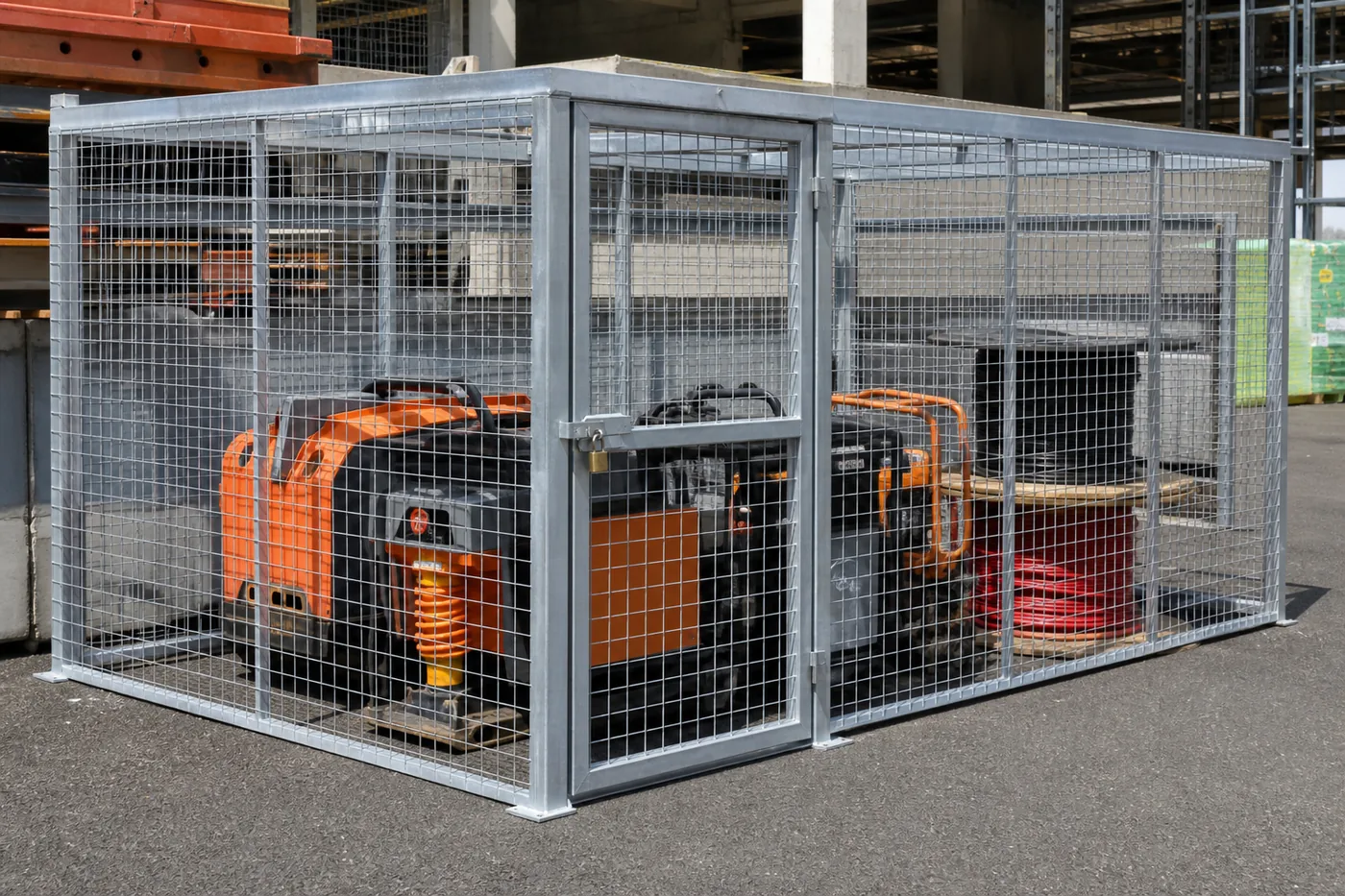
| Outdoor or parking-structure storage | Galvanized or weather-appropriate finish; drainage and anchoring reviewed |

Panels, doors and access control
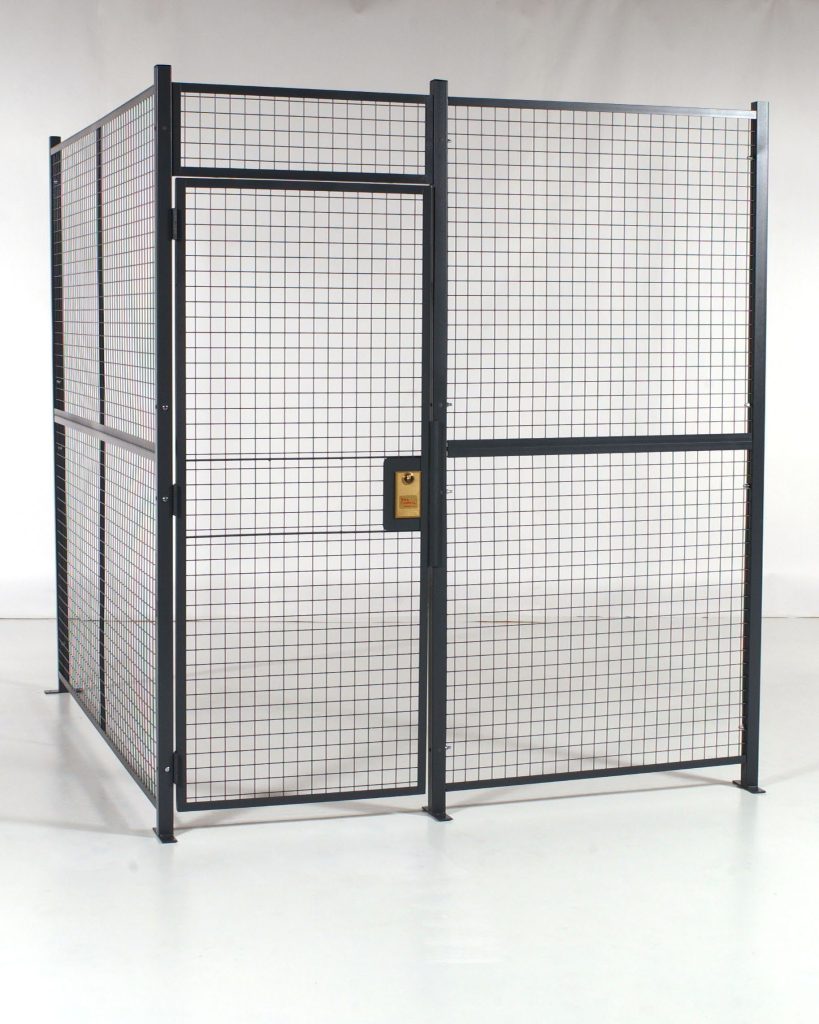
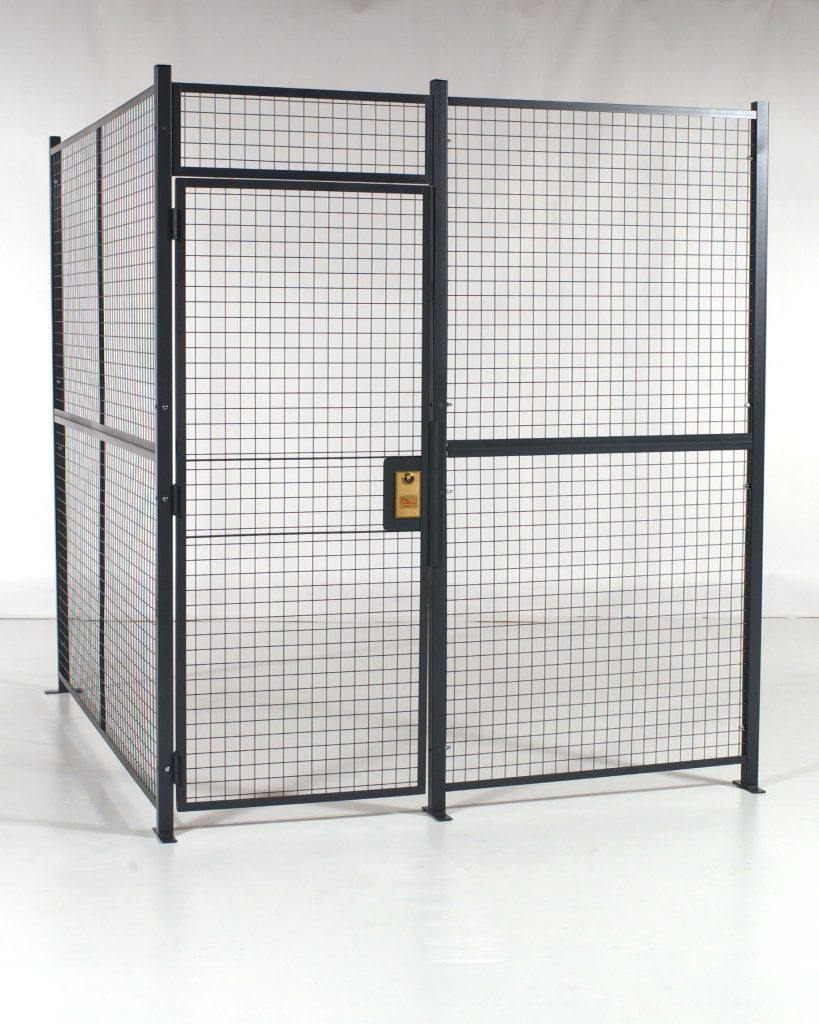
Panels. Welded wire mesh is the standard for hotel interiors: rigid, see-through so a supervisor can check stock without unlocking, light and air pass through, and damage is visible. Mesh opening is chosen against the smallest item being protected — a beverage cage and a linen cage do not need the same specification. The trade-offs are covered in wire mesh panel options. For bulk grounds and equipment storage where economy matters more than reach-through resistance, a chain link storage cage is often the better build.
Doors. Hinged doors suit most hotel storerooms. Sliding doors earn their place where a corridor is too narrow for a door swing — common in service basements. Whatever the type, the opening has to fit the cart, and the door has to close by itself, because in hospitality the door that requires a deliberate action to close will be left open on the busiest night of the year.
Access. Most properties already run an electronic access system for back-of-house doors, and cage doors can be integrated with electric strikes or keypads rather than adding another key ring — see cage locks and access control. The operational rule matters more than the hardware: one department owns each cage, one named list of people can open it, and personal padlocks never appear on a company enclosure.
Fire protection, egress and chemical storage
A hotel is an occupied assembly and residential building, and back-of-house spaces are on egress paths for staff. Three questions have to be answered before an enclosure is ordered, and none of them are answered by the cage supplier.
Egress. A cage must never obstruct, narrow or lengthen an exit route, and it must not compromise the operation of an exit door. OSHA’s exit route maintenance requirements (29 CFR 1910.37) set the plain-language baseline for the employee side; the building and fire codes and the local authority having jurisdiction decide the rest, and in a hotel the fire marshal is an active participant.
Sprinkler obstruction. Enclosure tops can obstruct sprinkler distribution. Open welded wire tops interfere far less than solid ones, but the specifics depend on the sprinkler design and what is stored. Have the fire protection contractor review the layout before the order, not after installation.
Chemicals. Pool chemicals, cleaning concentrates and paints in a hotel are governed by storage rules of their own; OSHA’s flammable liquids standard (29 CFR 1910.106) is one starting point, and local fire code requirements for pool chemical rooms are frequently stricter. A wire enclosure controls access; it does not provide separation, containment or ventilation, and it should never be treated as a substitute for a properly designed chemical storage room.
Nothing here is a compliance determination and no enclosure is automatically code compliant. Confirm egress, sprinkler and chemical storage requirements with your fire protection contractor and your local authority having jurisdiction.
Installing in an occupied hotel
Hotels do not close. Installation is planned around guests, events and the delivery schedule, and the constraints are different from an industrial site in three ways.
Access route. Panels and posts have to reach the space through service corridors, service elevators and doorways that were sized for carts. Panel lengths sometimes have to be selected for what fits in the elevator rather than for what is most economical on paper.
Noise and hours. Anchoring into a slab is loud. Work under or beside guestrooms, meeting space or a restaurant is usually scheduled for off-peak windows agreed with the property in advance.
Housekeeping of the work itself. Drilling dust, packaging and staged panels have to be controlled in a space that staff are still using every hour of the day. Staging in phases — one enclosure at a time, cleaned down before the next — is slower on paper and faster in practice.
Our approach to sequencing, anchoring and site conditions is described on the security cage installation page, and we work throughout Utah from Salt Lake City to the mountain resort corridor — see security cages in Utah.
Planning secured storage in a hotel or resort?
Send us the space you are working with, the ceiling and door constraints, and what you need to control. We will come back with a panel layout, door recommendation and a budget range — and flag the egress and sprinkler questions for your fire protection contractor.
Operating rules that make hotel cages work
- One department owns each cage. Shared enclosures with three key holders from three departments become open enclosures within a season.
- Cage the reserve, not the working stock. Control the bulk inventory and leave par-level stock accessible, or staff will route around the cage on the busiest shift.
- Issue rather than browse for beverage and electronics. A named person retrieves and records; the door stays closed.
- Re-key or re-authorize at the end of each season. In a resort market, access lists go stale faster than anywhere else.
- Count what is caged on a short cycle. Segregating inventory only pays off if somebody counts it while discrepancies are still small.
- Inspect the enclosure quarterly. Cart strikes bend panels and loosen hasps; replace damaged panels rather than bending them back. The maintenance and inspection guide has a usable checklist.
- Review outdoor enclosures before each season. Weather, snow load and drainage change what an exterior cage needs — see outdoor security cages.
Shop Pre-Configured Wire Mesh Cage Kits Online
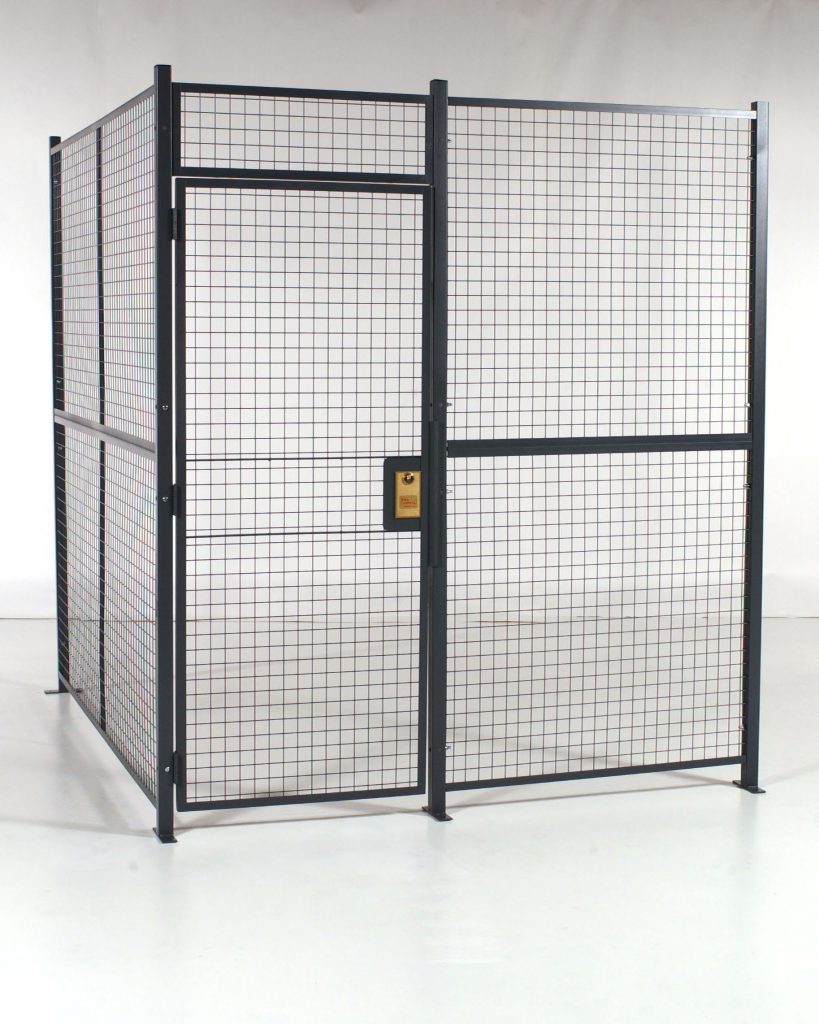
Standard-size welded wire cage kits, priced online, for smaller storage needs. Every kit still needs to be anchored to sound concrete — for tall, braced or engineered enclosures, request a quote with your building location and floor details.
Frequently asked questions
What do hotels most often use security cages for?
Can a cage be installed in a finished back-of-house room?
How do you handle low basement ceilings and ductwork?
Does a wire cage satisfy pool chemical storage requirements?
Can cage doors use our existing key card system?
Will installation disturb guests?
Looking for a project like yours? Browse more hospitality and facilities cage case studies, see all security cage case studies.
Take control of your back of house
Material Handling USA designs, supplies and installs welded wire security cages for hotels, resorts and hospitality properties across Utah and nationwide.