
Liquor Storage Cages for Distilleries, Wineries, Breweries and Bonded Warehouses
How alcohol producers, bonded warehouses, distributors and hospitality operators use wire mesh security cages to separate in-bond from taxpaid stock, cut pilferage and keep high-value bottles visible — and what the federal rules actually say.
Supplied and installed nationwide from Salt Lake City — call (800) 326-4403.

By tax status
Cages follow bonded vs taxpaid, not just SKU
Open mesh
Stock stays visible and sprinkler water passes through
Modular
Panels move as barrel and case volumes change
Nationwide
Layout, supply and install from Salt Lake City
Why alcohol inventory ends up behind wire mesh
Few products combine high value, small size and universal appeal the way bottled spirits, wine and beer do. A case of premium bourbon fits under one arm, resells instantly and carries federal excise tax on top of its product cost. That makes alcohol one of the most pilfered categories in any warehouse, stockroom or back bar — and it is why the people who make, store and sell it lean so heavily on physical separation.
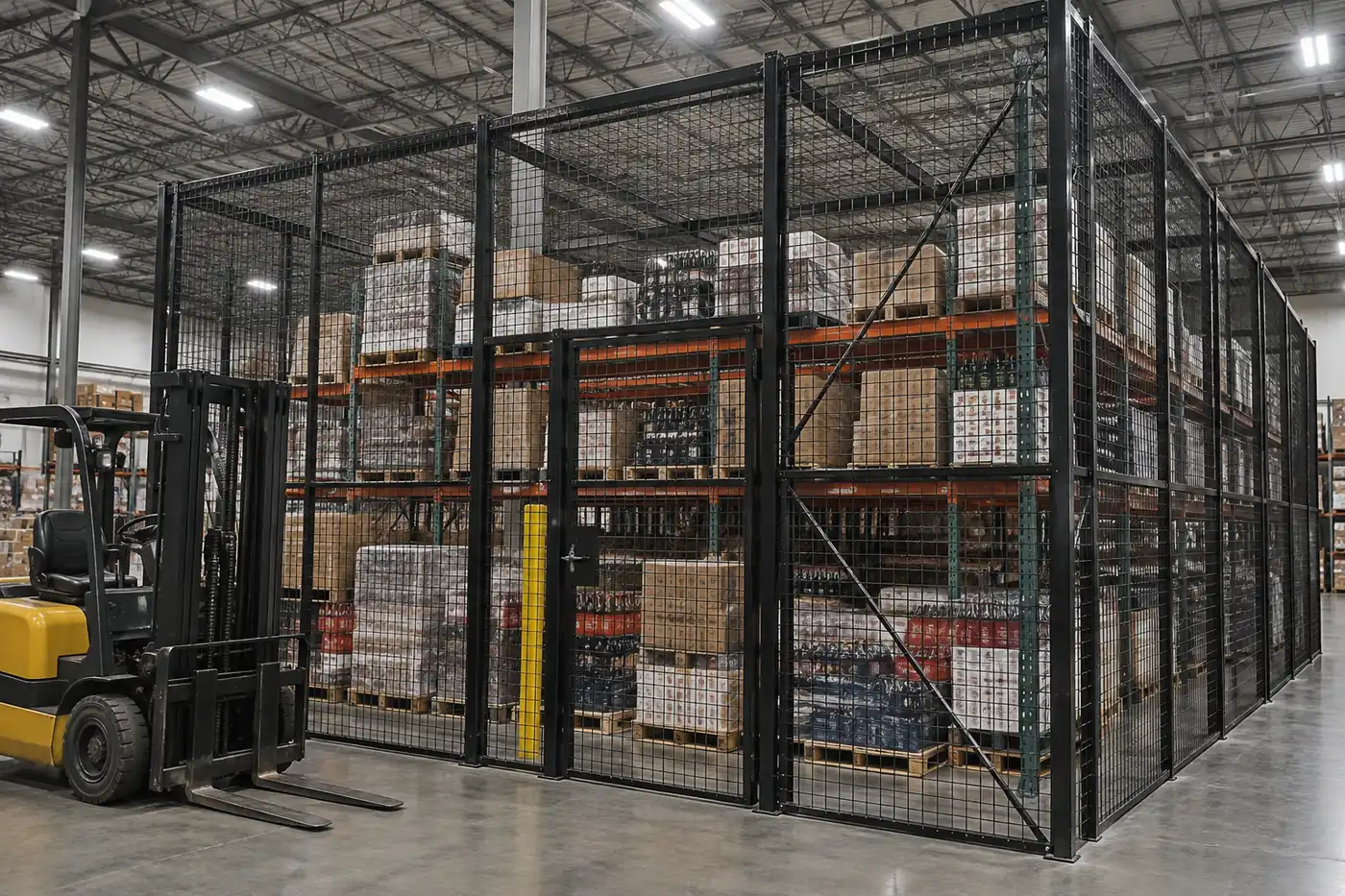
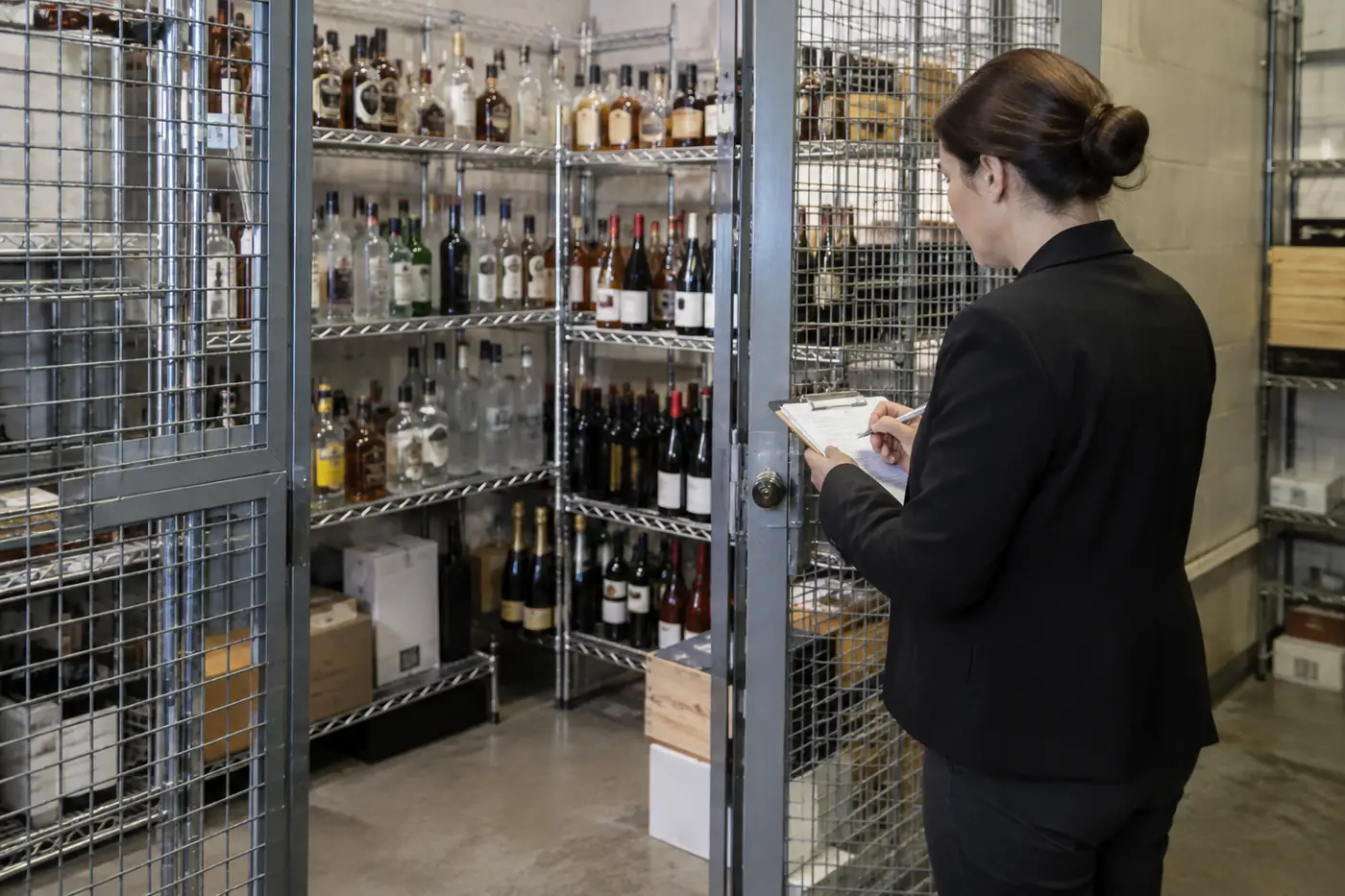
For most operations the practical answer is a set of wire mesh security cages and partitions. A cage turns a status on a spreadsheet into a boundary on the floor: in-bond spirits on one side, taxpaid finished goods on the other; top-shelf bottles behind a door, everyday stock on open racking. This guide explains the zones that usually get their own enclosure, what the federal alcohol and customs rules say about security and segregation, and the building issues to plan around. It is written for distillery and winery operations managers, brewery owners, bonded warehouse proprietors, beverage distributors, and hotel, restaurant and venue beverage managers.
What a liquor cage does
- Reduces pilferage: the highest-value bottles and cases sit behind a door someone is responsible for, not on an open aisle.
- Separates tax status: in-bond product and taxpaid product stay physically apart, the way the regulations expect.
- Supports counts: a defined, locked area makes cycle counts and variance checks faster and more believable.
- Stays visible: open mesh lets supervisors see stock levels without opening every door, and lets light and air through.
- Moves with you: bolted modular panels can be extended when a new release, label or warehouse bay comes online.
What the federal rules say about alcohol storage security
No federal regulation says “build a wire mesh cage.” The rules set outcomes — substantial construction, lockable storage and clear separation by tax status — and leave the method to the proprietor and the regulator. The most relevant ones are summarized below; always read the current text and confirm your plan with the agency that supervises your premises.
For distilled spirits plants, 27 CFR 19.192 requires adequate security to protect the revenue, says buildings, rooms and partitions must be constructed of substantial materials, and requires approved locks on outside doors to rooms holding spirits in portable bulk containers such as barrels. A separate rule, 27 CFR 19.58, says taxpaid spirits may cross bonded premises but may not be stored there, and must be kept separate from spirits on which tax has not been paid. Every plant also files a statement of plant security describing how buildings or parts of buildings are secured and who holds the keys; under 27 CFR 19.123 a change to that description means amending the registration.
Wineries have a parallel rule. 27 CFR 24.166 requires wine premises buildings and rooms to be built of substantial materials and separated from adjacent areas in a manner satisfactory to TTB, and calls for a storage room equipped for locking where spirits are received in packages. When a winery alternates space between bonded and taxpaid use, 27 CFR 24.135 requires untaxpaid and taxpaid product to be physically separated — by tanks, rooms, buildings, partitions, pallet stacks or another method that clearly distinguishes them. Breweries storing taxpaid beer from other brewers must segregate it from nontaxpaid beer under 27 CFR 25.24, and TTB can require physical segregation if needed to protect the revenue. TTB summarized these separation rules across all three industries in Industry Circular 18-3.
Imported wine and spirits held in a customs bonded warehouse add a second regulator. 19 CFR 19.4 makes the warehouse proprietor responsible for physical and procedural security, and when part of a facility holds non-bonded merchandise, the CBP port director designates the means of separation — for example a wall, fence or painted line.
| Rule | What it asks for | Where a cage can help | What a cage does not decide |
|---|---|---|---|
| 27 CFR 19.192 (distilleries) | Substantial buildings, rooms and partitions; secured openings; approved locks on outside doors to bulk spirits rooms | Secured storage areas inside a larger building | Whether mesh satisfies TTB for your premises — confirm with TTB |
| 27 CFR 19.58 | Taxpaid spirits not stored on bonded premises; kept separate | A distinct taxpaid finished-goods enclosure | Where your bonded premises boundary is — that is in your registration |
| 27 CFR 24.166 / 24.135 (wineries) | Substantial, separated rooms; locking room for packaged spirits; physical separation of untaxpaid and taxpaid wine | Partitions or locked cages for spirits and taxpaid case goods | Replace signs, tags or records that identify tax status |
| 27 CFR 25.24 (breweries) | Taxpaid beer from other brewers segregated; TTB may require physical segregation | A small enclosure for other brewers’ taxpaid beer | Wholesaler permit or recordkeeping obligations |
| 19 CFR 19.4 (customs bonded) | Proprietor supervises physical security; port director designates bonded / non-bonded separation | Fence-style mesh partition as the designated separation | CBP approval of the method — the port director decides |
State alcohol control rules sit on top of these, and they vary widely — control states such as Utah run their own warehouses (see how the State of Utah stores liquor), while license states set their own storage and recordkeeping conditions for wholesalers and retailers. For how cages fit other regulated programs, see our security cage regulations by industry guide.
The zones that usually get their own enclosure
Plan around tax status and value first, then size each zone by how much product moves through it. These are the enclosures we see most often across the alcohol supply chain:
Bonded and taxpaid: never share a door
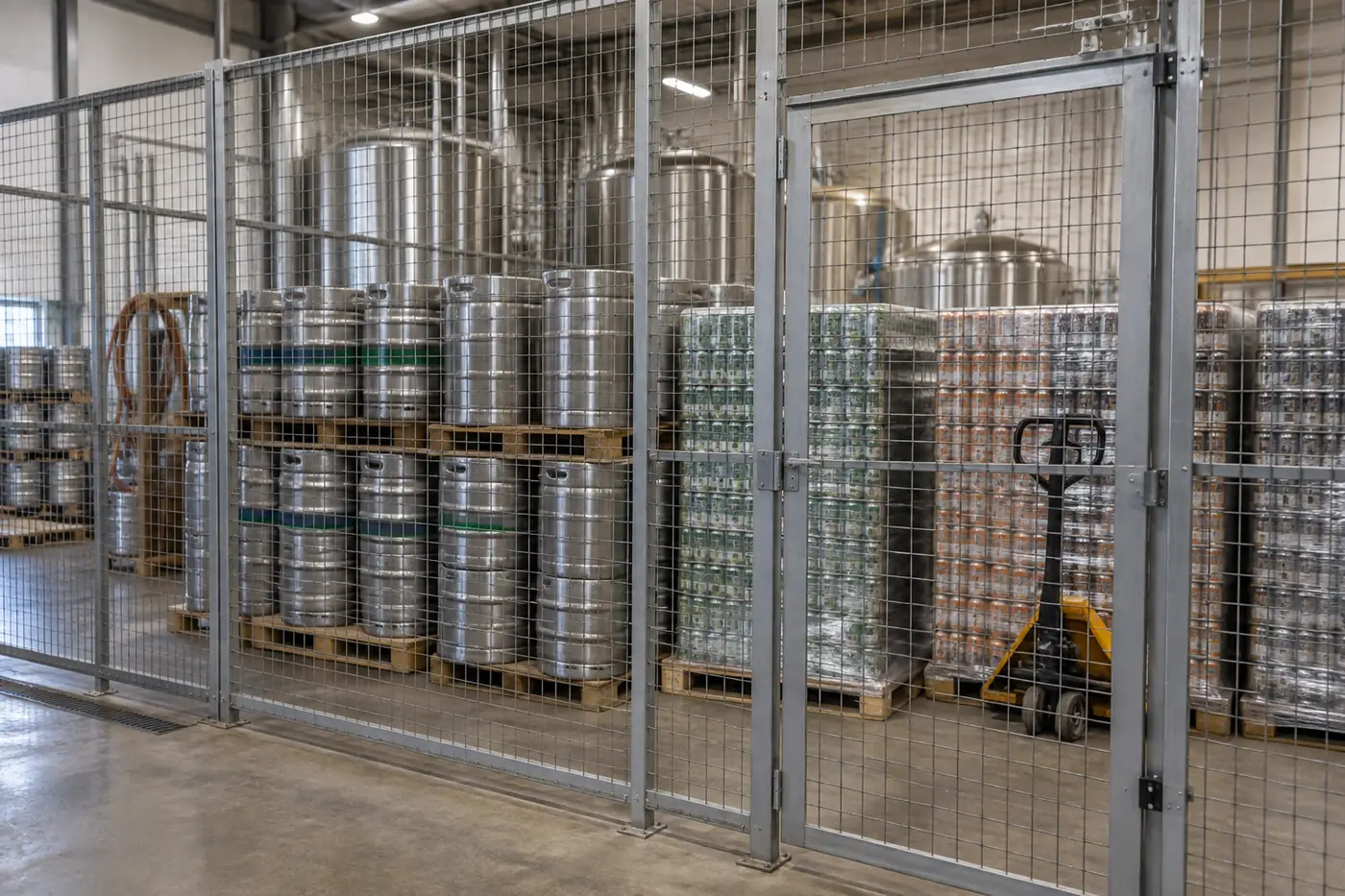
The single most useful layout rule is that an in-bond area and a taxpaid area should never connect through an internal door. Product should move between them only through a documented transfer, at a point someone is responsible for. A mesh partition makes that boundary obvious to every employee and visitor, while still letting supervisors see both sides at a glance.
Signs, tags or labels that identify tax status still matter — the cage adds a physical boundary, it does not replace identification or records.
Cage types that fit alcohol storage
Full enclosures around barrel and case storage
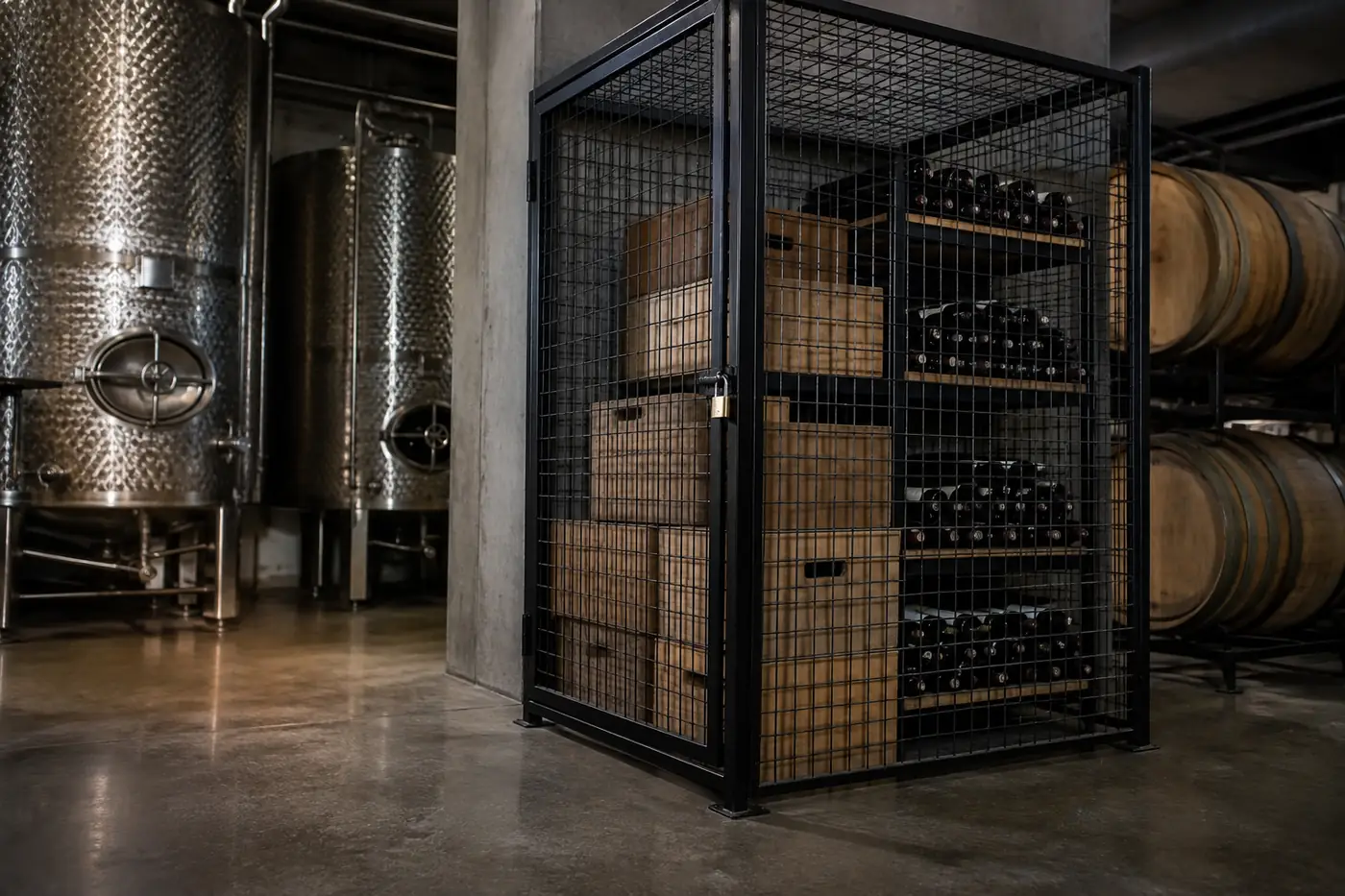
Distilleries and bonded warehouses usually start with a full-height mesh enclosure around barrel racking or palletized case goods, with a personnel door and a wide hinged or sliding door for forklift or barrel-handling traffic. Bolted modular panels can wrap irregular areas around columns and racking, and can be extended as the barrel inventory ages and grows.
Door styles are compared on our security cage doors page, and mesh and gauge choices on wire mesh panel options.
Rack-integrated enclosures for distributors
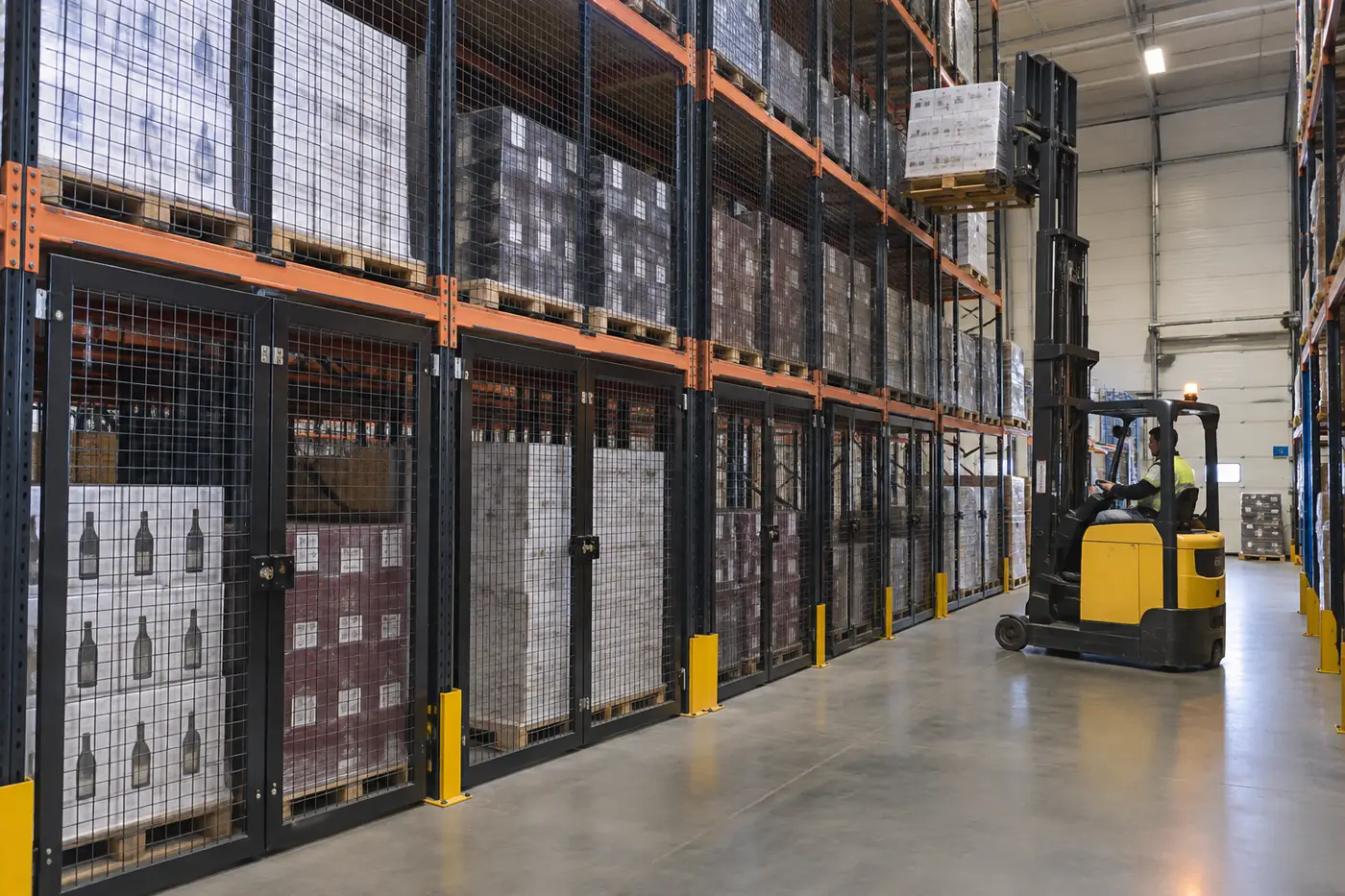
Beverage distributors rarely want a separate room for every high-value SKU. Instead, mesh back panels, end panels and locking doors can be fitted to selected pallet rack bays, creating secured pick and reserve locations for allocated and premium product inside an existing rack layout. It is also a quick way to create a returns or hold area without losing floor space.
See pallet rack security enclosures for how the panels attach, our beverage distribution pallet racking guide for the racking side, and carton flow for liquor distribution for faster case picking.
Other formats we supply for alcohol storage include freestanding wire mesh partitions that divide a production building into bonded and taxpaid areas, smaller standard-size cage kits for tasting rooms and retail back rooms, and larger warehouse security enclosures for distribution centers.
Back-of-house liquor cages for hospitality
Hotels, restaurants, casinos and stadiums keep a liquor cage behind the bar program: a lockable enclosure with shelving where par stock lives, issued to outlets against requisitions. Open mesh lets the beverage manager see stock levels without unlocking the door, and the cage gives every count a fixed, controlled starting point.
Our Hyatt Park City back-of-house project shows a hotel cage in practice, and our Las Vegas security cages page covers casino and resort storage.
Building and site constraints to plan around
Alcohol buildings add a few constraints that a general warehouse cage project does not face:
Fire protection and structure
- High-proof spirits are flammable liquids, and barrel warehouses often have specific fire protection designs; keep cages clear of sprinkler heads and their spray patterns, and involve the fire protection engineer before adding anything overhead
- A ceiling on a cage changes how sprinkler water reaches the contents — see security cage ceilings before adding one
- Keep exits, extinguishers, fire department connections and electrical panels outside every enclosure, and do not let a cage block an egress path
- Anchor posts to sound concrete; tall runs and seismic regions may need bracing — see our anchoring and seismic bracing guide
Operations and environment
- Size doors for the widest load: barrel trucks, forklifts with double-stacked pallets, or keg dollies
- Cellars and barrel rooms run cool and humid; galvanized or powder-coated finishes hold up better than bare steel
- Leave clearance for barrel racks, tank access walkways and inspection, and keep any regulator access routes open
- Plan floor drains, spill response and cleaning so the cage does not trap liquid or block a washdown

Talk to the regulator before you build
Because a distillery’s plant security statement describes how buildings and parts of buildings are secured, and a winery’s premises must be separated in a manner satisfactory to TTB, a new enclosure that changes those boundaries can mean paperwork. Whether a mesh partition is acceptable as a premises boundary, and whether your registration or application needs amending, is a question for TTB — or, in a customs bonded warehouse, for the CBP port director — not for your cage supplier. Raise it early, and keep your premises diagram in step with what gets installed.
Access, keys and count principles
A cage only stops pilferage if the doors are managed. We keep hardware discussion general here; the right access design for a specific facility is worked out privately with the customer.
- Give bonded and taxpaid areas separate doors, and never connect them directly
- Keep a current list of who holds keys or credentials for each enclosure — distilleries already list key custodians by position in their plant security statement
- Issue product out of the cage against an order, transfer record or outlet requisition at a single point
- Match cage locations to the location codes in your inventory or warehouse management system, and cycle count high-value cages more often than open stock
- Review access after staff changes and after any unexplained variance
Lock and access options are compared on our security cage locks page. For federal bonded premises, check the lock requirements in 27 CFR 19.192 before choosing hardware.
Adding or reworking a liquor cage
Map tax status and flow
Trace product from production or receiving through bonded storage, tax determination, finished goods, shipping, returns and destruction. Each change of status is a candidate boundary.
Size each zone
Size by barrel count, pallet positions or case volume, and leave room for new releases, seasonal peaks and aging inventory.
Check the building
Confirm fire protection, exits, door widths, drains and the slab before the layout is fixed.
Layout and quote
We produce a CAD layout with doors and rack-integration parts and a line-item quote.
Regulator and permits
You confirm with TTB or CBP whether premises paperwork changes; building and fire review runs in parallel where required.
Install and hand over
Our crews install and anchor the enclosure, clean up all hardware, and hand over keys or credentials to the people you name.
A rough floor plan, photos of the area and a list of the zones you need are enough to begin. Sketch an enclosure in our security cage configurator, measure with our sizing guide, or read how we handle security cage installation. For Intermountain distilleries, wineries and distributors, our Utah security cage team works locally out of Salt Lake City.
Shop Pre-Configured Wire Mesh Cage Kits Online
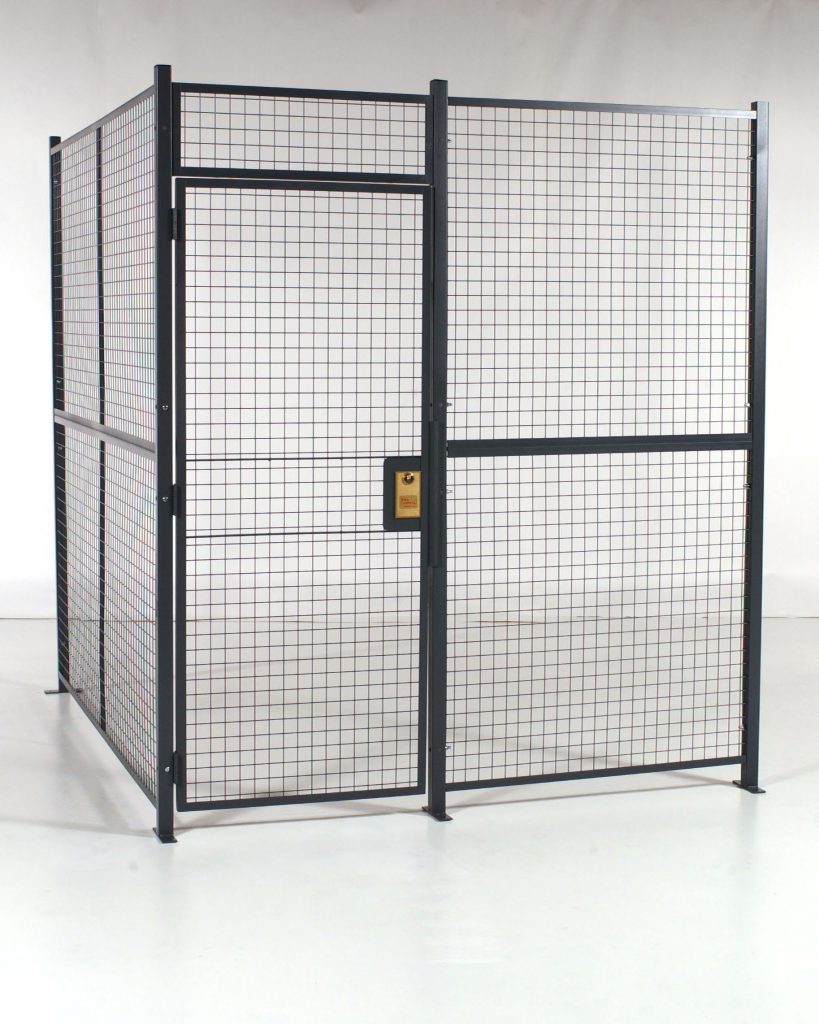
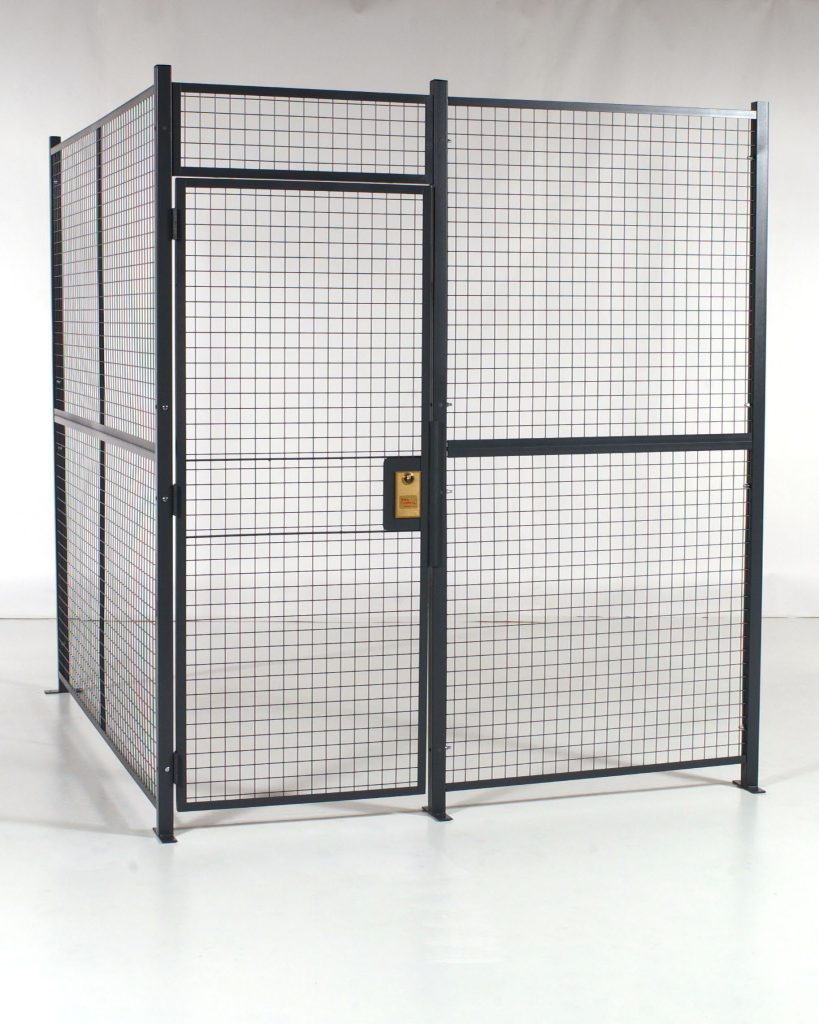
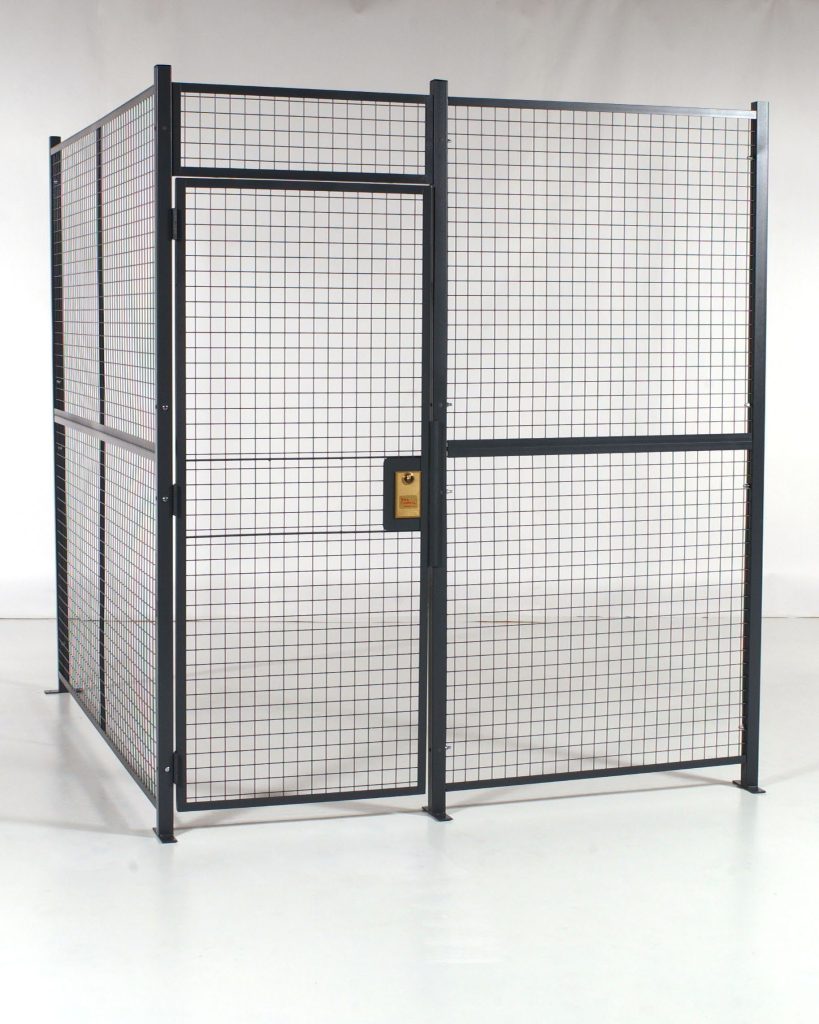
Standard-size welded wire cage kits, priced online — a quick way to add a liquor cage to a tasting room, back bar storeroom or retail back room. Every kit still needs to be anchored to sound concrete; for barrel enclosures or rack integration, request a quote.
Liquor Storage Cage FAQs
Does TTB require a security cage for distilled spirits?
Can taxpaid and in-bond spirits share a cage?
Do I have to tell TTB if I add a cage at my distillery?
Can a mesh partition separate bonded and non-bonded goods in a customs bonded warehouse?
What is a liquor cage in a hotel or restaurant?
Will a wire cage hold up in a humid wine cellar or barrel room?
Can you enclose existing pallet rack instead of building a room?
Does MH-USA install liquor cages outside Utah?
Planning a liquor or bonded storage cage?
Send the building location, a sketch of the area and the zones you need. We will return a layout with doors and rack enclosures and a line-item price — supplied and installed nationwide from Salt Lake City.