
Laboratory Loss Prevention and Pilferage Cages: Tyndall Air Force Base Case Study
How an Air Force laboratory at Tyndall Air Force Base, Florida, used individual high-value asset cages and a walk-in lab cage with a sliding door to cut pilferage risk, bought and installed through a federal contract.
Supplied and installed nationwide from Salt Lake City. Call (800) 326-4403.

Tyndall AFB
Air Force laboratory, Florida
Two systems
Asset cages plus a walk-in lab cage
Heavier mesh
Wire upgraded by contract change
Installed
Delivered, assembled and accepted
The project in brief
A laboratory at Tyndall Air Force Base in Florida needed a better way to protect the small, valuable and portable items that keep a working lab running: instruments, test equipment, electronics and costly supplies. The Air Force put the requirement out for bid as a laboratory loss prevention project, and MH-USA won the award with a system of wire mesh security cages from our partner SpaceGuard Products.
The order had two parts. The first was a set of individual high-value asset cages, each a lockable mesh unit with its own door, fitted with different shelf arrangements so that tall items and stacked cases each had a home. The second was a walk-in laboratory cage with a wide sliding door, sized to fit an existing room and arranged so the door sat where the lab’s workflow needed it. MH-USA handled the quote, the manufacturer order, freight to the base, assembly and installation, and the government invoicing that followed. The Air Force confirmed the cages were installed in early 2025.
At a glance
- Customer: an Air Force laboratory at Tyndall Air Force Base, Florida
- Requirement: laboratory loss prevention and pilferage control
- System: SpaceGuard BeastWire welded wire mesh, gray powder coat
- Scope: high-value asset cages, one walk-in lab cage, freight, assembly and installation
- Buying route: competitive federal bid, firm fixed price, delivered to the base
- Change after award: mesh upgraded to a heavier wire gauge through a contract modification

Following our standard practice for military and government customers, this page leaves out room sizes, quantities, the layout, contract values, personnel and every lock or access detail. What it does cover is the problem, how the system was chosen, and what other labs and bases can learn from it.
Why labs lose equipment to pilferage, and why cages help
Pilferage is theft in small amounts, usually by someone who already has access. It rarely looks like a break-in. A meter goes missing from a bench, a case of consumables runs out faster than it should, a loaned instrument is never returned. Each loss is small enough to explain away, and that is what makes pilferage expensive: it goes on for months before anyone can say where the gap came from.
Laboratories are exposed to it for a few simple reasons:
Wire mesh cages answer pilferage in a way that open shelving and ordinary cabinets do not. Each cage gives a defined group of items one door and one responsible person. The mesh keeps contents visible, so a supervisor can see at a glance what is on the shelf without opening anything, and an empty space where a case should be is obvious. Because the cages are built from bolted panels, the same system can make a single cabinet-sized unit or a room-sized enclosure, which is exactly what this lab needed.
What we supplied
Individual high-value asset cages
The core of the system was a group of individual loss prevention cages. Each is a self-contained lockable unit built from welded mesh panels with a hinged mesh door, closer to a heavy-duty wire locker than to a walk-in room. Giving each unit its own door means one section or team can be responsible for the contents of one cage, instead of everyone sharing a single storeroom.
The Air Force specified the shelving cage by cage. Some units have two welded mesh shelves that create three storage levels for cases and boxed equipment, some have a single shelf for two levels, and one is left open for tall or bulky items. Welded mesh shelves keep the same open, visible construction as the walls. Our wire mesh lockers page explains this style of unit in more detail.


A walk-in laboratory cage with a sliding door
The second part was a single walk-in cage built from BeastWire mesh partitions with a mesh ceiling, made to fit inside an existing laboratory space. Its defining feature is a wide sliding door placed off center. A sliding door does not swing into the room, so it keeps the floor in front of the cage clear for benches and foot traffic, and a wide opening lets carts and larger equipment in and out without tilting or unloading them.
Placing the door off center was a workflow decision, not a styling one: the opening lines up with how people and equipment actually move through the lab. For more on door styles, see our security cage doors guide.
| Part of the system | What it does in the lab | Why it fits a pilferage problem |
|---|---|---|
| Individual asset cages | Hold instruments, cases and supplies by team or category | One door and one responsible person per group of items; gaps are visible through the mesh |
| Shelf arrangements per cage | Three levels, two levels or open, chosen cage by cage | Every item has a defined place, which makes a missing item easy to spot |
| Walk-in lab cage | Secures a larger working stock inside an existing room | Turns an open corner of the lab into a controlled space without new walls |
| Wide sliding door | Lets carts and large equipment through without a swing arc | Keeps the controlled space practical to use, so staff do not prop it open |
A mesh upgrade after award
Changing the wire gauge through a contract modification
After the contract was awarded, the Air Force decided the cages needed a heavier wire than the one originally specified. The contracting office issued a formal modification that added a line for the change, stating it was necessary to meet the technical requirements of the cage project. We revised the manufacturer order to the heavier mesh before production, so the cages shipped to the upgraded specification.
Federal fixed-price contracts allow this. Under the standard changes clause, FAR 52.243-1, the contracting officer may change drawings, designs or specifications for specially made supplies, with an equitable adjustment to price or schedule. Catching the change before the material was cut is what kept it simple.
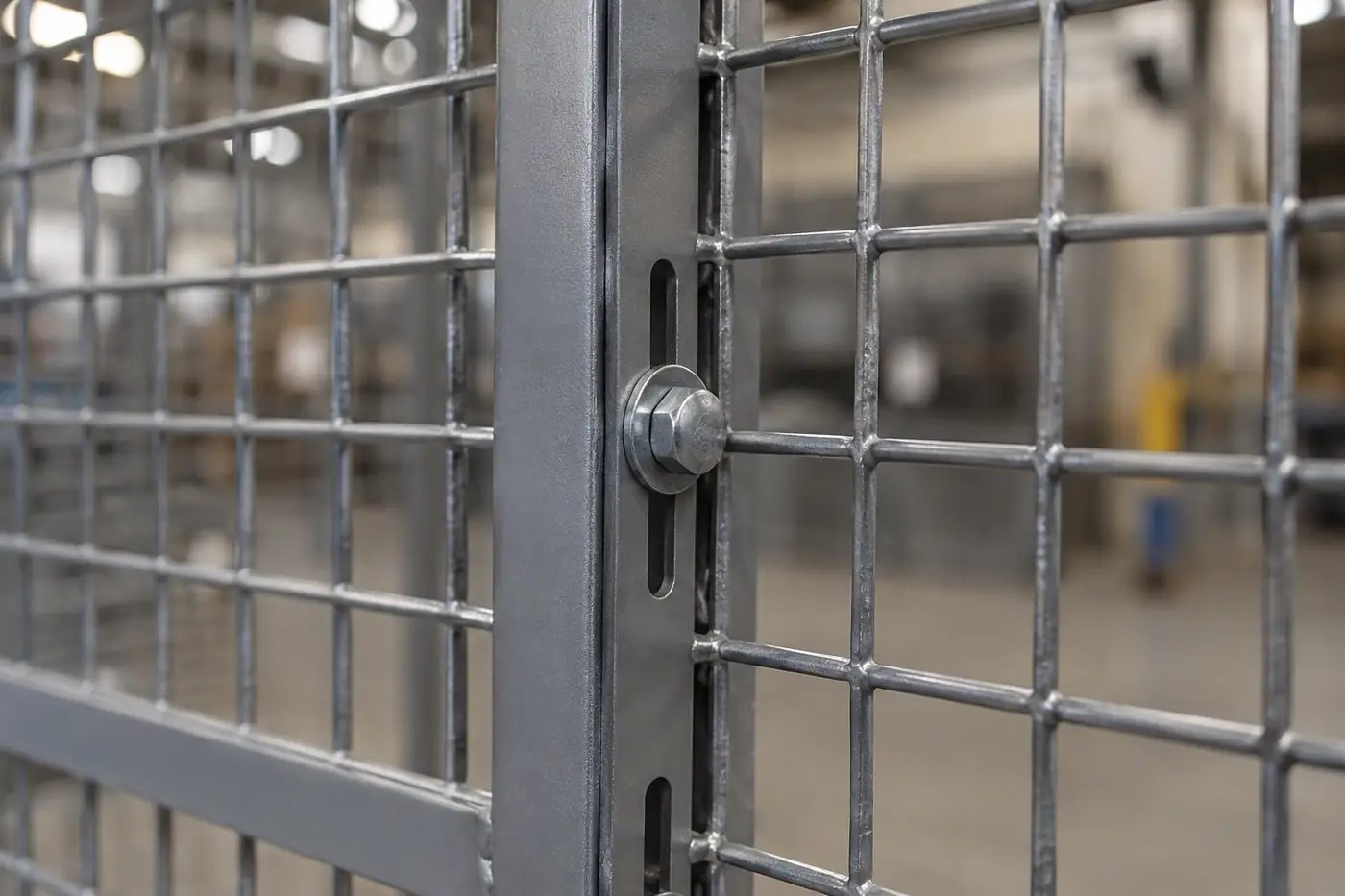
How wire gauge choice works in general. SpaceGuard publishes two standard welded wire options for its mesh lockers and partitions: a standard No. 10 W&M gauge wire (0.130 inch) and a heavy-duty No. 6 W&M gauge wire (0.192 inch), both welded into a 2 inch square mesh. A lower gauge number means a thicker wire. Heavier wire adds rigidity and resistance to bending, and it adds weight and cost. Which one a facility needs depends on what is stored, how much abuse the cage will see and what the buyer’s own requirements say. Our wire mesh panel options page compares mesh types side by side.
The practical lesson: settle the mesh specification before the order is released. A change after production starts means new panels, not a paperwork update.
From federal contract to installed cages
Military buyers judge a supplier on the whole job, not just the product. On this project the work after award mattered as much as the quote.
Respond to the bid
We quoted the solicitation with a priced system that matched the Air Force’s line items for asset cages, the lab cage and installation.
Confirm the specification
After award, we worked through the mesh change and the sliding door placement with the manufacturer before release.
Manufacture and ship
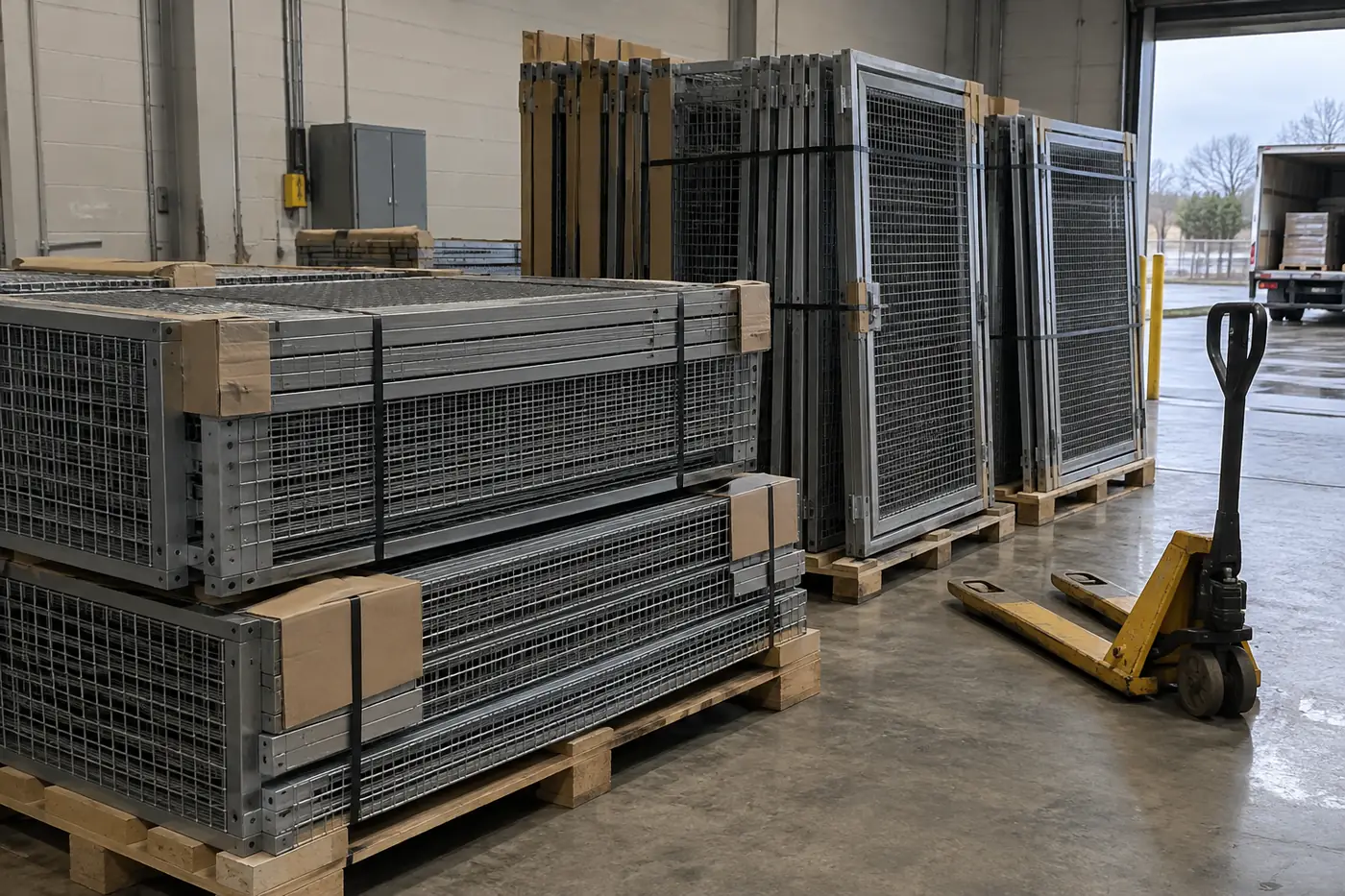
SpaceGuard built the panels, doors, shelves and ceiling in gray powder coat and shipped them to the base.
Deliver to the base
The contract was free on board destination, so delivery to the site was our responsibility through to arrival.
Assemble and install
Our installation partner assembled and set the asset cages and erected the walk-in lab cage in place.
Invoice and close out
With the cages installed and accepted, we submitted the invoice and receiving report through the Defense Department’s electronic system.
Getting paid on a Defense contract
Most Defense Department contracts include the clause DFARS 252.232-7006, which requires payment requests and receiving reports to go through Wide Area WorkFlow (WAWF). A contractor needs a designated electronic business contact in SAM.gov and a WAWF registration, and the document type has to match what the contract specifies. For a supply-and-install job like this one, the receiving report is what tells the government that the goods arrived and the work is done.
For buyers this matters too: a supplier that knows the process closes the contract cleanly, without chasing your finance office for weeks. Our Robins Air Force Base case study covers the bidding and base-delivery side of a military cage project in more depth.
Assembly in a working building
Bolted mesh systems suit occupied buildings because nothing is welded on site. Panels, doors, shelves and ceiling sections arrive flat, are bolted together and anchored to the floor, and the work stays inside the footprint of each cage. Units must be set plumb and level so the doors close and lock properly. Our security cage installation page explains what we plan for on every install.

Lessons for labs and bases planning loss prevention cages
- Mix unit sizes. Individual cages for items owned by a team, and one walk-in cage for shared stock, gives clearer accountability than one big storeroom.
- Specify shelves per cage. Defined places for items make shortages visible, which is most of what stops pilferage.
- Choose the door for the workflow. A wide sliding door suits carts and tight rooms; hinged doors suit individual units.
- Lock in the mesh before release. Decide wire gauge and mesh type during the bid or right after award, not during production.
- Keep the access plan private. Who holds keys, how entry is logged and what is stored where belongs in your own procedures, not in a supplier brochure.
- Pair cages with procedures. Sign-out records, regular counts and a named owner for each cage are what turn a cage into a loss prevention program.
If your problem looks more like accountable property in a contractor facility, see our government contractor accountable property cage case study. For controlled inventory at a federal agency, see the Homeland Security custody cage project, and for a commercial testing lab, our Analytical Resource Laboratories case study. When none of the standard sizes fit your room, start with custom security cages.
Shop Security Cage Kits Online
Pre-configured wire mesh cage kits with sliding or hinged doors, with or without a ceiling, priced online. For individual asset cages, a lab cage sized to your room or a federal bid, request a quote.


Laboratory Loss Prevention Cage FAQs
What is a loss prevention cage?
How do security cages reduce pilferage in a lab?
Should a lab use individual cages or one walk-in cage?
Why choose a sliding door for a lab cage?
Can the wire gauge be changed after a federal contract is awarded?
Does MH-USA install cages on military bases?
Will you publish details of our security setup?
Looking for a project like yours? Browse more pharmaceutical, medical and laboratory security cage case studies, see all security cage case studies.
Planning loss prevention cages for a lab, base or agency?
Tell us what you need to protect and how your team uses it. We will recommend individual cages, a walk-in enclosure or both, quote to your solicitation, and deliver and install nationwide from Salt Lake City.