
Steel Shelving Units — Open & Closed Steel Shelving
All-welded and bolted steel shelving units for parts rooms, stockrooms, tool cribs and archive storage — 39″H and 75″H units, 12″, 18″ and 24″ deep shelves, up to 400 lb per shelf, open or fully closed, starter and add-on bays. We size the run, quote the units and accessories by manufacturer, and coordinate delivery and installation.
Since 1997 · 50 states shipped · sales@mh-usa.com
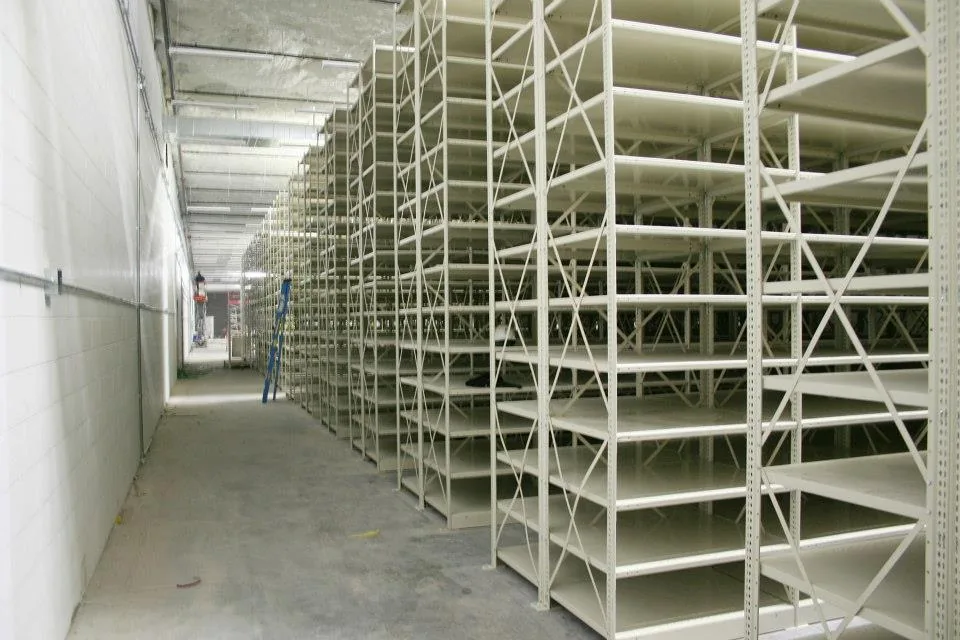
400 lb
per shelf, uniformly distributed, on 22 ga units
22 ga
all-welded steel shelf construction
39″/75″
standard unit heights, 4 to 8 shelf levels
720+
steel and solid shelving SKUs we supply
Shop Steel Shelving Units
Quantum Ironman 22 gauge closed and open steel shelving units and a Lyon 8000 Series open clip shelving starter — real units, priced and shipped knocked down from our online store. For a full run, add-on bays, closed units with doors or bin packages, request a quote and we will price it by manufacturer.
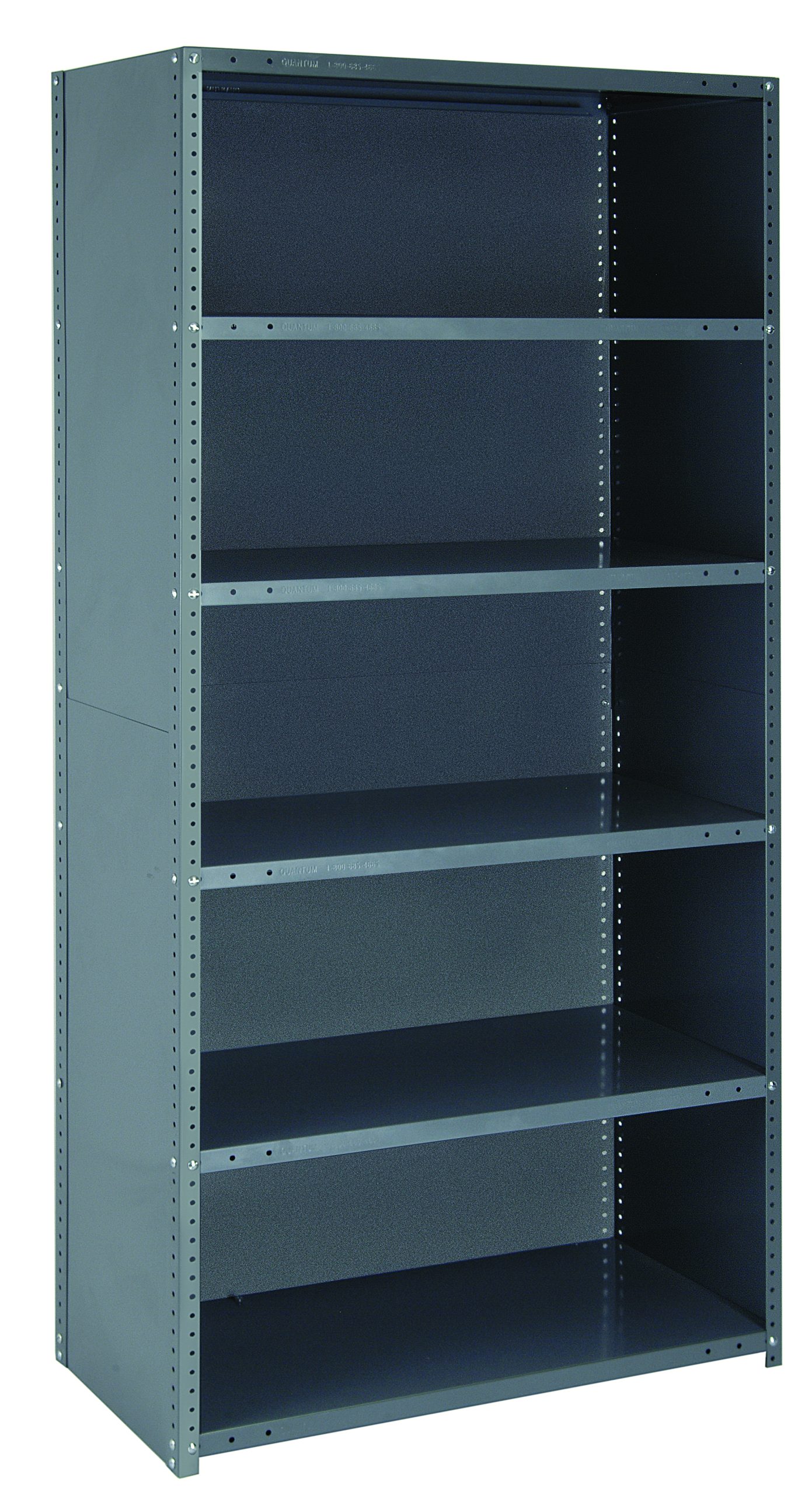


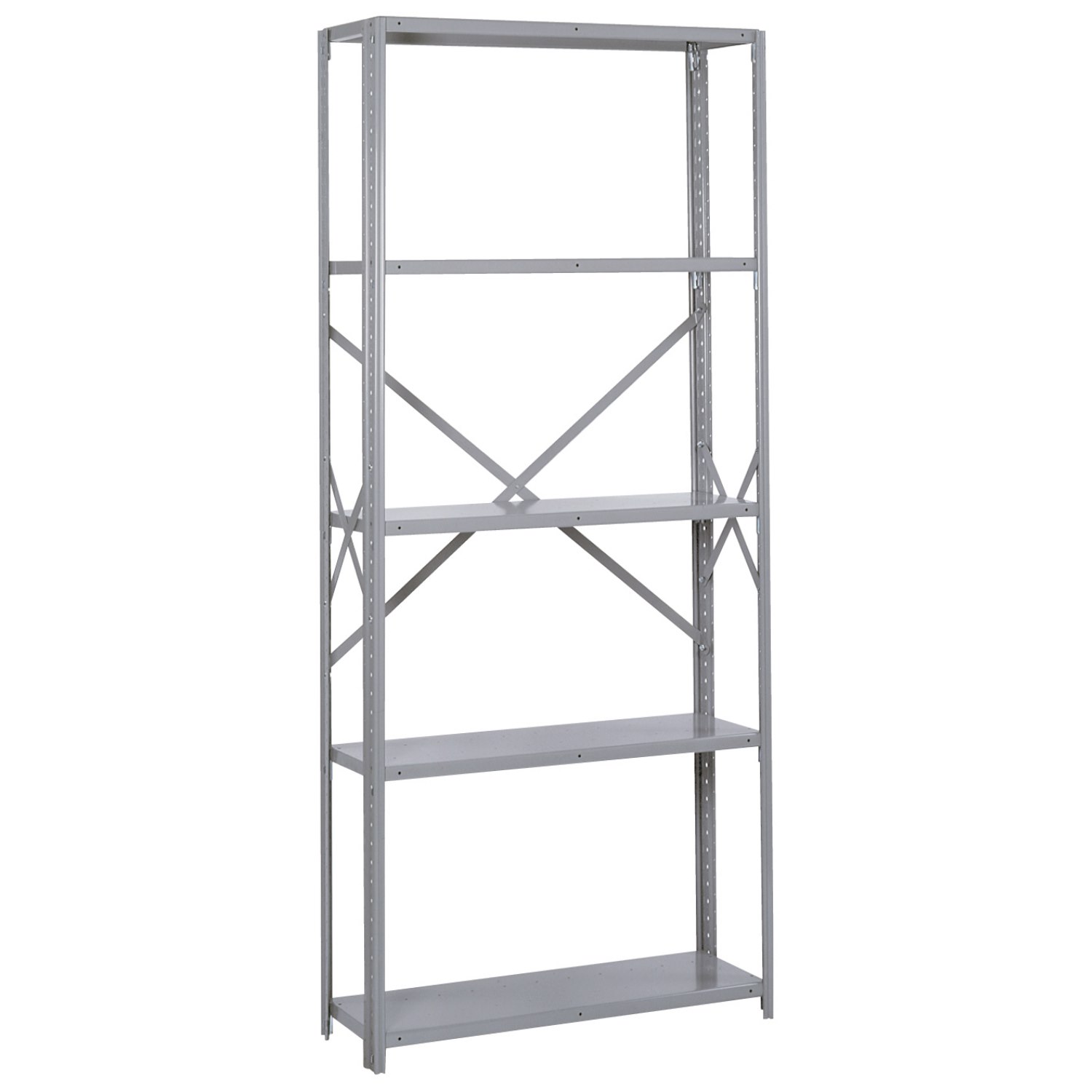
Steel shelving is still the cheapest square foot of organized storage you can buy
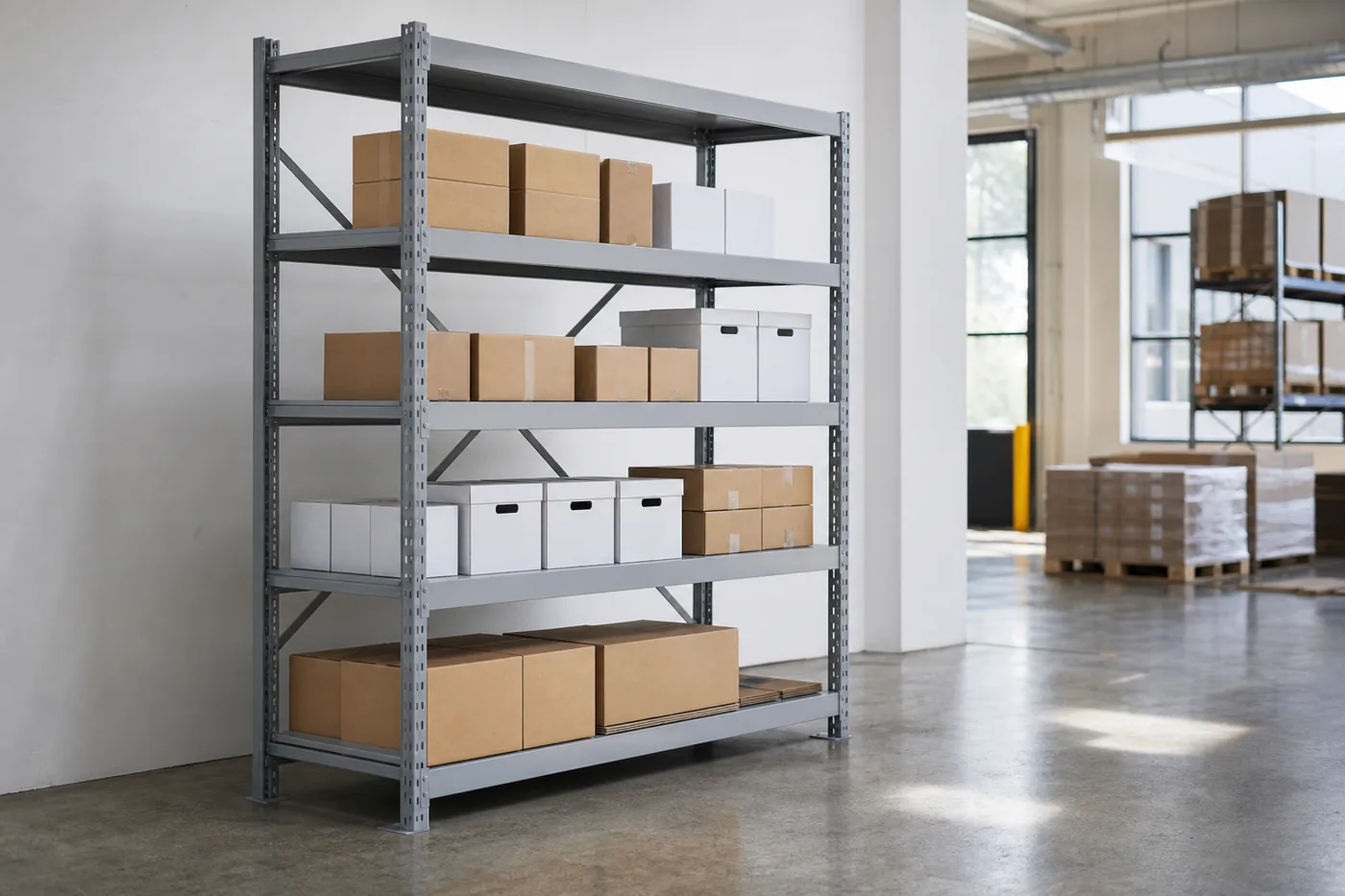
Steel shelving is the workhorse of every stockroom, parts department, maintenance store and records room in North America, and it has stayed that way for one reason: nothing else stores hand-stacked cartons, bins, trays and loose parts at a lower cost per usable cubic foot while surviving twenty years of daily abuse. A steel shelving unit is a set of formed steel shelves carried on four corner posts or welded frames, adjustable in height, open on all four sides or closed in with solid back and side panels. It does not need a forklift, it does not need a permit for a normal single-level installation, and it can be reconfigured by a maintenance tech with a wrench.
Material Handling USA supplies steel shelving from Quantum Storage Systems, Lyon, Penco, Tennsco, Hallowell, Equipto and Borroughs, which means we are not locked into one catalog when your openings, depths or capacities do not fit. We specify the unit, the shelf count, the accessories and the bin fit against your real parts profile, quote it as a complete run rather than a pile of part numbers, and coordinate delivery and installation.
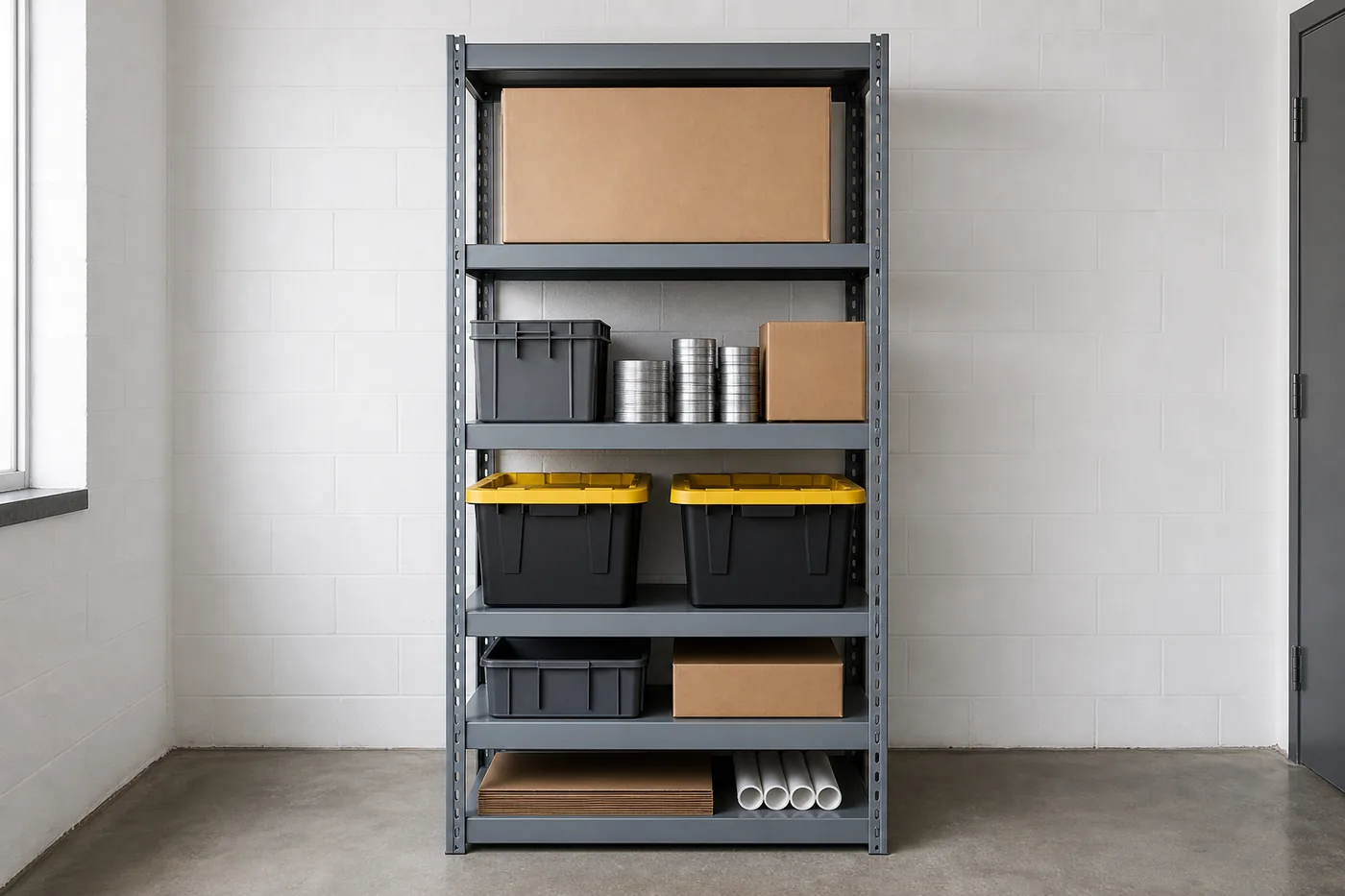
Not sure steel is the right family?
Boltless and rivet shelving have different economics; see boltless shelving. If you are still deciding between steel, boltless, wire and bulk rack, start at industrial shelving.
- Adjustable shelf levels so openings match your carton, tote or bin heights.
- Open or closed — closed panels keep dust off stock and stop items pushing through.
- Up to 400 lb per shelf on the 22 gauge all-welded units we quote most.
- Starter and add-on bays that share posts, so a long run costs less per foot.
- Accepts plastic bins, dividers, drawers and decking instead of being replaced.
- Repairable and reconfigurable — individual shelves and panels are replaceable parts.
Six steel shelving builds, and when each one is the right answer
Most of the shelving questions we get are really one question: which build. The units below all store the same kinds of goods, but they differ in how the stock is protected, how the shelf face is used, and how much handling the unit is expected to absorb. Pick the build first, then size it.
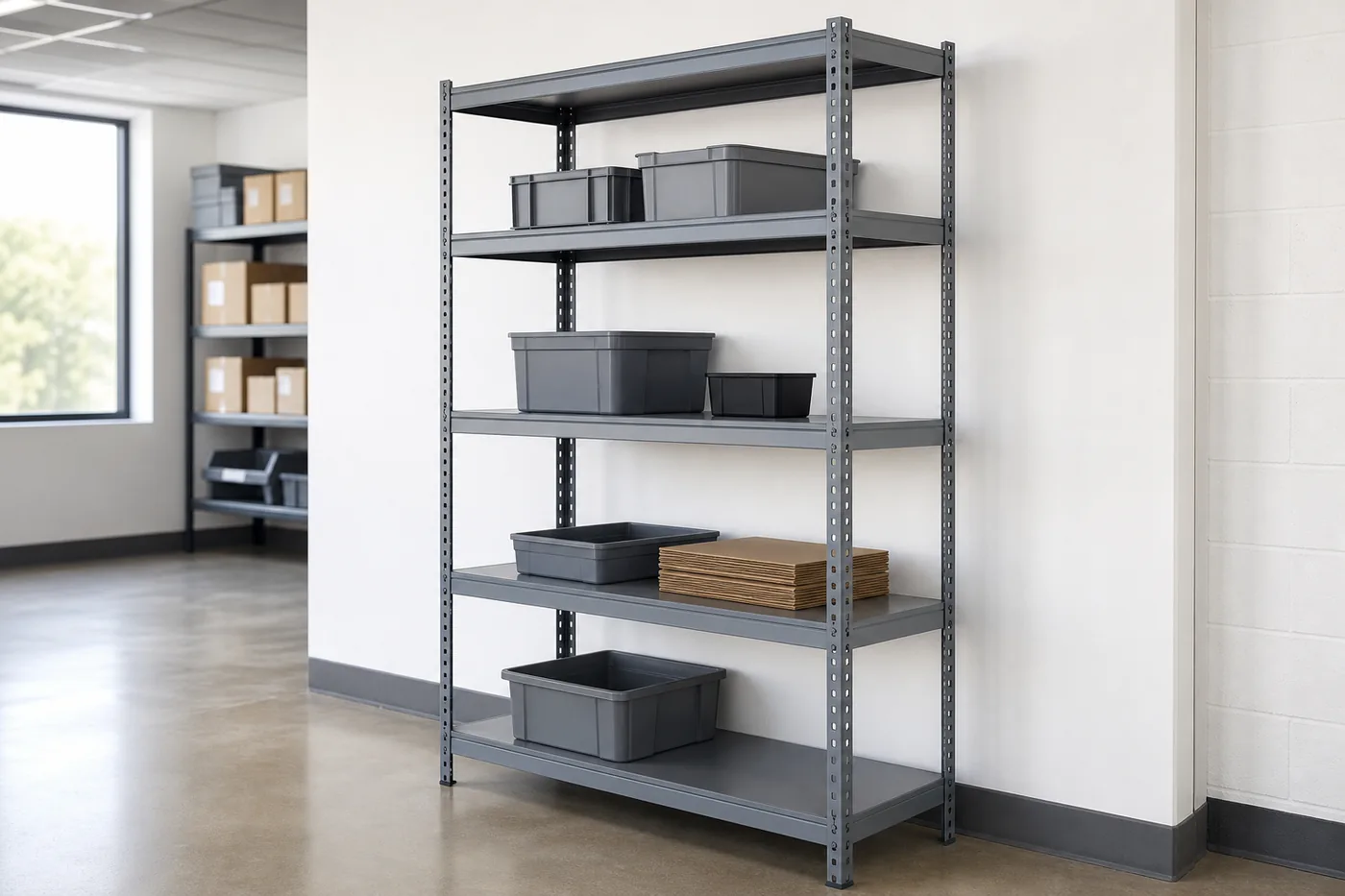
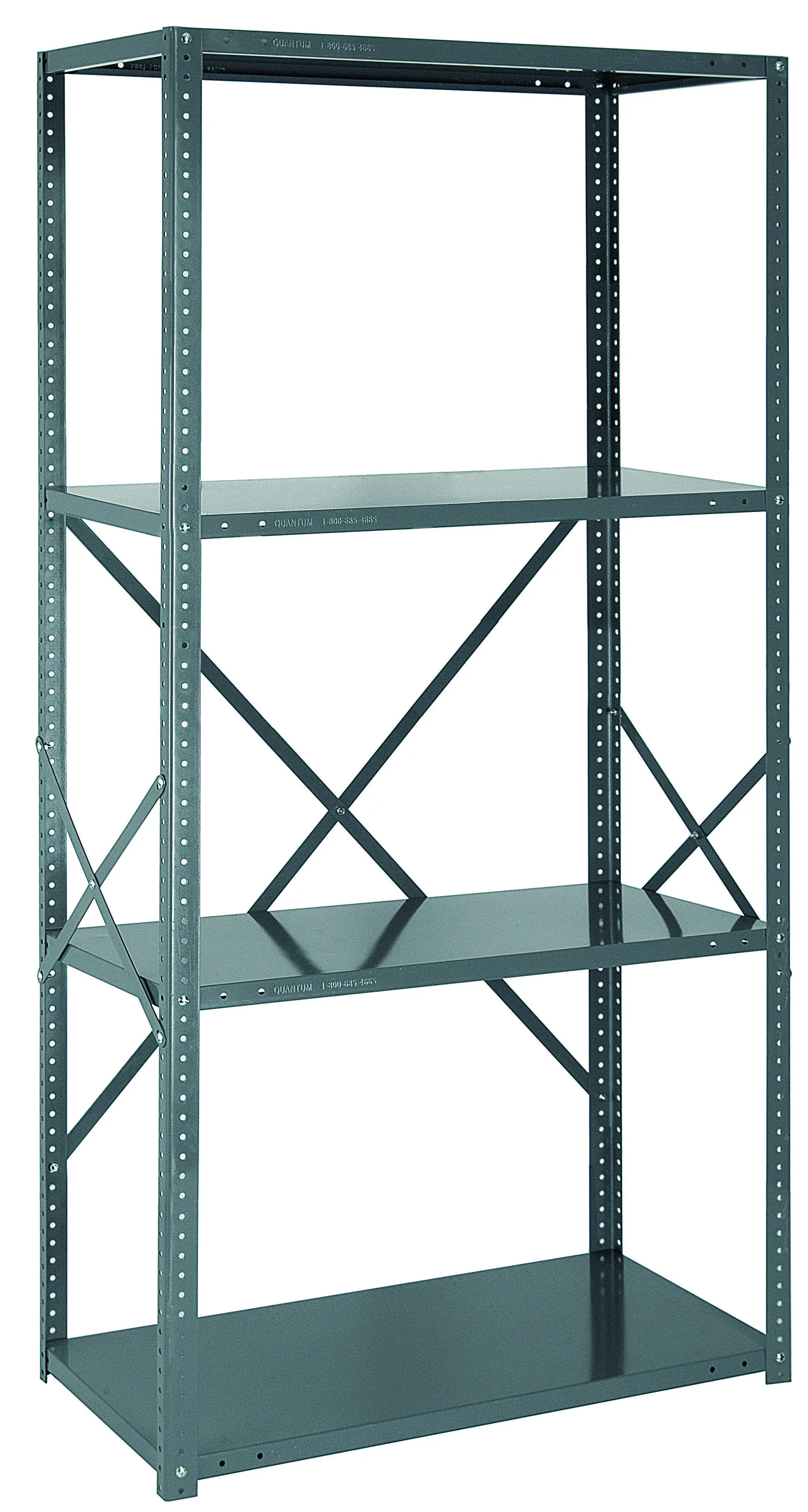 Open Steel Shelving UnitsThe default. Four-post units with adjustable 22 gauge all-welded shelves, open on all sides for two-way picking and maximum light. 39″H and 75″H, 4 to 8 shelf levels, up to 400 lb per shelf.
 Closed Steel Shelving UnitsDust-free and contained. Same shelves and posts, plus solid back and side panels so stock cannot be pushed through to the next aisle and airborne dust stays off it. Ideal against walls and in dirty plant environments.
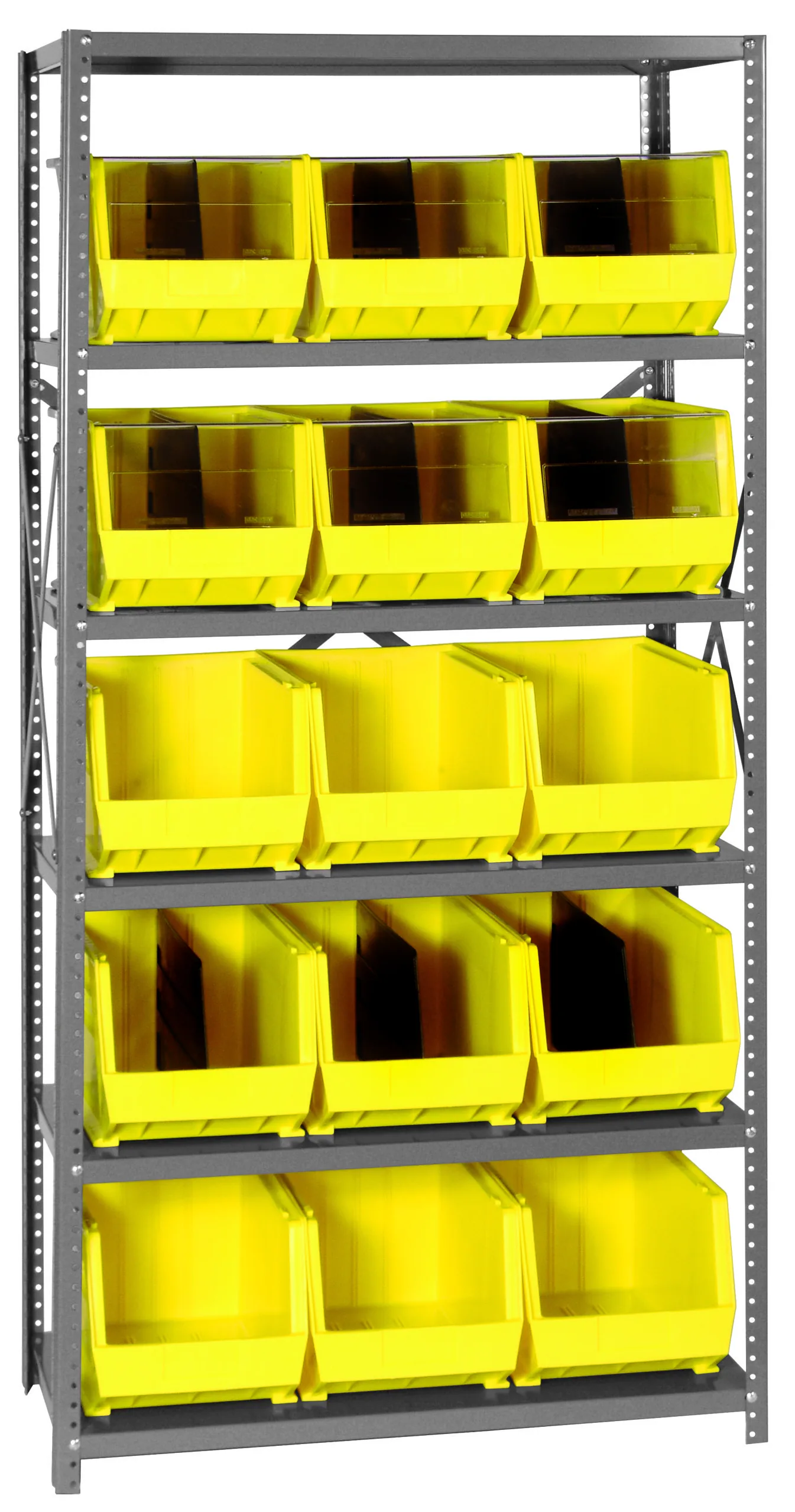 Steel Shelving With Bins (Complete Packages)Small parts, shipped as one unit. Galvanized steel units supplied complete with giant open-hopper bins — 12″D and 18″D packages, 6 to 10 shelves, bins in one color per unit. Windows and dividers optional.
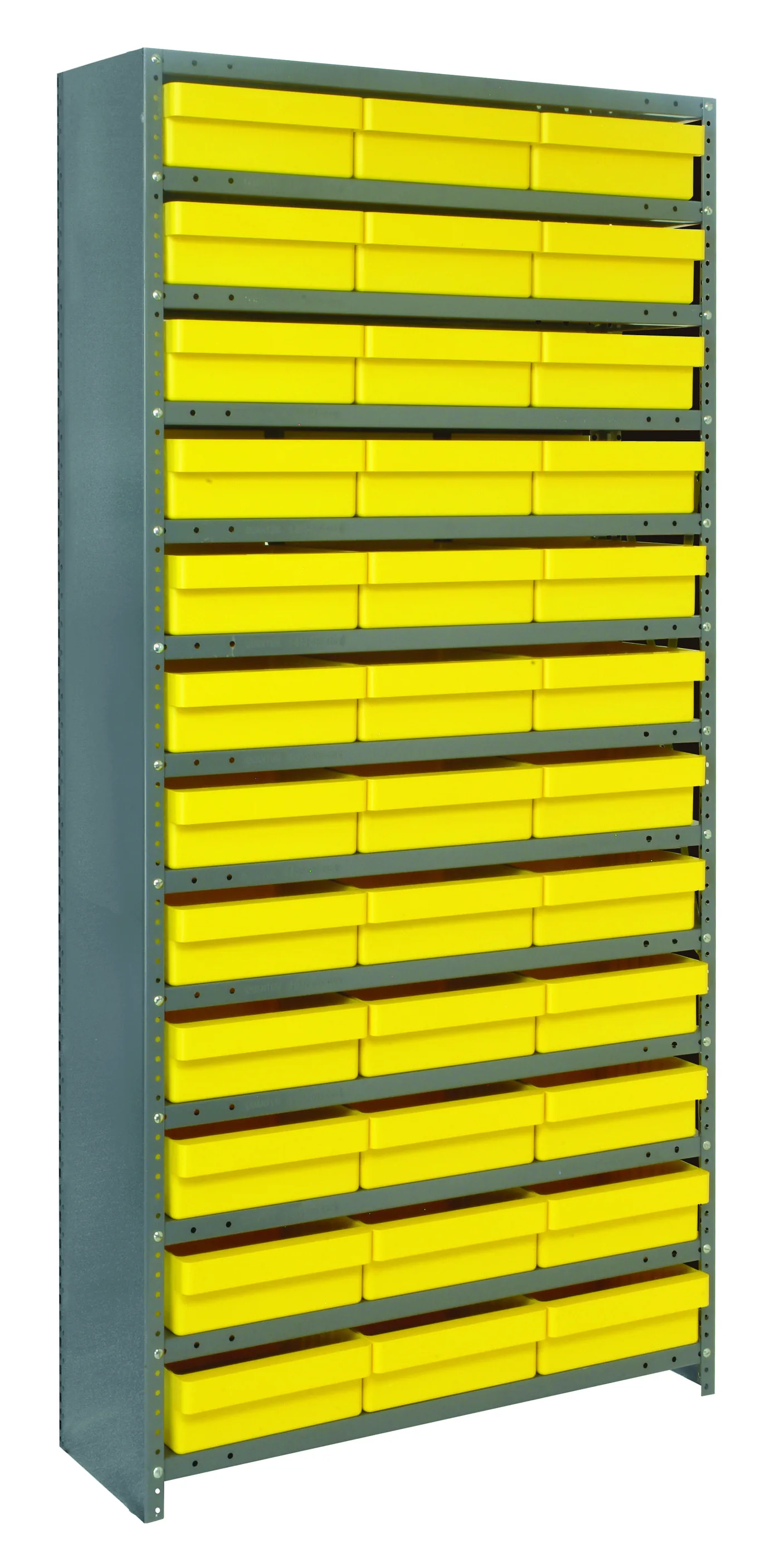 Closed Bin Shelving UnitsBin storage that stays clean. Closed-back and closed-side units pre-loaded with shelf bins or hopper bins for parts rooms where dust, cross-aisle spill and loose parts are a problem. Sized in our bin shelving section.
 Enclosed & Secured BaysControlled stock inside an open run. Individual bays closed in with solid or mesh panels and lockable doors, so consumables stay open-access while high-value or regulated items are locked, without a separate cabinet.
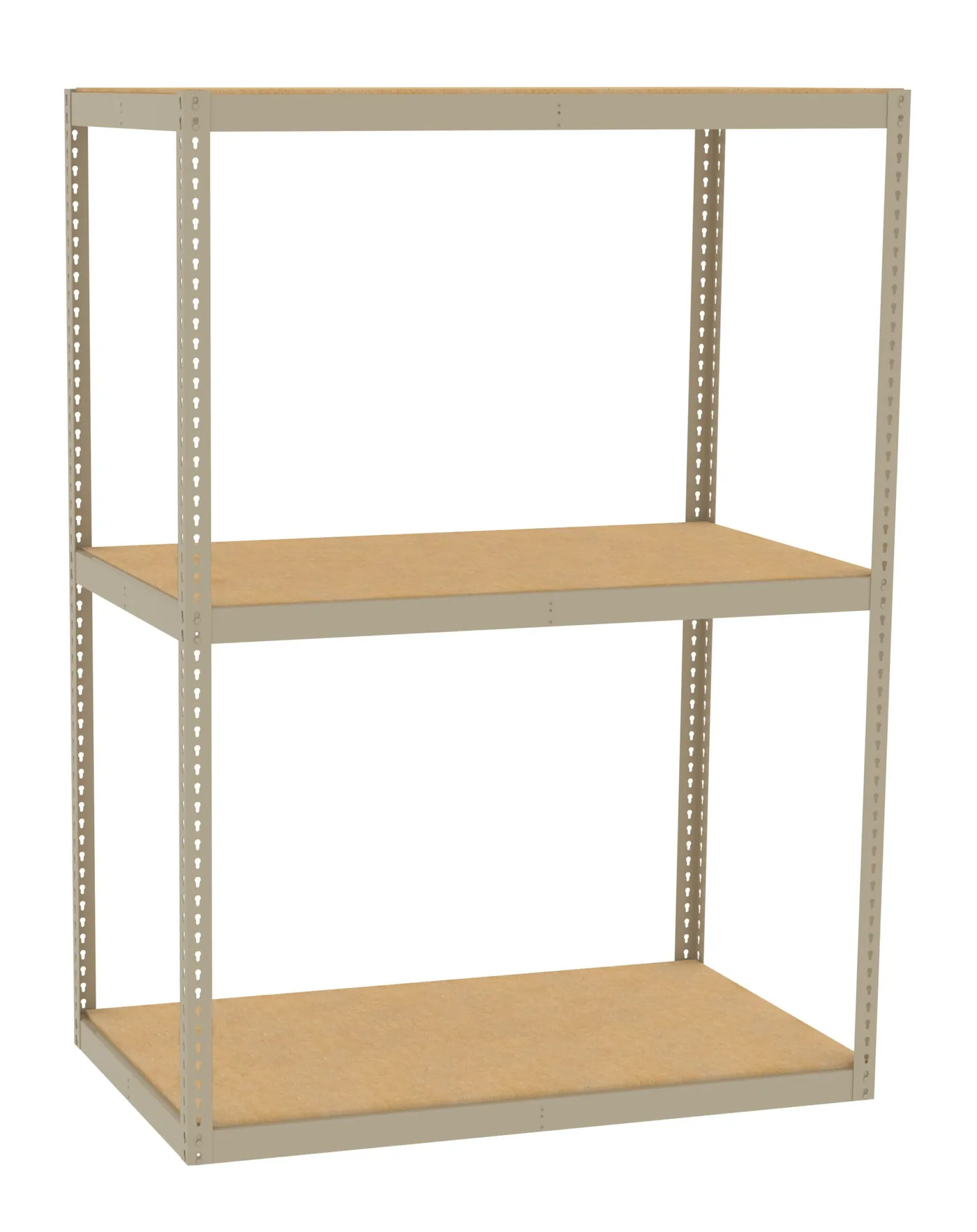 Wide-Span & Decked Shelving for BulkWhen cartons get big. Wider bays with wood or wire decking for bulky, awkward and hand-stacked items — territory we quote from the boltless, bulk rack and wide span shelving families when the load or span outgrows a steel shelf pan.
Open vs closed steel shelving: the decision in one table
Open and closed units use the same shelves, the same posts and the same capacities. What changes is the panelling, the ship weight and the price per bay. A closed 75″H unit with 18″ deep shelves ships around 47 lb heavier than the equivalent open unit — that steel is the back and side panels, and it is doing real work in the right environment. Choosing the wrong one is a common and expensive mistake: closed panels in a two-sided pick aisle waste money and block access, while open units against a plant wall let dust settle on stock and let small parts drop behind the run.
A practical middle path exists and is often the right answer: run open units through the middle of the room and closed units around the perimeter, sharing the same shelf part numbers so spares and future add-ons interchange. If only certain items need containment, add back panels to selected bays rather than buying closed units throughout — see accessories below.

| Consideration | Open steel shelving | Closed steel shelving |
|---|---|---|
| Access | All four sides; ideal for two-way pick aisles and island runs | Front only; suits wall runs and perimeter storage |
| Dust and debris | Stock is exposed to airborne dust and plant debris | Solid back and side panels keep the bulk of it off stock |
| Cross-aisle spill | Items can be pushed through to the aisle behind | Panels stop push-through and hold loose parts in place |
| Appearance | Utilitarian; contents visible from every angle | Tidier, more finished look in customer-facing rooms |
| Light and sprinkler flow | Best airflow and light penetration through the run | Reduced airflow; plan sprinkler coverage with your fire contractor |
| Ship weight (18″ × 36″, 75″H, 6 shelves) | 89 lb | 136 lb |
| Best for | Active parts picking, tool cribs, kitting, WIP staging | Archive and records storage, dirty plants, retail backrooms |
Knock-down steel shelving: starter units, add-on bays and how a run is priced
Industrial steel shelving ships knocked down — flat-packed posts, shelves, panels and hardware — and is assembled on site. That is what keeps freight sane on a 40-bay order, and it is why the two words you will see on every quote are starter and add-on.
A starter unit is free-standing with its own four posts (or two welded end frames). An add-on unit shares a pair of posts with the unit beside it, so a continuous run of ten bays needs eleven post pairs instead of twenty. Add-ons cost less per bay and stiffen the whole run, but they only work in a straight line — so we lay the room out before splitting the order into starters and add-ons, and a corner or a column always starts a new starter.
Assembly is basic hand tools: clip shelving (Lyon 8000 Series, Penco Clipper, Tennsco Q Line) hooks compression clips into slotted posts with no fasteners on the shelf; bolted units (Quantum Ironman, Lyon 2000 Series closed) use four nuts and bolts per shelf. Either way a damaged shelf is a spare part, not the end of the unit. For full rooms, tall runs and anchored installations we quote assembly with the shelving.

Unit heights, shelf sizes and shelf counts
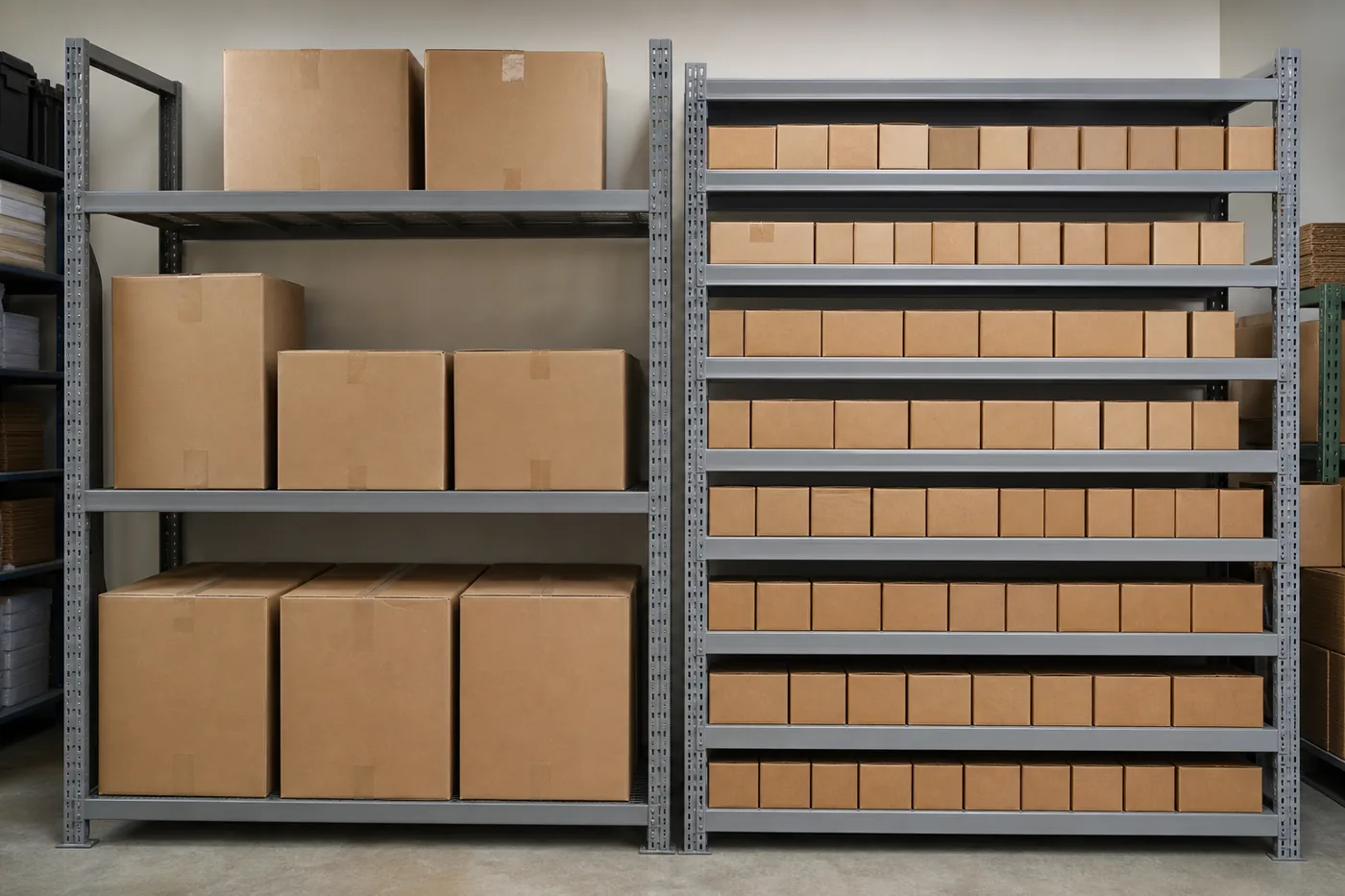
Steel shelving is specified in three numbers: shelf depth, shelf length and unit height — then a shelf count. The 22 gauge all-welded units we supply most often come in two heights, 39″H for counter-height and under-mezzanine runs, and 75″H where the ceiling and reach allow it. Shelf sizes are 12″ × 36″, 18″ × 36″ and 18″ × 42″, and complete bin and heavy-duty units also come 24″ deep. Shelf counts run 4, 5 or 6 levels at 39″H and 4 through 8 levels at 75″H, which is how you tune the opening height to what you actually store. Clip shelving lines from Lyon, Penco and Tennsco extend the range to 84″, 87″ and 97″ posts and 48″ widths.
Ship weights matter more than people expect. They tell you how much steel is in the unit, they drive freight cost on a multi-bay order, and on an upper-floor or mezzanine installation they are the number your structural engineer asks for first. They are also the honest way to compare two quotes: a “heavy-duty” unit that ships 20% lighter than ours is not the same product.
| Unit height | Shelf sizes (D × W) | Shelf counts | Open unit ship weight | Closed unit ship weight |
|---|---|---|---|---|
| 39″H | 12″ × 36″ | 4, 5 or 6 shelves | 45–61 lb | 71–87 lb |
| 39″H | 18″ × 36″ | 4, 5 or 6 shelves | 63–87 lb | 94–118 lb |
| 39″H | 18″ × 42″ | 4, 5 or 6 shelves | 75–91 lb | — |
| 75″H | 12″ × 36″ | 4 to 8 shelves | 55–87 lb | 90–124 lb |
| 75″H | 18″ × 36″ | 4 to 8 shelves | 69–109 lb | 115–156 lb |
| 75″H | 18″ × 42″ | 4 to 8 shelves | 85–125 lb | — |
Rule of thumb we use on site
Set the lowest shelf at 4–6″ off the floor so a mop and a pallet-jack wheel can pass, keep the golden zone between 30″ and 55″ for your fastest-moving SKUs, and leave the top level for slow-moving or overstock. If you are still adding shelves after the unit is installed, buy the extra shelf levels with the original order — they are the cheapest capacity you will ever add.
What “22 gauge all-welded” actually buys you
The shelves in the Quantum Ironman units we quote most are 22 gauge all-welded steel with a smooth powder coat finish, and each shelf assembles to the posts with four nuts and bolts. That specification does three things. The welded box construction stops the shelf pan flexing and spreading under a distributed load, so a shelf still sits flat after years of loading. The powder coat is smooth and easy to wipe down, and it does not shed the way painted mill finishes do. And the bolted shelf-to-post connection means a damaged shelf is a spare part, not the end of the unit.
Post design is the other half of the unit. Slotted or punched posts on close centres let you move shelf levels in small increments instead of coarse jumps, which is what makes it possible to match openings to real carton heights. Corner posts also carry the vertical load path down to the floor, so post condition, plumb and floor contact are what you inspect when a run starts to feel loose. Heavier 20 and 18 gauge shelves, and reinforcing channels under wide shelves, are how the clip-shelving lines reach 600–800 lb ratings.

 Closely Slotted PostsSmall adjustment increments mean openings match carton and tote heights instead of wasting 2–3″ of clear height per level.
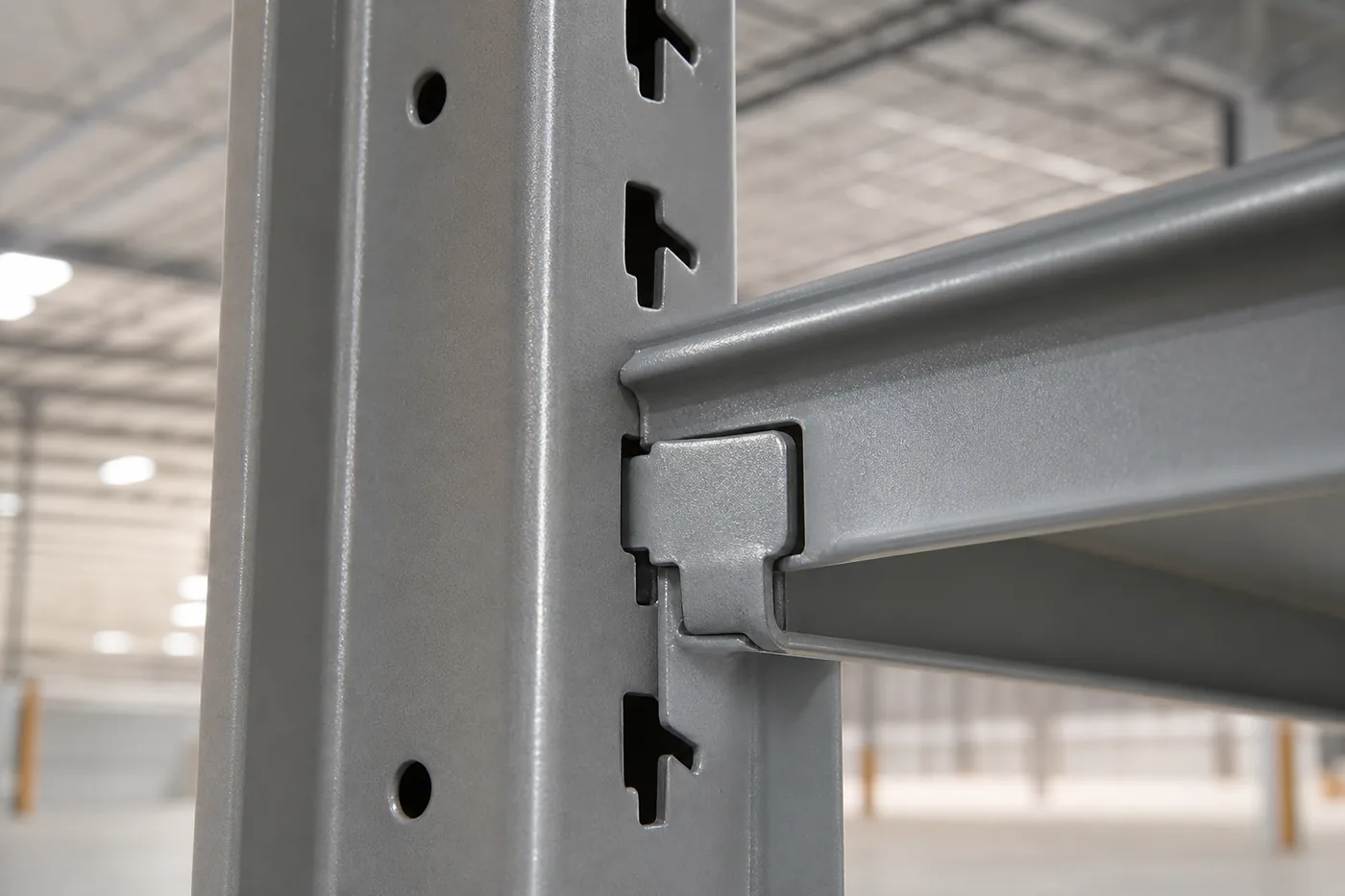 Positive Shelf EngagementBolted or clipped shelf-to-post engagement transfers load into the post and keeps the shelf square under uneven loading.
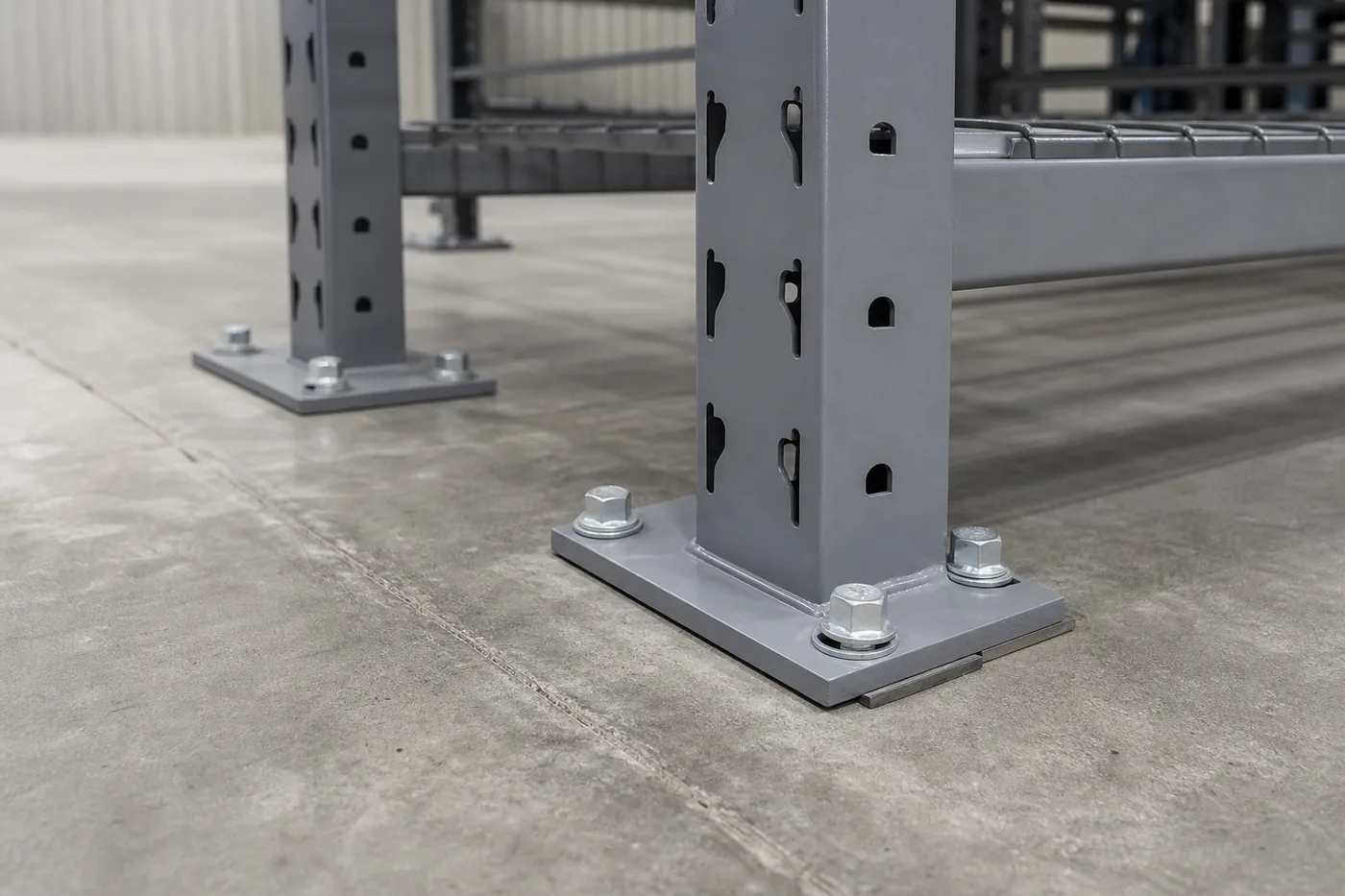 Anchoring & LevellingTall runs, seismic regions and any unit over roughly 4:1 height-to-depth get anchored and shimmed. We plan anchors with your facility team; your local authority sets the requirement.
| Specification | What we supply | Why it matters |
|---|---|---|
| Shelf material | 22 gauge all-welded steel shelf pans (20/18 ga on heavy-duty clip series) | Resists flexing and spreading under distributed load |
| Finish | Smooth powder coat; galvanized on bin units | Wipes clean, resists chipping, no rust bloom from bare edges |
| Shelf assembly | Four nuts and bolts per shelf, or compression clips | Individual shelves are replaceable and repositionable |
| Adjustability | Multiple slot positions per post (1″–1½″ increments) | Openings tuned to carton, tote and bin heights |
| Capacity | Up to 400 lb per shelf standard, uniformly distributed; 600–800 lb heavy-duty | Covers hand-stacked cartons, bins and most loose parts |
| Bays | Starter units plus shared-post add-on units | Long runs cost less per linear foot than free-standing units |
Load capacity: the number everyone quotes and almost nobody applies correctly
Published shelf capacity — up to 400 lb per shelf on the units we quote most — is a uniformly distributed load. It assumes the weight is spread evenly across the shelf pan, not concentrated in the middle or on one corner. A 350 lb transmission case in the centre of a 400 lb shelf is not a 350 lb load in engineering terms, and that is exactly how shelves get bent. Five practical rules follow from this, and they cover almost every failure we get called out to look at.
- Spread the load. Distribute across the full shelf width; put point loads on a shelf rated well above the item weight, or on decking designed for it.
- Heavy low, light high. Loading a run top-heavy is the most common cause of a unit feeling unstable, and it makes every pick more dangerous.
- Do not sum shelf capacities into a unit capacity. Eight shelves at 400 lb is not an automatic 3,200 lb unit — total unit capacity depends on post, frame and floor loading. Ask us for the unit figure before you plan a heavy installation.
- Check the floor, not just the shelving. Upper floors, mezzanines and older slabs have their own limits; your structural engineer or the building owner sets those.
- Inspect after any impact. A post struck by a pallet jack has lost capacity even if it still looks straight. Replace damaged posts and shelves rather than derating by eye.
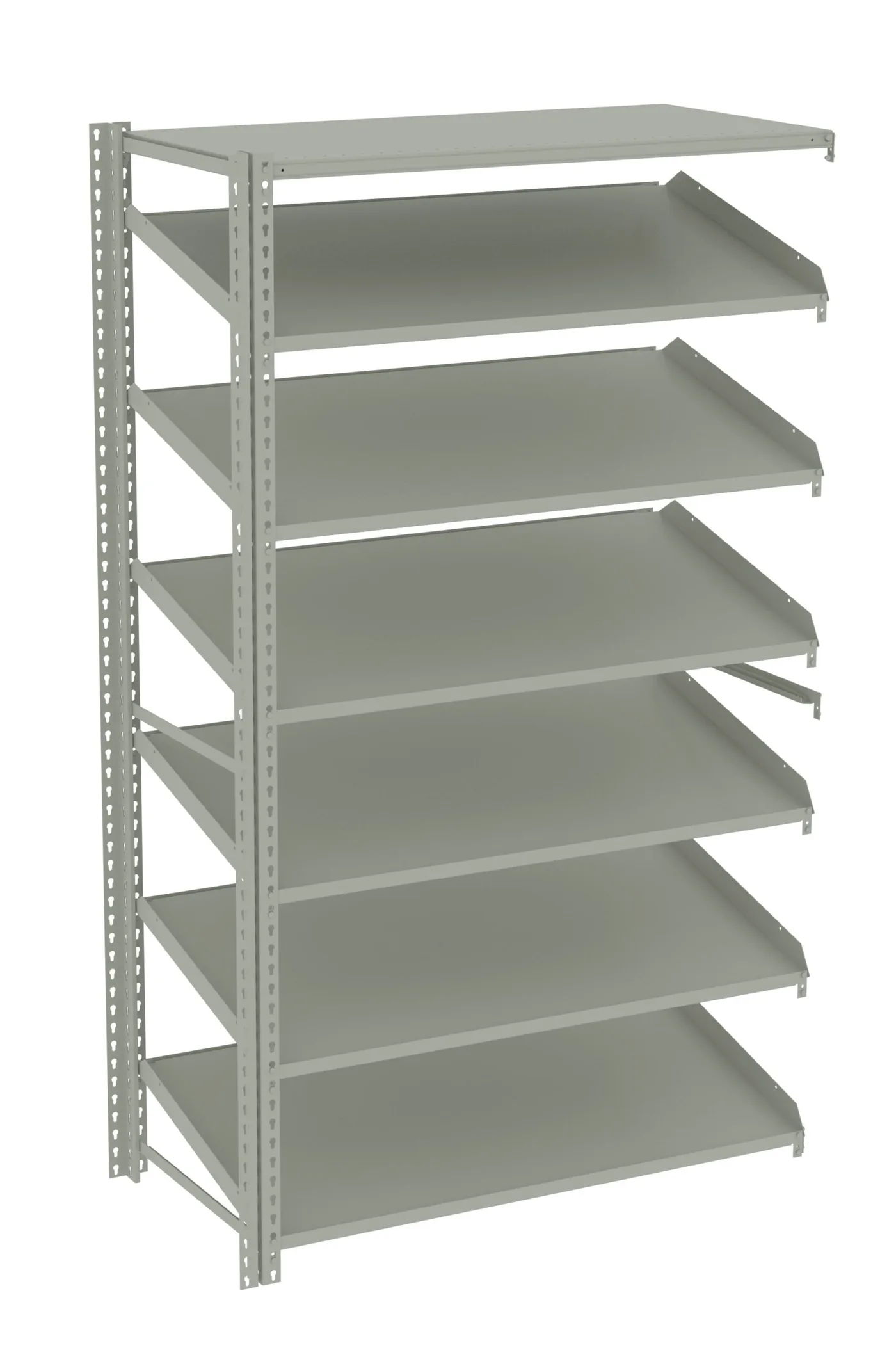
What we will not do
We will not tell you a shelving installation “meets code”. Anchoring, seismic bracing, aisle widths, sprinkler clearance and permitting are set by your local authority having jurisdiction, your insurer and your engineer of record. What we do is supply units with published capacities, build the run to the criteria your team provides, and document exactly what was installed.
Accessories that change what a steel shelving run can do
The reason steel shelving stays in service for decades is that the unit is a platform. Almost every storage problem that shows up after installation — small parts getting lost, stock pushing through, tools walking off, no work surface at the pick face — is solved by an accessory rather than a new unit. These are the ones we quote most often.
 Shelf DividersTurn one wide shelf into 3–8 addressable compartments. The cheapest way to stop small parts migrating and to make a location label mean something.
 Back & Side PanelsAdd containment to selected bays of an open run instead of buying closed units throughout. Also stiffens a tall unit noticeably.
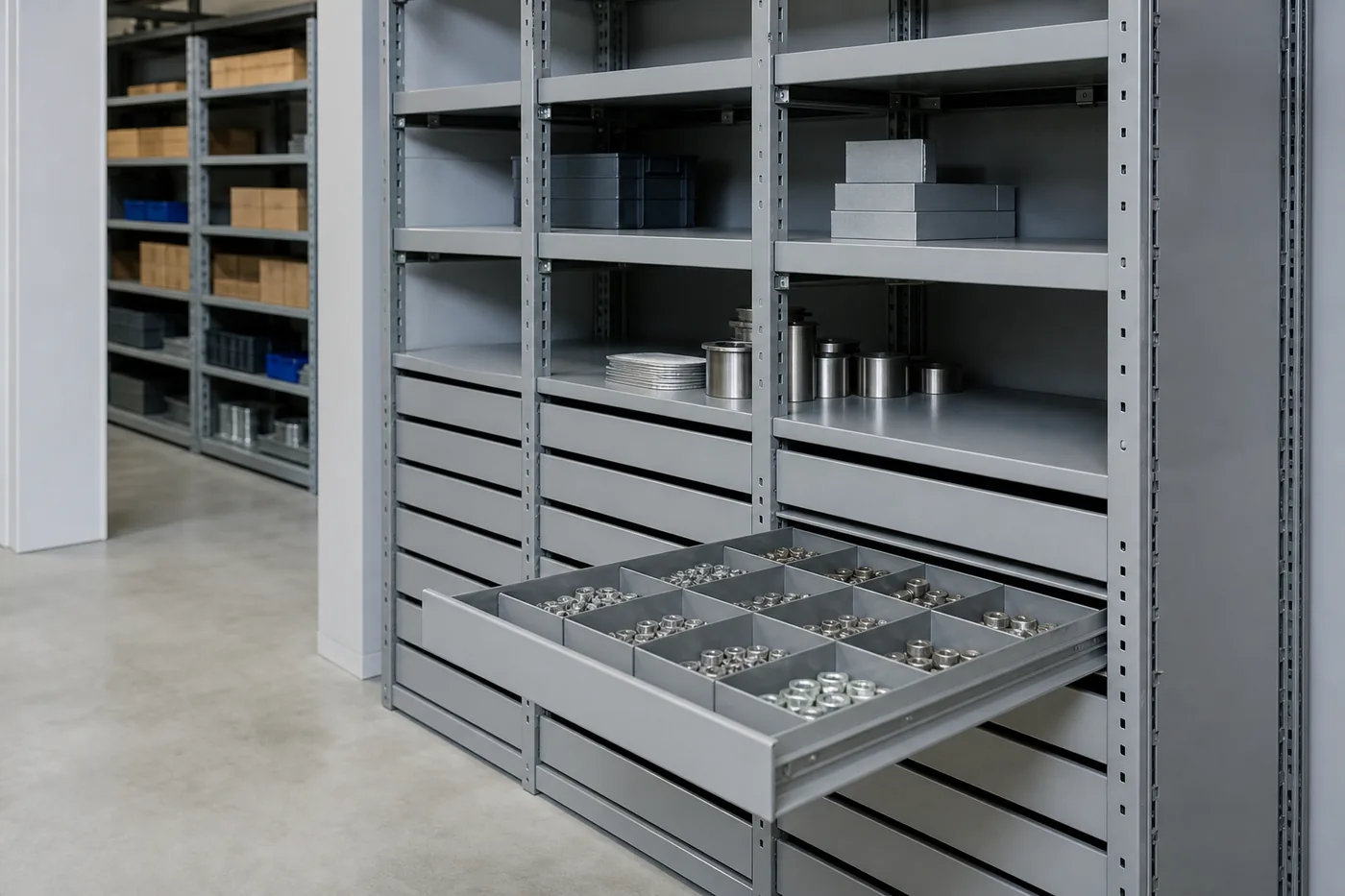 Drawer ModulesConvert one or two openings into shallow drawers for high-count small parts, tooling and inserts — drawer density inside a shelving footprint.
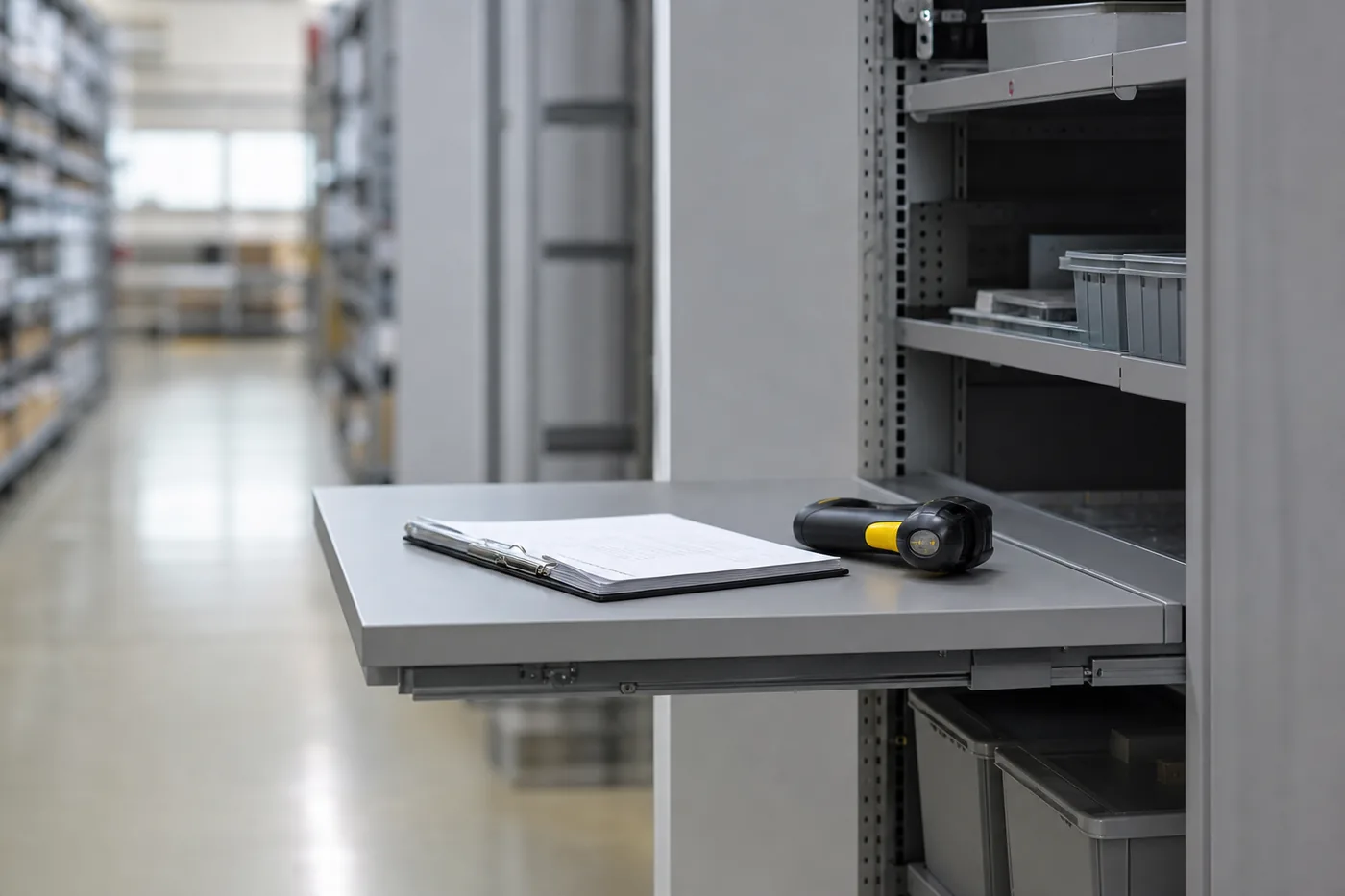 Pull-Out Reference ShelvesA work surface exactly where the picking happens: kitting, counting, labelling and paperwork without walking to a bench.
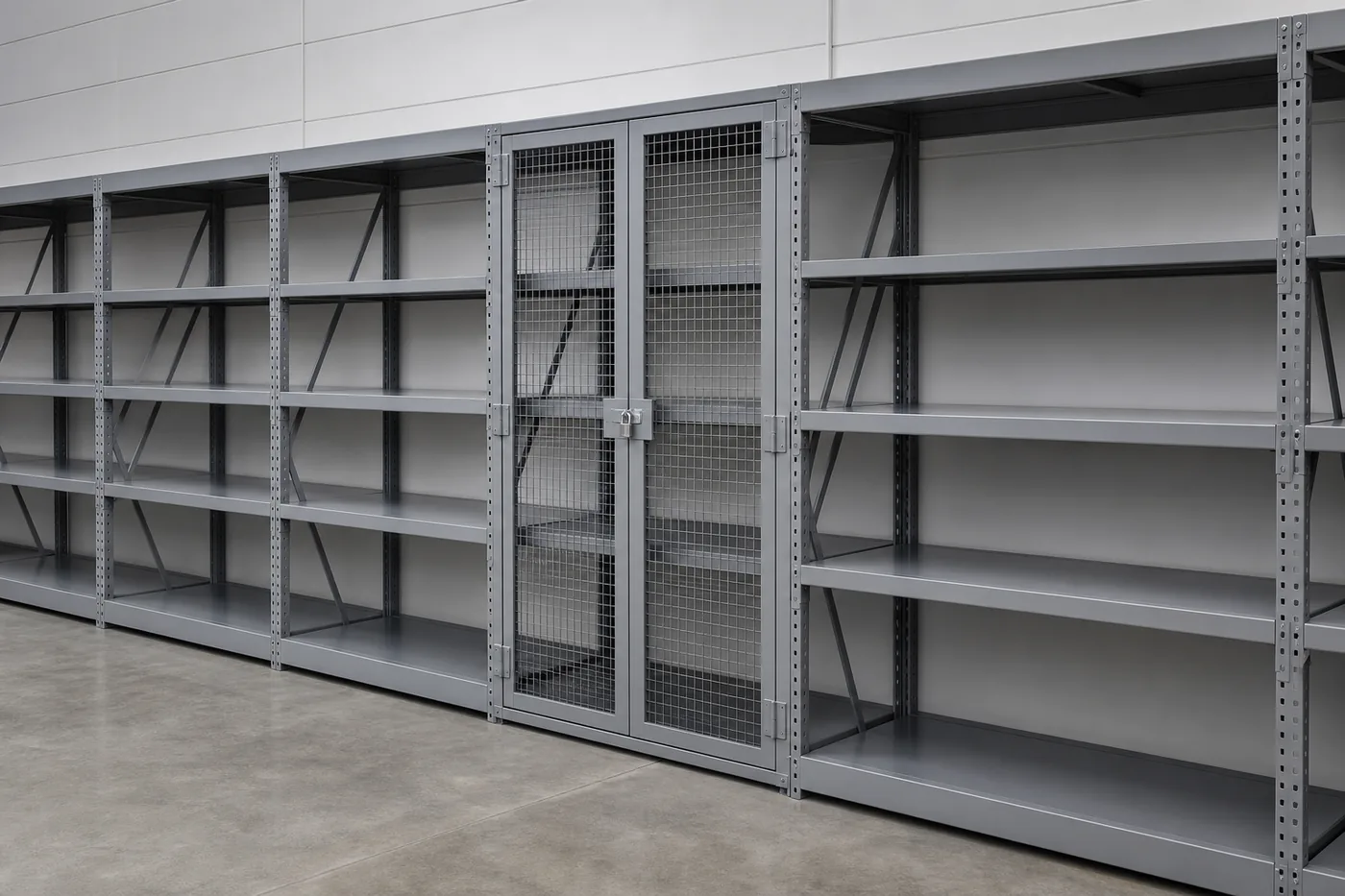 Security Panels & DoorsLock one bay of an open run for high-value, controlled or consumable theft items. Mesh keeps visibility; solid panels do not.
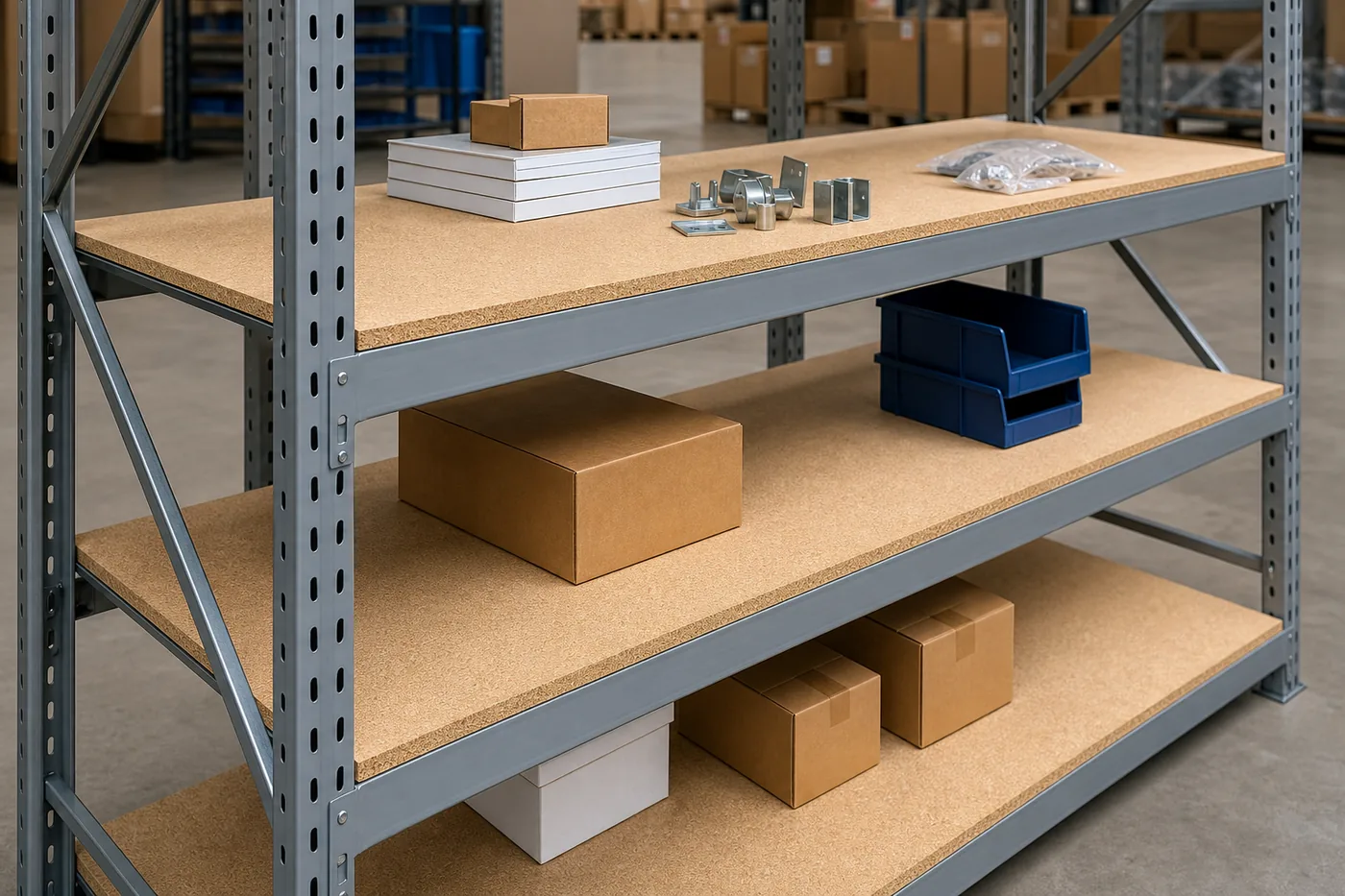 Decking & Bulk LevelsWood or wire decking on wider bays for bulky, awkward and hand-stacked items. Wire decking also lets sprinkler water and light through.
Buy accessories with the units
Extra shelf levels, dividers, panels and label holders bought with the original order arrive on the same freight and in the same finish batch. Bought a year later they cost more per piece, arrive separately, and occasionally do not match the finish. When we quote a run we list them as separate lines so you can decide with the numbers in front of you. Shelf clips, dividers, foot plates and sway braces for Lyon 2000 and 8000 Series units are also stocked individually in our online shelving store. For matching replacement parts to your posts, see our guide to steel shelving clips and dividers.
Steel shelving supplied complete with plastic bins
For small-parts storage the fastest specification is not a unit plus a bin list — it is a complete package where the bin count, bin size and shelf spacing were worked out for you. The galvanized steel bin packages we supply come in 12″ deep and 18″ deep builds on a 36″W × 75″H unit with up to 400 lb per shelf, loaded with giant open-hopper bins in a single color per unit. Optional clear window fronts increase usable bin volume and stop spillage; optional dividers split each bin into compartments.
| Package depth | Typical build | Bin sizes supplied | Best for |
|---|---|---|---|
| 12″ deep | 10 shelves with 36 small hopper bins plus 12 medium bins | 10-7/8″ × 5-1/2″ × 5″ and 14-3/4″ × 8-1/4″ × 7″ | Mixed fastener and small component rooms |
| 12″ deep | 8 shelves with 28 medium hopper bins | 10-3/4″ × 8-1/4″ × 7″ or 14-3/4″ × 8-1/4″ × 7″ | Dealership and MRO parts with mid-size items |
| 12″ deep | 8 shelves with 14 wide hopper bins | 14-3/4″ × 16-1/2″ × 7″ | Bulkier parts kept at the pick face |
| 18″ deep | 8 shelves with 21 large bins | 16″ × 11″ × 8″ | Assembly feed and kitting components |
| 18″ deep | 7 shelves with 24 deep bins | 18″ × 8-1/4″ × 9″ | Long, narrow parts and sub-assemblies |
| 18″ deep | 6 shelves with 15 tall bins | 18″ × 11″ × 10″ | High-volume consumables |
| 18″ deep | 6 shelves with 10 extra-large bins | 18″ × 16-1/2″ × 11″ | Large parts that still need a hopper front |
 Six-shelf 18″ deep package, large binsBlack hopper bins on a galvanized 75″H unit; the everyday kitting and assembly-feed build.
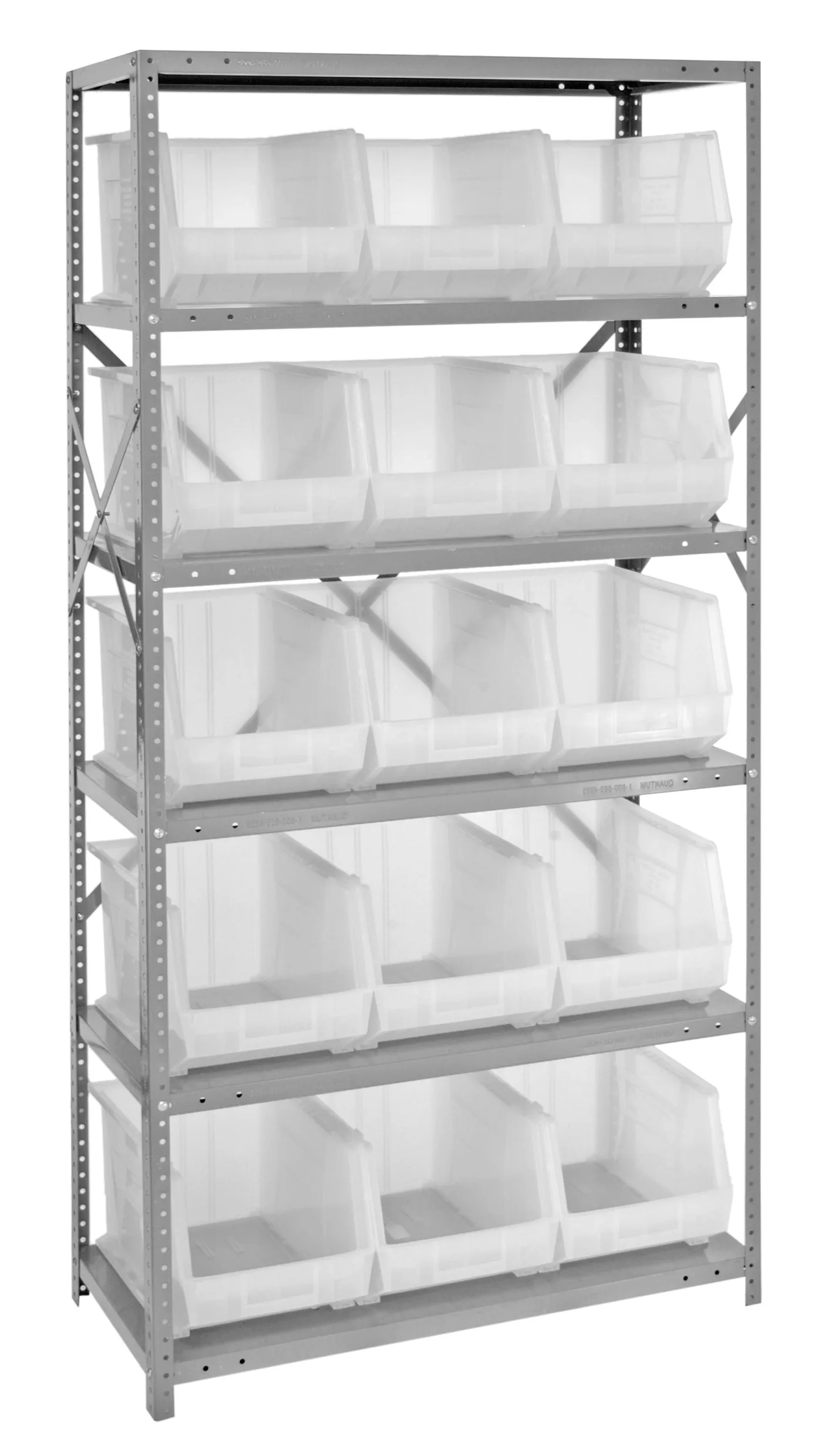 Clear-bin package for visual stock checksSee the fill level without pulling the bin — the pick for consumables and par-level rooms.
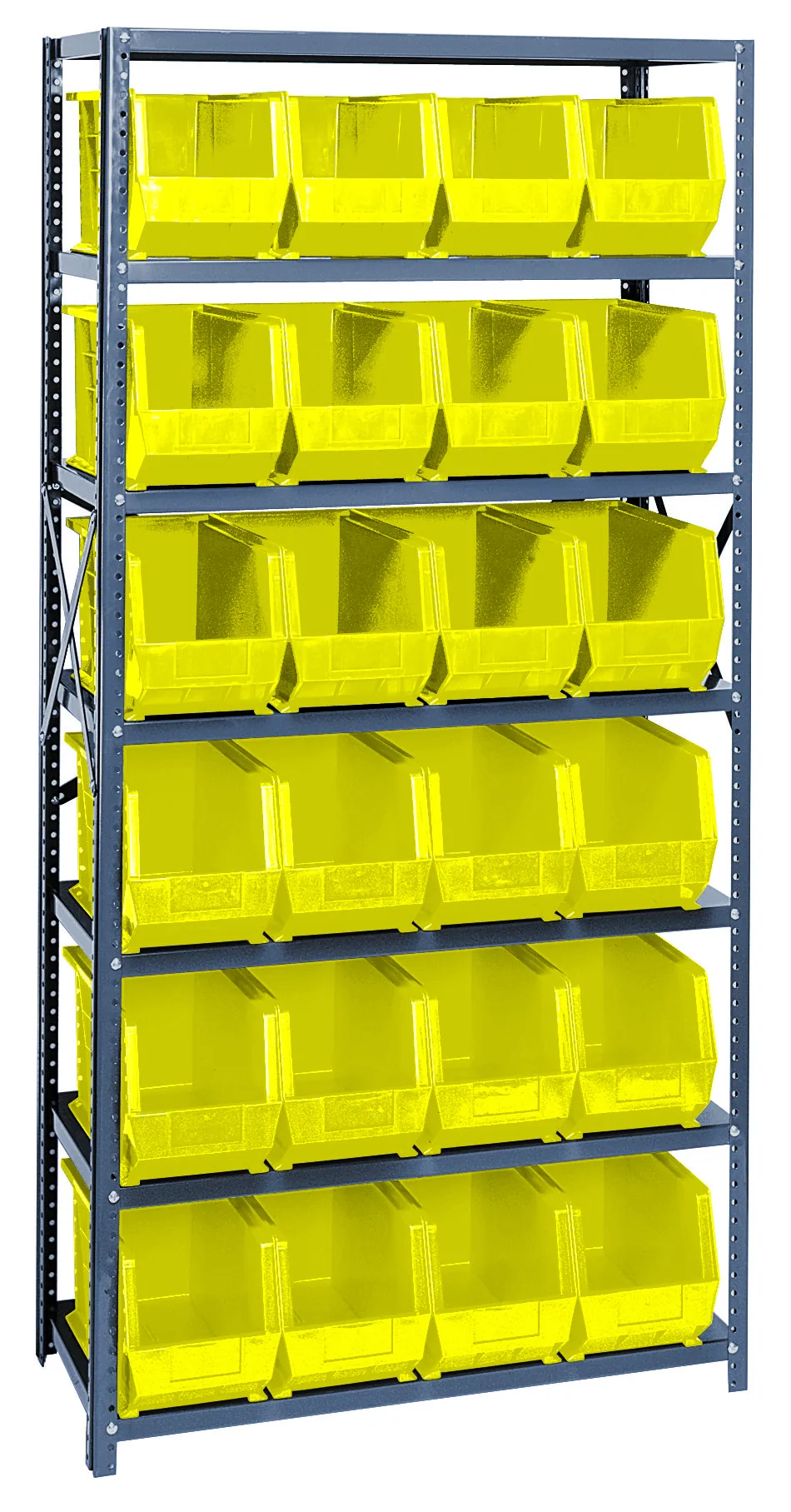 Seven-shelf package with deep binsDeep narrow bins for long parts and sub-assemblies.
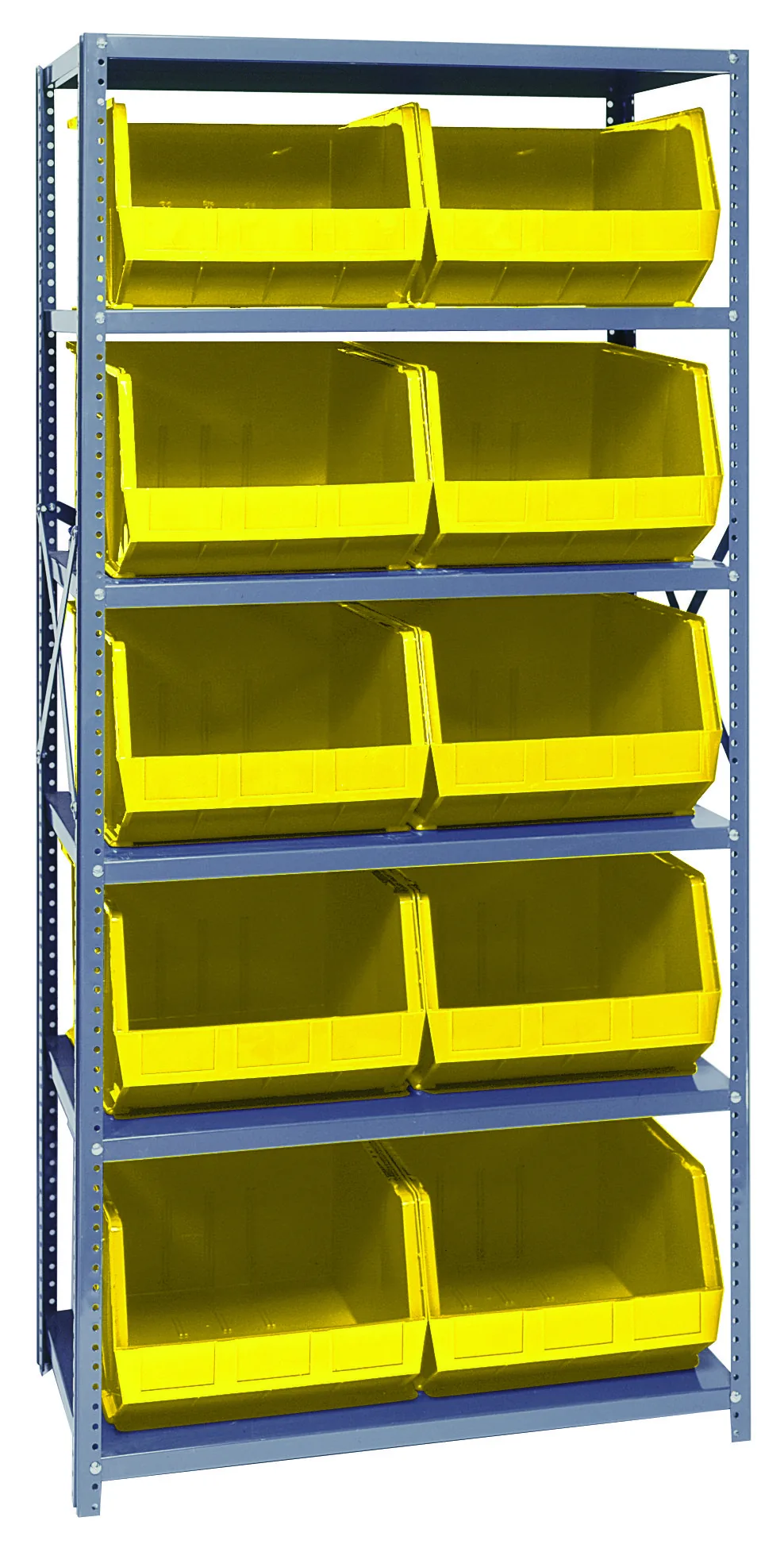 Six-shelf package with extra-large binsExtra-large hopper bins for bulky parts that still need a hopper front.
If bins are the point of the project rather than a bolt-on, start in the dedicated sections: bin shelving systems covers complete wire and steel bin units and sloped pick racks, industrial storage bins is the hub for the bins themselves — including plastic shelf bins in 4″, 6″ and 8″ front heights that drop straight onto a 12″, 18″ or 24″ deep steel shelf.
Steel shelving vs the alternatives
Steel shelving is the right answer more often than not, but not always. This is the comparison we walk through before quoting, and where each alternative genuinely wins.
| System | Best at | Watch out for | Where it lives on our site |
|---|---|---|---|
| Steel shelving (this page) | Hand-stacked cartons, bins, trays, archive boxes; fine shelf adjustment; closed options | Not for palletised loads; shelf spans are modest | You are here |
| Wire shelving | Airflow, visibility, wash-down and mobile applications; sprinkler-friendly | Small items need mats or bins; costs more per shelf | Wire shelving |
| Boltless / rivet shelving | Bulk cartons and wide bays with decking; fast assembly with no fasteners | Coarser shelf adjustment; decking adds thickness per level | Boltless shelving |
| Bin shelving systems | Small-parts rooms where the bins are the storage medium | Bin fit drives the whole design; get it wrong and capacity is lost | Bin shelving |
| Stainless steel shelving | Corrosive, wet and wash-down areas that must be cleaned aggressively | Significant cost premium; specify only where needed | Stainless shelving |
| High-density mobile shelving | Doubling capacity in a fixed room by removing fixed aisles | Needs track, floor tolerance and a single-user access pattern | Mobile shelving hub |
| Pallet racking | Palletised, forklift-handled loads | Wrong tool for hand-stacked small goods; aisle widths grow | Pallet rack |
New vs used steel shelving
Used steel shelving can look like the budget option, but the savings are usually used up at installation: parts rarely fit well after disassembly, and installer time spent straightening bent posts and fitting mismatched shelves costs more than new. Reusing shelving you already own can work, yet new is sometimes still cheaper once that fix-up time is counted. Send our sales team a few pictures of what you have and we will tell you which way makes sense.
Two related pages are worth a look if you are still narrowing the field: metal shelving covers the broader metal shelving family in buyer language, and industrial shelving compares steel, boltless, wire, bulk rack and bin shelving side by side from a whole-facility point of view. For polymer and wire shelving in food and clean environments, and for anything going into a clinical setting, our sister company covers healthcare and laboratory storage at Labs USA.
Where steel shelving earns its keep
Six industrial and commercial applications we specify steel shelving for every month, and what changes in the specification for each one.
 Supply Depots & Distribution Pick FacesThroughput first. Open units, mixed openings, fast movers at waist height and clear location labelling. Add dividers where one shelf carries several SKUs. Distribution shelving →
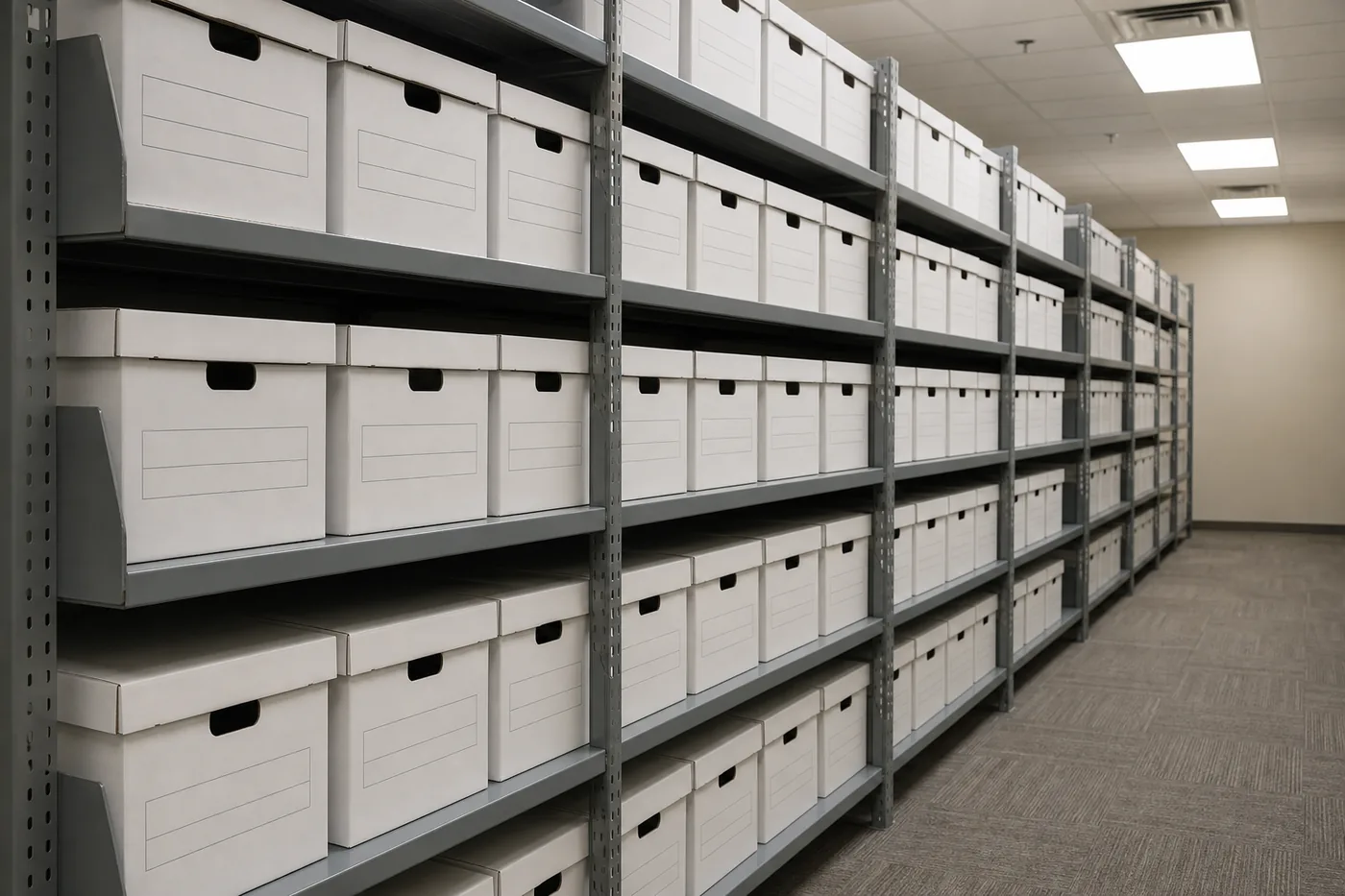 Records & Archive StorageUniform boxes, uniform openings. Closed or open runs sized exactly to the carton so no clear height is wasted, with the run depth matched to a single or double box row. Records storage →
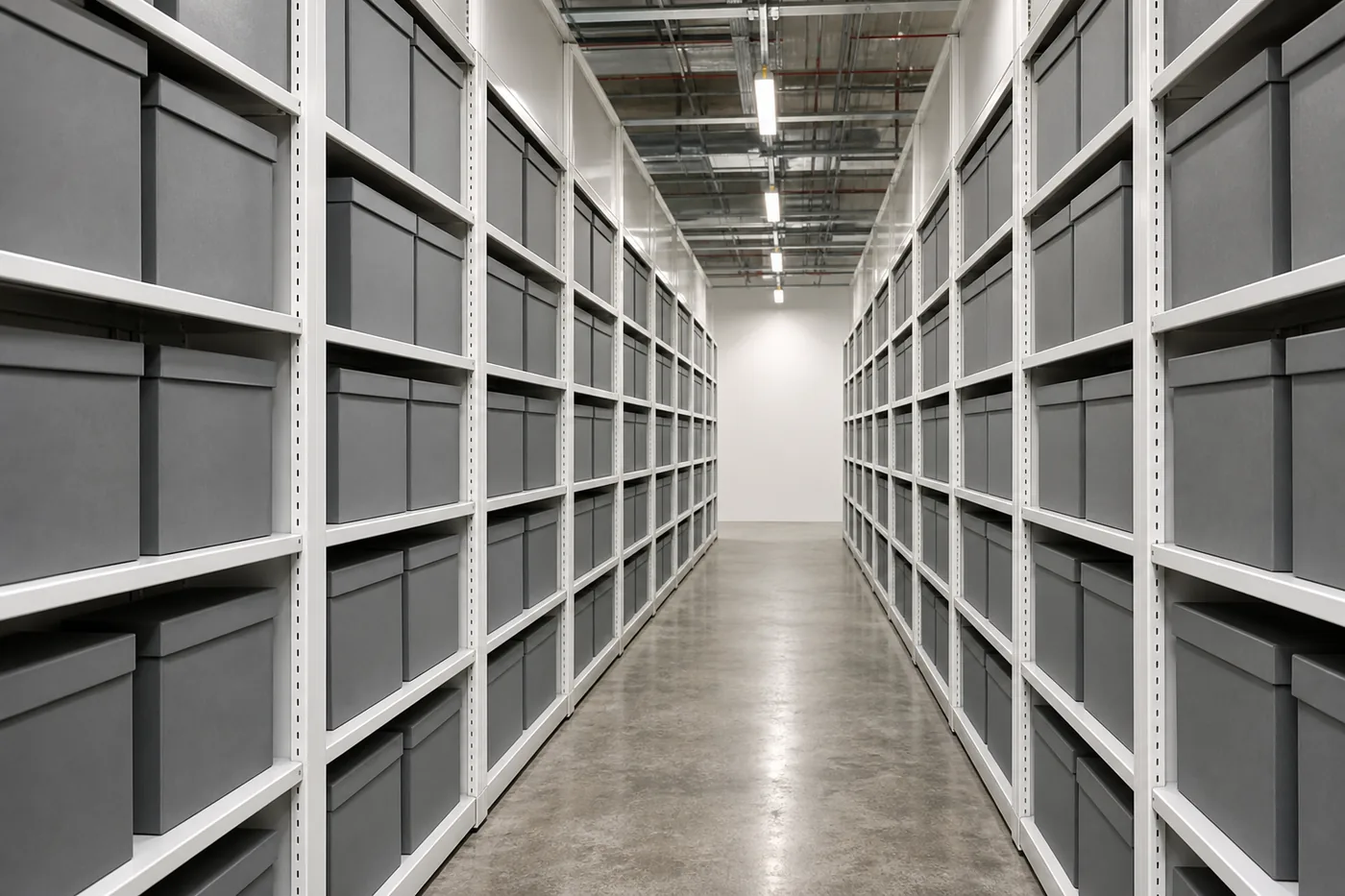 Corporate & Government Back-of-HouseTidy, contained, repeatable. Closed-back ranges keep the aisle looking finished and stop boxes being pushed through into the next range. Government storage →
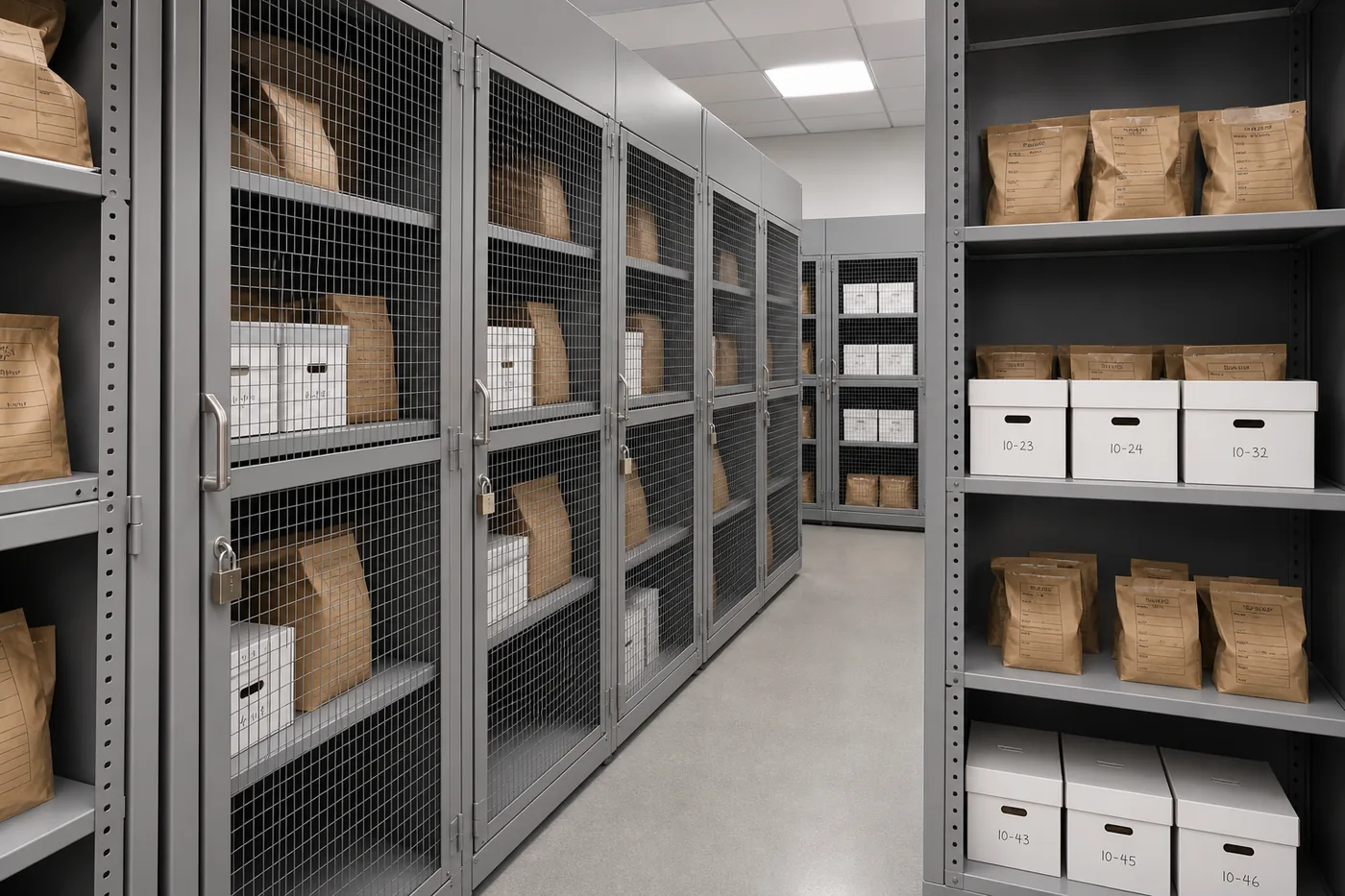 Evidence & Controlled PropertyChain of custody. Closed backs, lockable bays and a documented layout so every item has one location and one key-holder. Evidence storage →
 Collections, Parts Museums & Long-Term StorageAccess without handling damage. Wide shelf spacing, closed backs and a stable, level installation matter more than raw capacity for slow-moving, fragile stock. Collections storage →
 Reference Rooms & Tall RunsReach and stability. 75″H units, anchored where required, with the top level reserved for slow movers so routine picking stays inside safe reach. Library storage →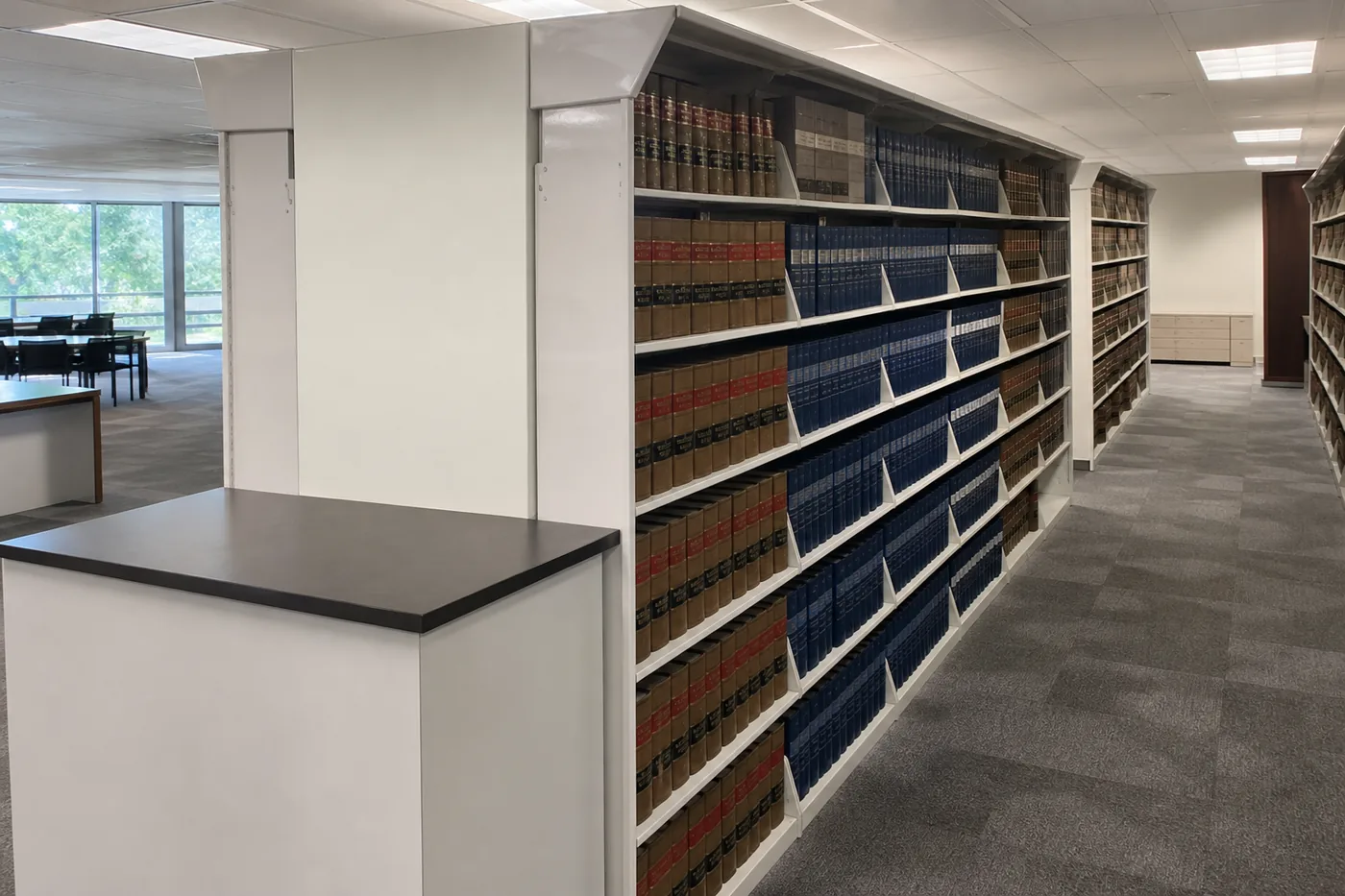
Parts rooms are the largest single application for steel shelving, and they get their own page: parts shelving covers dealer and fleet parts departments, machine-parts storage and the divider, bin and drawer combinations that make a 36″ steel shelf hold forty part numbers. Automotive dealers and repair shops should also see automotive shelving and parts department shelving systems; tool cribs and MRO stores see tool cribs.
In Utah, Idaho, Nevada and Colorado we survey and install these rooms ourselves; elsewhere we ship knocked down and coordinate partner installation. Utah projects start at Utah shelving.
Steel shelving manufacturers we quote — and when each one wins
Steel shelving buyers ask for “the best manufacturer”; the honest answer is that each line wins a different job. We quote all of these, and the table tells you where we usually start.
| Manufacturer / series | Construction | Where it usually wins | Detail |
|---|---|---|---|
| Quantum Ironman | 22 ga all-welded bolted shelves, open and closed; bin packages | Ready-to-ship units and shelving-with-bins packages priced online; 39″H and 75″H | Build & price shelving |
| Lyon 8000 / 2000 Series | Clip shelving (8000) and closed beaded-post shelving (2000); T-post uprights | Parts rooms and tool cribs; clips, dividers, foot plates and braces stocked as parts | Lyon shelving |
| Penco Clipper | Compression-clip steel shelving, open and closed, 18–22 ga | Records, evidence, military and government supply; deep accessory range | Penco Clipper |
| Tennsco Q Line / Imperial | Clip and bolted steel shelving, 18–22 ga, closed and open | Stockrooms and parts departments; fast standard lead times | Tennsco shelving |
| Hallowell Hi-Tech | Steel clip shelving, open and closed, with drawer and door options | General plant and warehouse storage; broad stocked range | Hallowell |
| Equipto V-Grip | Bolted steel shelving with heavy uprights; drawer and bin inserts | Industrial MRO and machine-parts storage | Equipto V-Grip |
| Borroughs Box Edge Plus | Box-edge steel shelving with matched drawer cabinets and Flexi-Bins | Automotive dealers and parts distributors | Borroughs shelving |
We quote lead times by manufacturer and coordinate freight to your dock or to our installation crew. Open 22 ga units are usually the fastest; closed units with doors and drawers, and non-standard colors, take longer.
Federal, state and cooperative buyers can purchase most of these lines through contract vehicles — see GSA shelving contracts and state shelving contracts. Specification writers can pull the four-post steel shelving specification guide. For a brand-name four-post system with doors, filing drawers and dividers, see Aurora shelving.
How we specify and quote a steel shelving run
Five steps, and we do the work in all of them. You do not need to arrive with part numbers.
Profile the stock
Tell us what goes on the shelves: carton and tote sizes, heaviest item, how many SKUs, how often they are picked, and whether anything is dirty, oily or high-value.
Measure the room
Clear ceiling height, obstructions, sprinkler heads and lighting, door and aisle widths, and the floor condition. Photos and a rough sketch are enough to start.
Set depths, heights and openings
We pick shelf depth and length from the stock profile, then set the shelf count and opening heights so nothing is stored on its side or double-stacked unsafely.
Decide open, closed or secured, and add accessories
Panels where containment matters, dividers where a shelf carries several SKUs, drawers for high-count small parts, doors where stock walks.
Quote as a run, then deliver and install
Starter and add-on bays, accessories, freight and installation coordination in one quote — with the shelf capacity and unit weights stated so your team can check them.

Installation is quoted with the shelving, not bolted on afterwards. Crews assemble and anchor runs in occupied rooms in phases, so a parts counter or records room keeps working while the old shelving comes out and the new goes in. Every run leaves with the published shelf capacity, the unit weights and the anchoring detail documented for your safety team.
Buying a handful of units rather than a run? Standard steel shelving units, bins and accessories are priced in our online store — see the row below — and the Build & Price Shelving tool compares steel, wire and boltless units side by side.
Get a free quote
Tell us what you are storing, the room size and your timeline. A project specialist will follow up with layout options and pricing. Prefer to talk? Call (800) 326-4403.
Steel shelving FAQ
How much weight can a steel shelf hold?
What is the difference between open and closed steel shelving?
What is knock-down steel shelving?
What sizes does industrial steel shelving come in?
Is steel shelving the same as industrial shelving?
Do steel shelving units need to be anchored to the floor or wall?
Is steel shelving better than boltless or rivet shelving?
Can steel shelving be used with plastic bins?
What finish does steel shelving come in, and will it rust?
Do you install steel shelving, or is it delivered flat?
Related shelving & storage sections
Shelving Families
Manufacturers & Guides
Tell us what goes on the shelves — we will size the run
Send us your stock profile and room dimensions and we will come back with unit sizes, shelf counts, accessories and a quote for the whole run, including freight and installation coordination. No pricing games, no part-number soup.