
Electric Cooperative Warehouse Security Cage: Federated Rural Electric
How a member-owned rural electric utility controls transformers, meters, connectors and copper in a stores warehouse that crews have to reach at 2 a.m. in the middle of an outage.

2020
Year Material Handling USA supplied security cage and wire partition product to Federated Rural Electric
5,200+
Member-owners served by the cooperative across southern Minnesota and northern Iowa
2 locations
Headquarters in Jackson, Minnesota and a separate warehouse in Welcome
24/7
Hours a utility stores area has to support — outages do not wait for the stores clerk
The project
Federated Rural Electric Association is a member-owned distribution electric cooperative headquartered in Jackson, Minnesota, with a separate warehouse in Welcome. It serves more than 5,200 member-owners across Jackson and Martin counties and parts of the neighboring counties in southern Minnesota, along with members across the state line in northern Iowa. Like most distribution cooperatives, it has run load-management programs for its members for decades and buys wholesale power through a generation and transmission cooperative.
Material Handling USA supplied welded wire security cage and partition product to Federated Rural Electric in 2020. A utility stores operation is not a warehouse in the ordinary sense. Its whole purpose is to be raided — quickly, often at night, frequently by people who are not the stores clerk — and yet the material inside is high value, tightly accounted for, and in several categories has an open resale market.
This page sits under our wire security cage hub and describes the general design problem an electric cooperative faces, and how MH-USA approaches it. It contains no facility layout, no dimensions, no inventory detail and no security specifics for this customer.
Why utility stores are a distinct problem
Three things make a cooperative’s warehouse different from a normal distribution building.
The inventory is a regulated asset record, not just stock. Transformers, meters, regulators and reclosers carry serial numbers that follow the unit through its whole service life — into a work order, onto a pole, back to the yard, out to salvage. A unit that leaves the building without being recorded does not just cost money; it breaks the asset record that plant accounting and the work management system depend on.
Some of it is scrap-market bait. Copper wire, grounding material, connectors and salvaged conductor have a standing cash market that does not care where they came from. Cooperatives across the country publish theft-reporting programs for exactly this reason, and a stores yard staged with reels is a softer target than an energized substation.
The access pattern is inverted. A normal warehouse is busiest when it is staffed. A utility stores area is most likely to be entered when it is not — storm response, a broken pole at midnight, a crew pulling a transformer on a Sunday. Any control scheme that assumes a person is present will be defeated within one storm season.

What a co-op puts behind mesh
The useful pattern is several small controlled areas rather than one large locked room. Different material, different access lists, different traffic:
Interior fit-out — shelving, bin systems, reel storage and a counter — is the same kit used for any industrial tool crib, sized for utility material.
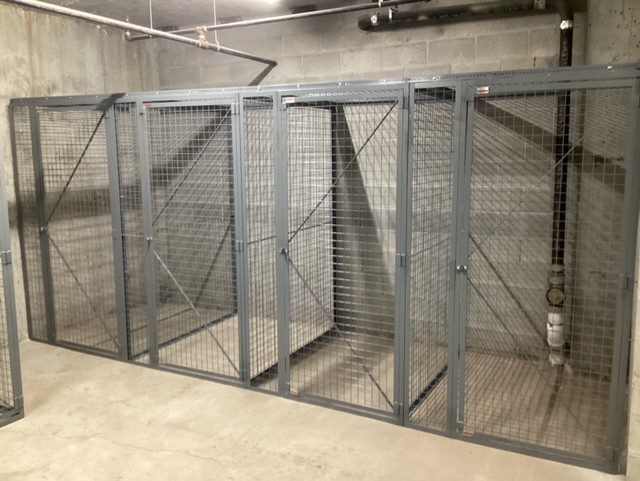
Designing for after-hours crew access
This is the design test that decides whether a utility enclosure survives. If a lineworker at 2 a.m. cannot get what the job needs, the cage will be cut, propped or bypassed — and management will hear about it after the outage, not during.
- Tier the enclosures by who needs them at night. Emergency stock a crew must reach unaccompanied belongs in its own enclosure with a wide access list. Meters and serialized units belong in a separate enclosure with a short one. Putting both behind the same door forces a bad choice.
- Issue by window where possible. A service window or dutch door lets a clerk hand out material while the enclosure itself stays closed during the working day.
- Design the record to be a byproduct. A scan station or logbook at the opening, rather than inside, means the transaction happens where people already stop.
- Keep key lists short and auditable. Two or three enclosures with a handful of keyholders each control far more than one enclosure with thirty. Lock options run from padlock hasps to keyed cylinders to access-control-ready hardware.
- Keep aisles legal during the rush. Storm loading is exactly when clear aisles matter; OSHA’s storage and passageway requirements at 29 CFR 1910.176 still apply.
Transformers, reels and heavy material
Utility material is heavy, round, and handled by machine. That drives most of the enclosure design:
- The rack carries the load, not the cage. Pad-mount and pole-mount units stored on pallet rack are a rack engineering question first. Mesh panels are a barrier only. Where a caged area is formed around rack bays we use pallet rack security enclosures so the enclosure attaches to the rack system correctly instead of fighting it.
- Deck the levels you enclose. Wire mesh decking keeps connectors, cut lengths and odd-shaped material from dropping through beams into the caged aisle below.
- Size the opening for the machine, not the part. A forklift carrying a reel on a shaft, or a unit on a spreader, needs far more opening and approach than the item itself. Sliding doors remove the swing clearance a fork truck cannot give up.
- Protect the corners. Guard posts or base channel where trucks turn. A mesh panel is repairable in an afternoon; a post taken out by a loaded truck costs a day.
- Watch the ceiling condition. If the enclosure is not full height to deck, a mesh top is usually needed. Cage ceiling options cover the sprinkler, lighting and access-panel details that come with it.
For wider caged rack areas in a utility warehouse, see warehouse security enclosures.

Outdoor material yards
Cooperatives store more outside than almost any other kind of customer: poles, conductor reels, pad-mount units, cross arms, anchors and salvage. Outdoor enclosures are specified differently from indoor ones:
- Finish is the first decision. Galvanized or another high-durability finish wherever weather, UV and ground moisture are real. An interior powder-coated panel put outside will show it within a season, and southern Minnesota gives it four seasons of reasons.
- Anchoring and base condition. Slab, asphalt and compacted-gravel bases each need a different base detail. Anchoring into deteriorated asphalt is one of the most common field failures we see.
- Wind and exposure. Enclosures in open yards, and anything with solid infill or a cover, are checked against local wind requirements with the authority having jurisdiction. Open mesh is far less wind-sensitive, which is a large part of why it is used.
- Visibility works for you outdoors. An open barrier lets patrols, cameras and passing staff see into the yard. A solid fence mostly provides concealment for anyone who is already inside it.
- Match the barrier to the value. For bulk, lower-risk yard material a chain link storage cage is often the better economic choice than welded wire, and MH-USA supplies both. Reserve welded wire for the material that would actually hurt to lose.
More on this application is on our outdoor security cages and equipment protection page. Public-sector operations with a shared shop face a closely related problem — see our municipal facility security cage case study.
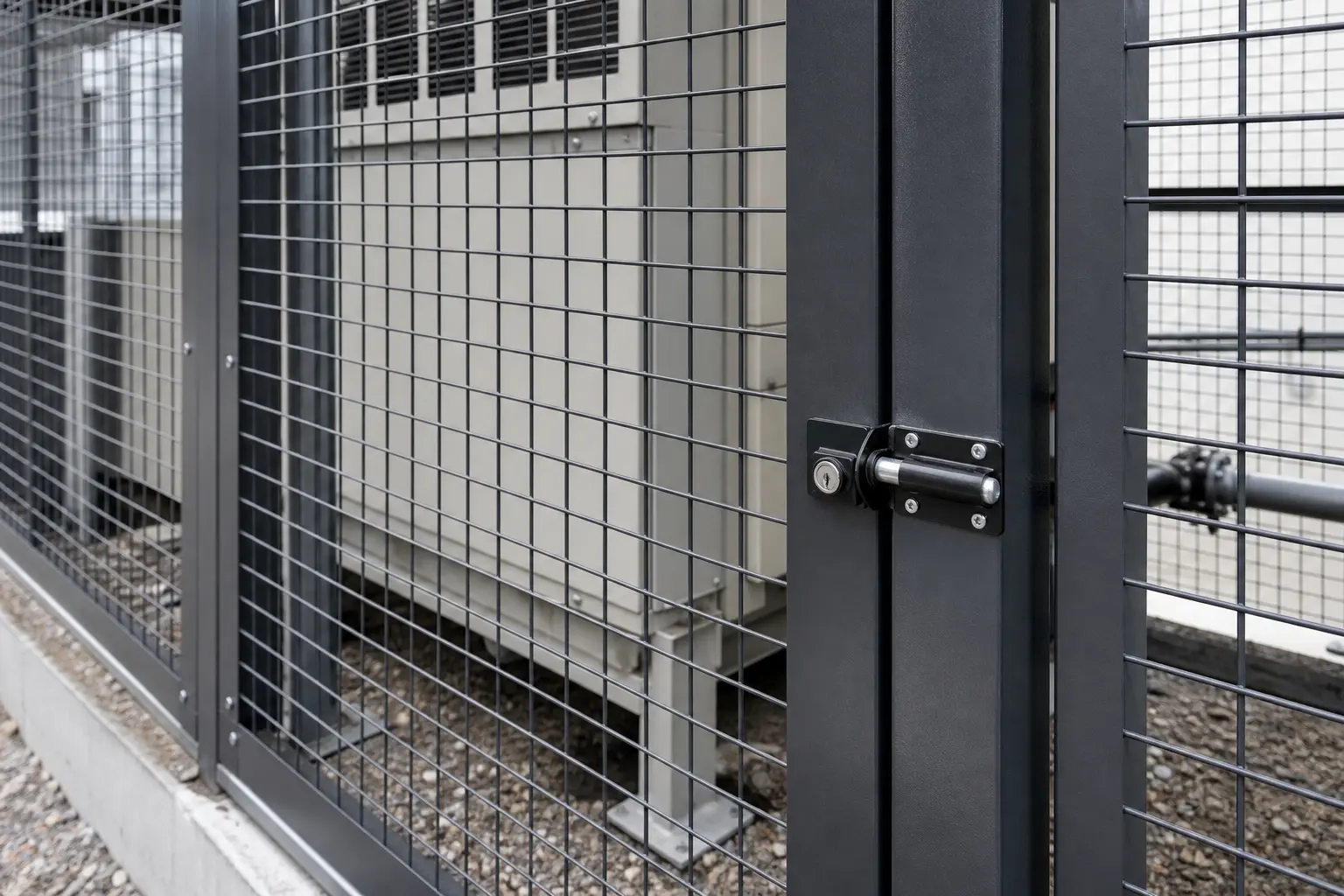
Specification: panels, doors and access
The specification for a cooperative stores building is short, and driven by traffic and abuse tolerance more than by attack resistance:
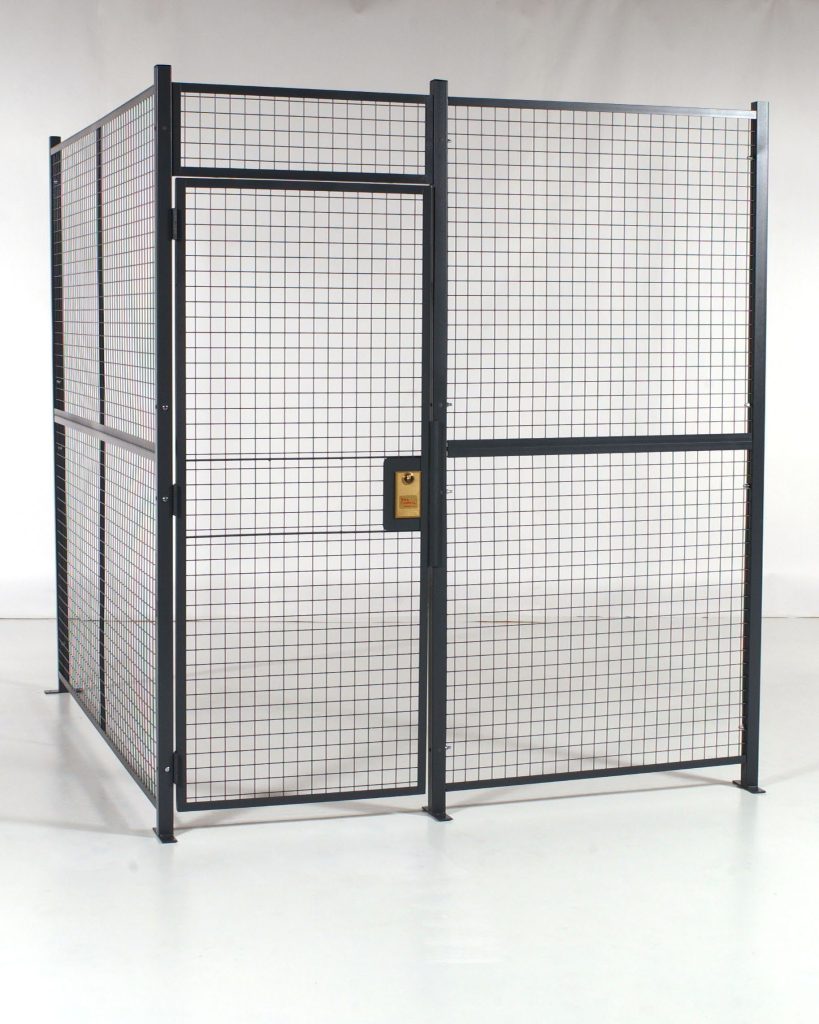
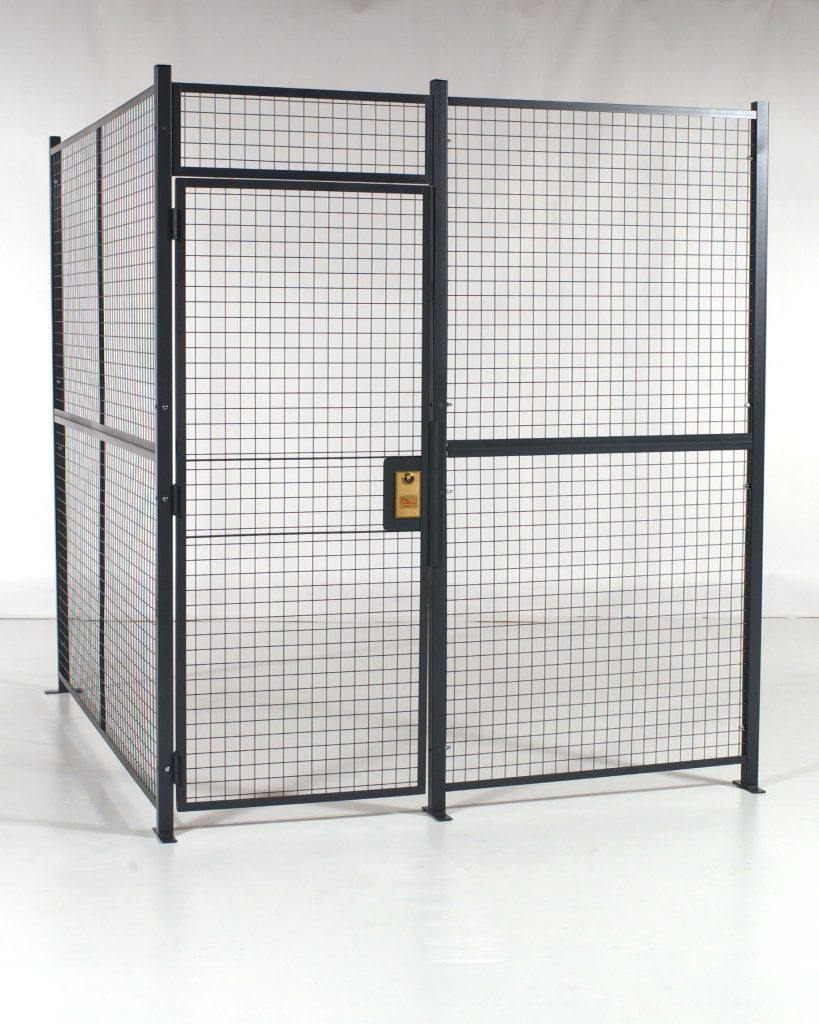
- Welded wire panels in steel frames. Visible, ventilated, repairable panel by panel and far more tolerant of cart and truck contact than drywall. Mesh opening and wire diameter are chosen for the control level required — see wire mesh panel options.
- Height and top. Partial height suits supervised counter areas. Full height with a mesh top is used wherever reach-over or climb-over is realistic, which in a stores building with rack alongside it usually means yes.
- Doors. Sliding doors where aisles are tight or fork trucks approach; hinged personnel doors for foot traffic. Options are on security cage doors.
- Issue window. The single highest-value feature in this application, as above.
- Modularity. Co-op stores change with the construction work plan, and system growth changes what has to be stocked. Bolted wire mesh partitions can be extended, subdivided or relocated; framed walls cannot.
Installing without taking stores offline
A cooperative cannot close its warehouse for a week, and it cannot be half-finished when weather arrives. Installation is sequenced accordingly.
Field-verify before ordering
Measured openings, ceiling and obstruction clearances, floor condition, and the actual truck used in the aisle. Our cage sizing guide lists what to record.
Sequence one enclosure at a time
Material is relocated once, not repeatedly. Each enclosure is completed and returned to service before the next area is opened up, so there is never a night with no controlled storage.
Anchor around the work plan
Drilling is noisy and dusty. It is scheduled around crew load-out, around any storm watch, and around meter or test work happening nearby.
Hand over the process with the panels
Key list, who issues, where the after-hours stock lives, where the record gets made. An enclosure delivered without an agreed process becomes an open room within a month. Walk it on a schedule using the cage maintenance and inspection guide.
Installation detail is on the security cage installation page. Material Handling USA designs, supplies and installs utility stores enclosures nationwide — start at the security cages hub, or tell us which part of the warehouse you are trying to control.
Shop Pre-Configured Wire Mesh Cage Kits Online
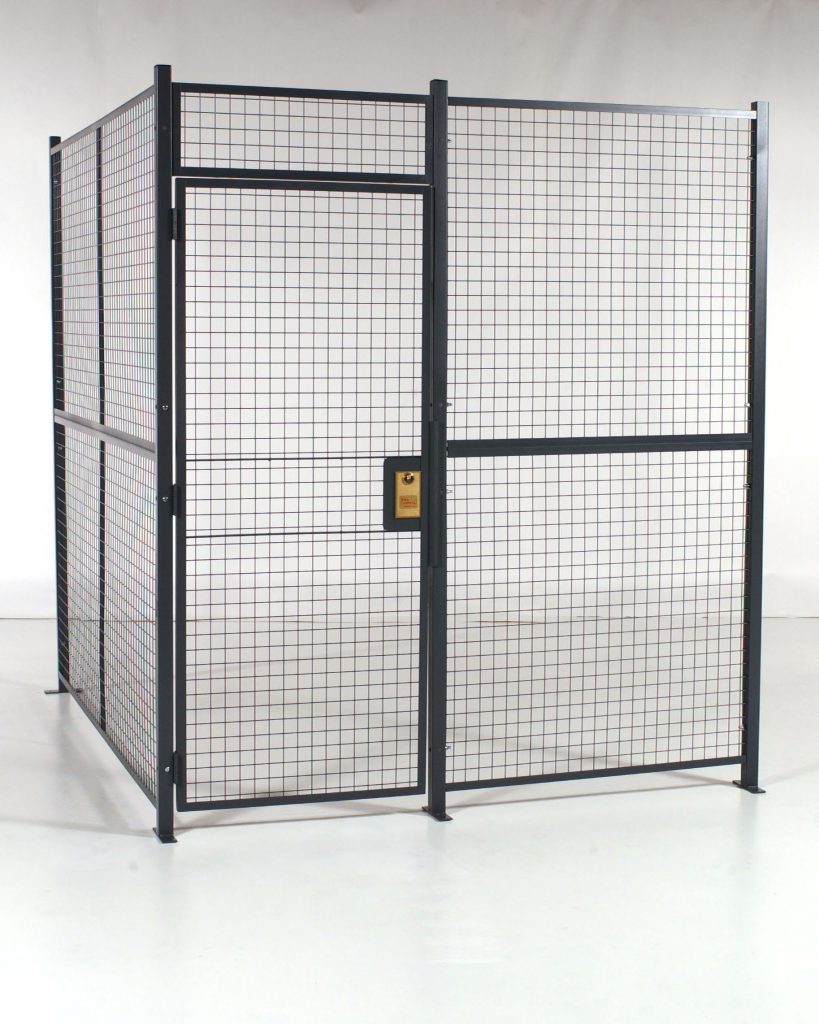
Standard-size welded wire cage kits, priced online, for smaller storage needs. Every kit still needs to be anchored to sound concrete — for tall, braced or engineered enclosures, request a quote with your building location and floor details.
Frequently asked questions
How do electric cooperatives control meter and transformer inventory?
Won’t a locked stores area slow down outage response?
What stops copper and conductor loss in a utility warehouse?
Welded wire or chain link for a co-op material yard?
Can an enclosure be built around existing pallet rack?
What finish should an outdoor utility enclosure have?
How many separate enclosures does a stores warehouse need?
Do cages interfere with line tool inspection requirements?
Looking for a project like yours? Browse more government and military security cage case studies, see all security cage case studies.
Control the stores building without slowing down the crews
Material Handling USA designs, supplies and installs welded wire security cages, meter enclosures and material yard storage for electric cooperatives and utilities nationwide.