
Fire Cache and Emergency Equipment Racking: Utah Wildland Firefighting
An emergency cache is judged on one thing: how fast a complete, serviceable order goes out the door at 2am in August. The racking either makes that possible or gets in the way.

2025
Year of this state-contract project
Pallet rack
Product category we supplied
Wildland fire
Application
Seasonal surge
The demand pattern the layout serves
Plan your layout before you buy
Configure upright height, beam width, bay count, and load levels in our free 3D Pallet Rack Configurator, then get an instant bill of materials and request a quote.
The project
Material Handling USA supplied pallet rack in 2025 for a Utah state wildland firefighting program, under a state contract. Wildland fire in Utah is run cooperatively between state and federal agencies, and equipment caches exist so that crews assigned to an incident can be outfitted and resupplied quickly.
Emergency equipment caches are a genuinely distinct racking problem, and one we have not seen written about carefully anywhere. The building looks like a warehouse and behaves like nothing else: demand is near zero for months and then near-vertical for weeks, orders leave as kits rather than SKUs, and a large share of what goes out comes back dirty, wet and needing inspection before it can be stored again. Below is how we think about pallet rack systems for that pattern.
What we publish
We name the client, the year and the product category and nothing else. For government, public-safety and emergency-response facilities we do not publish layouts, room or bay dimensions, site details, inventory quantities, security arrangements or contract values. Everything below is our own engineering and planning guidance for this class of facility, not a description of any customer’s building.

Why an emergency cache is not a distribution warehouse
Demand is spiky, not steady. A distribution centre smooths its work across the year. A fire cache does almost nothing in March and everything at once in July and August. A layout tuned for average demand fails at peak, which is the only time it matters.
Orders are kits, not lines. What leaves is a complete outfit — hose, fittings, hand tools, pumps, hydration, sleeping and camp gear — assembled against a standard list. Storage that is efficient per SKU can still be slow per kit if the kit is spread across the building.
Most of it comes back. Returned equipment arrives dirty, wet, damaged or incomplete, and cannot go straight back into issue stock. Refurbishment is a permanent function, not an exception, and it needs its own space.
Incomplete is the same as missing. A kit short one fitting is a failed order. That puts a premium on visible, countable storage rather than dense storage.
Staff change constantly. Surge staffing means people who have never worked in the building are picking from it. Location logic has to be obvious to a stranger at night.
Zoning by how fast something has to be issued
In a cache, the useful sorting principle is not product family — it is issue speed. Everything else follows from that.
| Zone | What belongs there | Storage that suits it |
|---|---|---|
| Immediate issue / pre-staged kits | Complete outfits and the highest-frequency items, ready to load | Ground-level pallet positions and floor staging next to the dock; the shortest possible travel |
| High-volume replenishment | Bulk hose, fittings, consumables, hydration, rations | Selective pallet rack with reserve pallets stored directly above the pick face |
| Bulk seasonal reserve | Deep stock held for the season and released as the incident tempo rises | Deeper lanes or higher levels — density is fine here because it is not touched hourly |
| Small parts and fittings | Couplings, nozzles, adapters, hardware, spares | Shelving and bins with clear labelling; pallet bays waste both space and time on small items |
| Returns and inspection | Everything coming back from an incident | A defined, generous area with work surfaces — never a spare aisle or a corner of issue stock |
| Refurbished, awaiting return to stock | Cleaned, tested and repaired equipment not yet re-shelved | A distinct staging run so nothing untested is issued by mistake |
| Long and awkward items | Pipe, tools with handles, hose reels, poles, structural items | Cantilever racking rather than forcing them into pallet bays |
The single biggest gain we see in facilities like this comes from making the returns and refurbishment zone deliberately large. When it is undersized, returned equipment migrates into aisles and issue positions, and the building loses both capacity and confidence in its own stock.
Designing storage around kits and orders
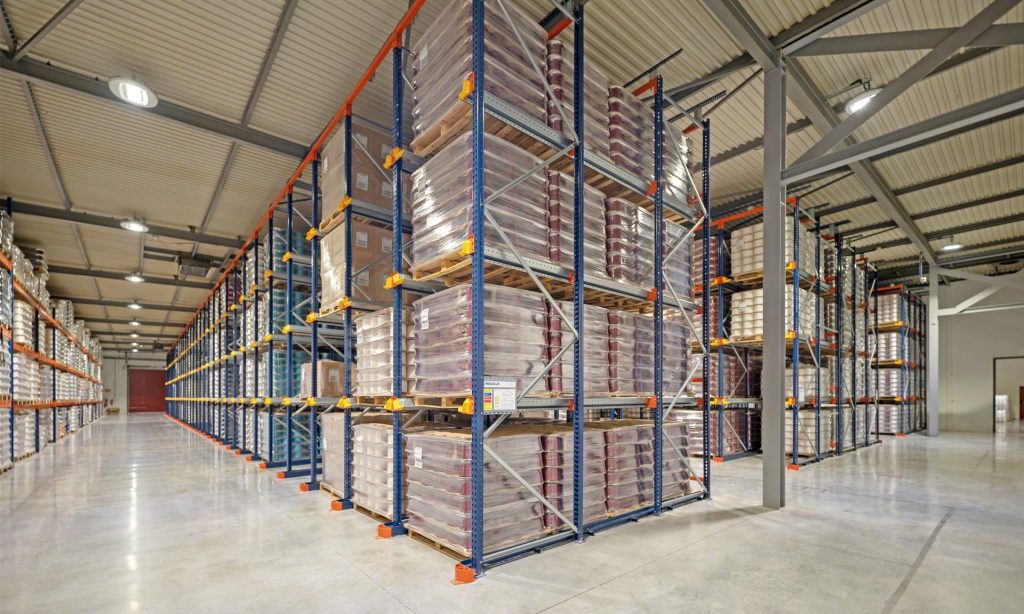
Slot by kit adjacency. If a standard outfit contains twenty items, those items should be reachable in one pass, not scattered by product family across the building. Kit-adjacent slotting can halve the pick time of a surge order.
Make quantities countable at a glance. Fixed-quantity pallet builds, bin sizes that match issue units, and level heights that fit the case — anything that lets someone verify a count without opening cartons.
Keep the pick face at working height. The bottom two levels do most of the work in a manual operation. Fast, heavy and frequently issued items belong there; reserve stock goes up.
Label for the newcomer. Beam-mounted position labels, aisle signs and end-of-row maps are what make a stranger productive on their first night shift.
Leave staging floor, on purpose. Kits are assembled on the floor. A layout with no marked staging area will use the aisles, which is where loading conflicts and injuries happen.
The parts-and-spares side of this is covered on our spare parts and MRO storage and heavy duty boltless shelving pages, and the public-agency version of the same problem in our municipal public works racking case study.
Long, awkward and heavy items
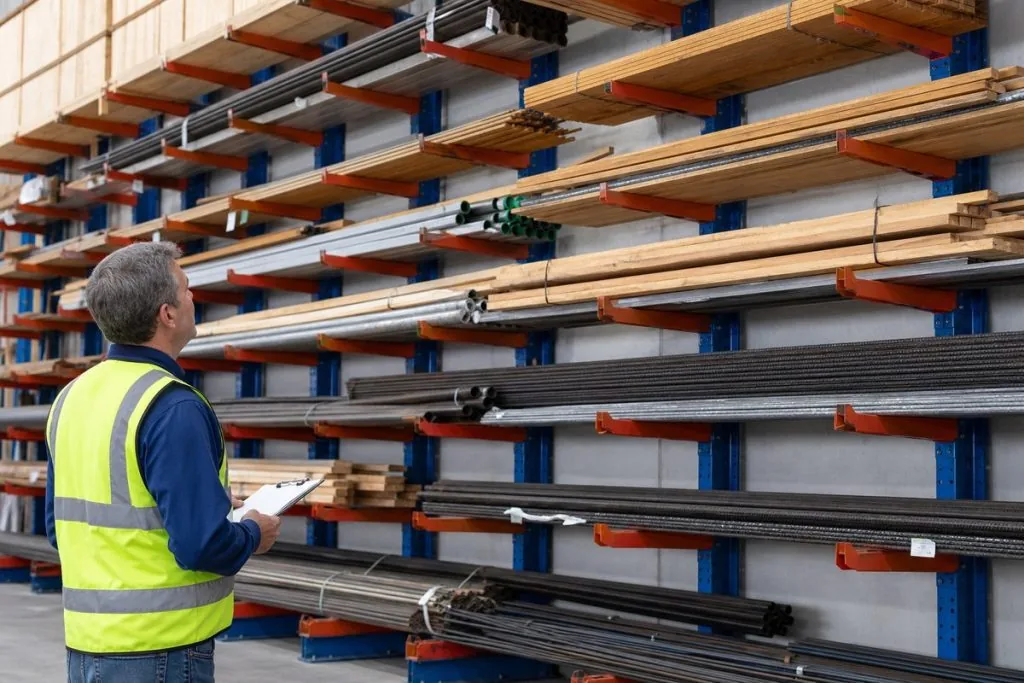
Caches accumulate items that do not fit a pallet: hose reels, pumps, hand tools with long handles, pipe, poles, engine spares and pre-built assemblies. Forcing these into pallet bays is how a warehouse becomes unnavigable. Station-side storage for structural turnout gear, hose and SCBA is a different job; see our turnout gear racks and bunker gear storage guide.
- Use cantilever for anything long. Cantilever racking gives an open face with no front column, so long items go in and out without threading them past an upright.
- Put heavy at the bottom. Pumps, engines and heavy assemblies belong at floor or second level. Nothing is gained by lifting mass, and seismic demand scales with stored mass — see pallet racking weight capacity.
- Consider structural rack where impacts are likely. Where loading is heavy or trucks work in tight quarters, structural pallet rack takes abuse better than roll-formed.
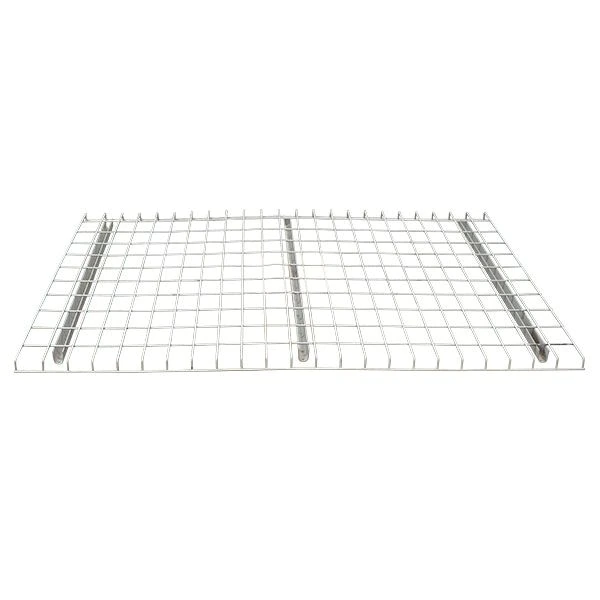
- Deck for irregular loads. Unpalletized and odd-shaped items need wire decking or solid deck rather than bare beams.
- Give hose its own logic. Rolled and bundled hose is heavy, awkward and issued in quantity. Dedicated levels sized for the roll diameter beat generic bays.
- Keep fuel, oil and chemicals separate. Small-engine fuel, oil and foam concentrate belong in appropriate storage away from textiles and camp gear, not on a general pallet run.
Contractors face a similar mix of long stock and kitted gear — our electrical contractor warehouse racking case study covers reel, conduit and jobsite kitting in more depth.
Seasonal surge and the empty-season problem
Design the peak, then check the trough. The layout has to work when the building is nearly empty and staff are few, and when it is full and busy with people who do not normally work there. Those are different buildings occupying the same footprint.
Plan a flexible band. A defined run of rack that holds seasonal reserve in spring and becomes staging in August is worth more than a fixed layout tuned to one state.
Do not let low season create bad habits. Empty positions invite floor stacking and temporary storage that never leaves. Marked floor zones and a defined home for everything are what stop the drift.
Use the quiet season for rack work. Inspections, repairs, reconfiguration and relabelling are off-season tasks. Trying to reconfigure a cache in August is not realistic.
Buy capacity you can extend. Standard, widely available rack components mean an add-on bay next season is a purchase, not a project — one reason we generally steer agencies away from unusual proprietary profiles.
Environment, security and housekeeping
Cache buildings are often part warehouse, part shop, part covered yard, and the storage has to cope with all three.
| Condition | Design response |
|---|---|
| Unheated or partly heated space | Freeze-sensitive items (liquids, batteries, some medical supplies) need a defined conditioned zone rather than a hopeful corner |
| Wet and dirty returns | Returns area with drainage-friendly floor space, work benches and off-floor storage so wet gear does not sit on the slab |
| Outdoor and covered-yard storage | Galvanized or otherwise protected steel, and a designed layout rather than an informal laydown area |
| Dust and smoke residue | Open decking and generous clearances make cleaning practical; enclosed bins protect textiles |
| High-value and controlled items | Radios, medical items and tools benefit from a caged, access-controlled area inside the warehouse |
| Vehicle traffic through the building | Column protection at every drive-past upright, marked traffic routes and clear separation from picking on foot |
Where a caged area is the right answer, our security cages page covers wire mesh enclosures that can be built into a rack run rather than added as a separate room.
Safety, seismic and inspection
Public-sector storage is inspected and audited, and surge staffing raises the stakes on anything that depends on people knowing local quirks.
- Design to ANSI/RMI MH16.1. This is the US standard for industrial steel storage racks and is referenced by the building code; Utah’s seismic requirements make frame design and anchorage central rather than incidental.
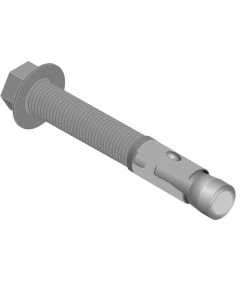
- Anchor every upright correctly. Right anchor bolts, right embedment, sound concrete. This is the load path from the rack into the building.
- Protect uprights from traffic. Rack guards at aisle ends, door approaches and loading positions cost far less than a replacement frame or an incident.
- Post load ratings per bay run. Surge staff will read a plaque; they will not read a submittal. Ratings should state capacity per level at the installed beam spacing.
- Inspect before the season, not after. An annual pre-season inspection catches impact damage from last year — see rack inspection and repair.
- Use qualified installers and keep the drawings. Plumb, level, pinned and anchored to spec — see pallet rack installation. Keep the as-built configuration on file so next season’s changes start from fact.
Worth reading at source: the Rack Manufacturers Institute for MH16.1, OSHA for general materials-handling duties, and the National Interagency Fire Center for how interagency wildland fire logistics is organised. We support agencies statewide — see Utah pallet rack and selective pallet racking.
Shop Pallet Rack Accessories Online
Protect and finish your pallet rack installation with these in-stock accessories, or request a quote for custom-sized rack, freight and volume pricing.

Frequently asked questions
What racking suits a fire cache or emergency equipment warehouse?
How do you design storage around kits rather than SKUs?
Why does the returns area need to be so large?
Can you store emergency equipment outdoors on racking?
Does seasonal use change the rack design?
What seismic requirements apply in Utah?
How often should rack in a seasonal facility be inspected?
Utah pallet rack project: This case study supports our Utah pallet rack design and installation guide and, at the top level, our main pallet rack systems hub.
Planning storage for an emergency or seasonal equipment cache?
We design and install agency storage across Utah — racking, shelving, cantilever and secure enclosures.