
Generator Cages for Commercial Standby and Job-Site Generators
How facilities, contractors, telecom operators and property managers protect generators from theft, copper stripping and vandalism — cage types, airflow and exhaust clearances, service access, anchoring and the fire and safety rules to check first.
Supplied nationwide from Salt Lake City — call (800) 326-4403.
Theft
Stops units, batteries and copper walking away
Airflow
Open mesh keeps radiator air and exhaust moving
Serviceable
Gates sized for technicians and parts
Anchored
Bolted to the pad or set in footings
Why generators get stolen, and what a cage does
A generator is only useful if it is there and working when the power goes out. Unfortunately it is also one of the easiest valuable things to steal or strip on a property. Portable and towable units can be loaded onto a truck in minutes. Standby generators stay put, but their batteries, copper cable, fuel and control panels are easy pickings on a quiet night, and the damage often goes unnoticed until the next outage or the next weekly exercise run.
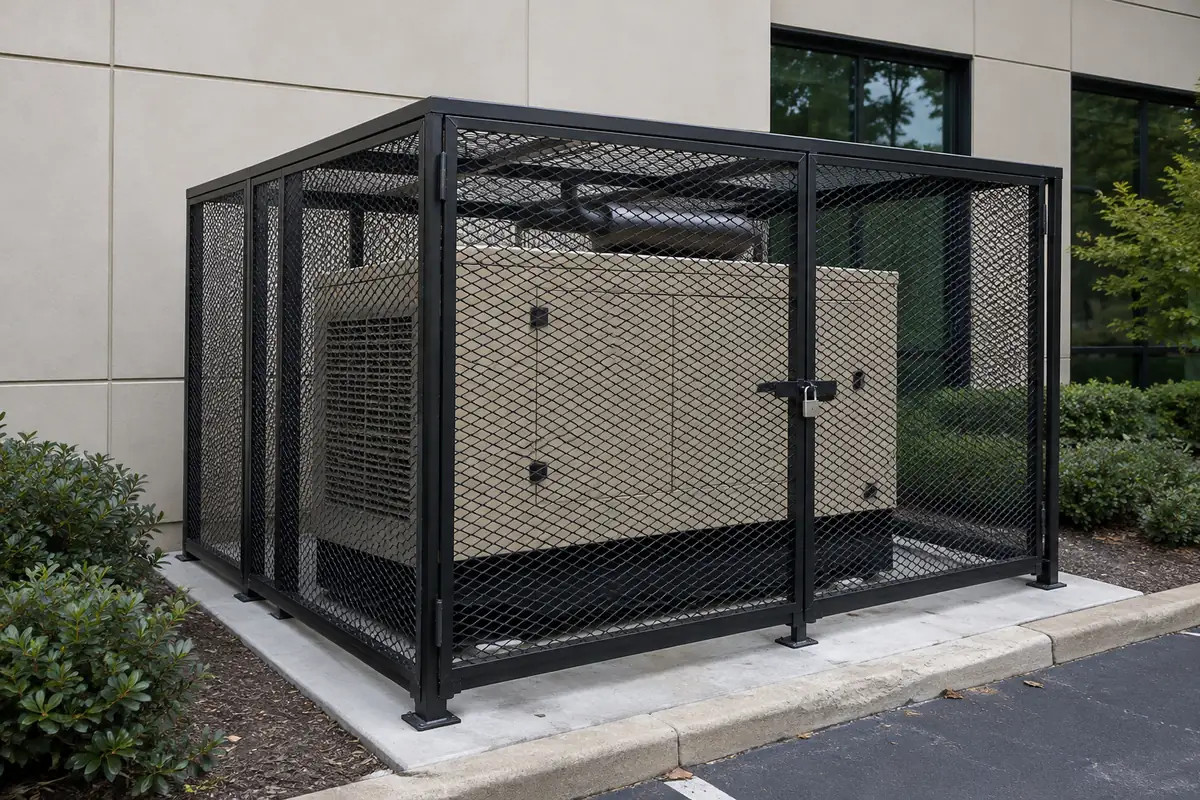
A generator cage is a lockable steel enclosure, anchored to the pad or ground, that keeps people and tools away from the unit while letting air, exhaust and service technicians through. It does not replace the manufacturer’s weatherproof housing; it goes around it. Generator cages are one of the most common outdoor applications in our security cages range, alongside cages for HVAC and water equipment.
What a generator cage protects against
- Whole-unit theft: portable and trailer-mounted generators driven or carried off site.
- Copper and battery stripping: cables, starting batteries and wiring cut out of standby units.
- Fuel theft and tampering: diesel siphoned from base tanks, caps removed or contaminated.
- Vandalism: louvers kicked in, panels pried open, controls switched off.
- Downtime: a building, tower or job site left without backup power when it is needed most.
Types of generator cage and enclosure
“Generator cage,” “generator security cage” and “generator fence” cover several different builds. The right one depends on the generator size, whether it moves, and how often technicians need to get inside:
| Option | Best for | Strengths | Watch for |
|---|---|---|---|
| Bolt-down panel cage | Standby generators at offices, retail, clinics and multifamily | Compact, strong, tidy appearance | Clearance to the housing doors and radiator |
| Modular mesh panel cage | Mid-size and large standby units, irregular pads | Configurable, extendable, smallest mesh openings | Outdoor finish and anchor layout |
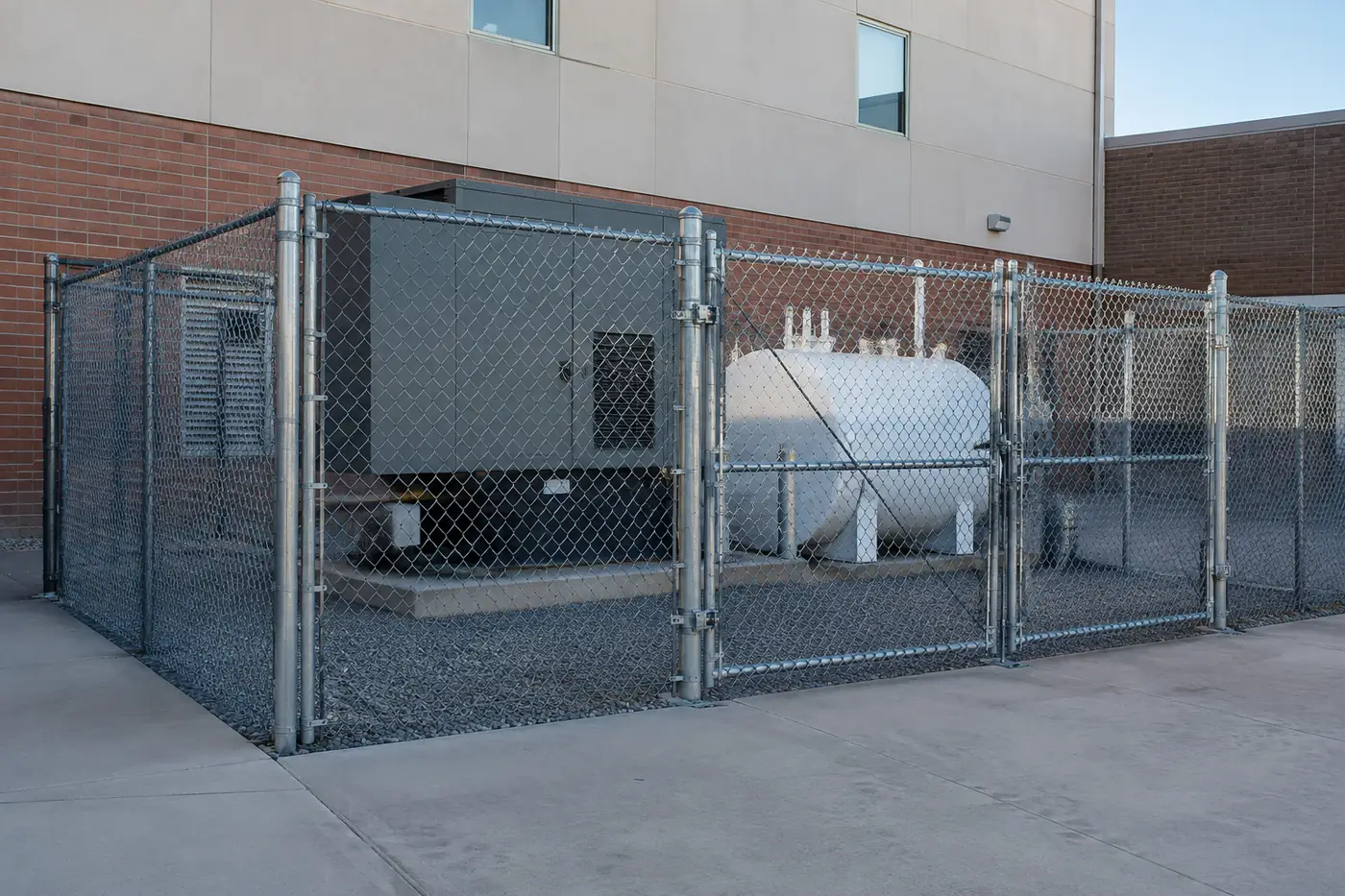
| Fenced compound | Large diesel sets, fuel tanks, hospitals, data centers, utilities | Room to work, one gate for everything | Gate width, fire department access, site footprint |
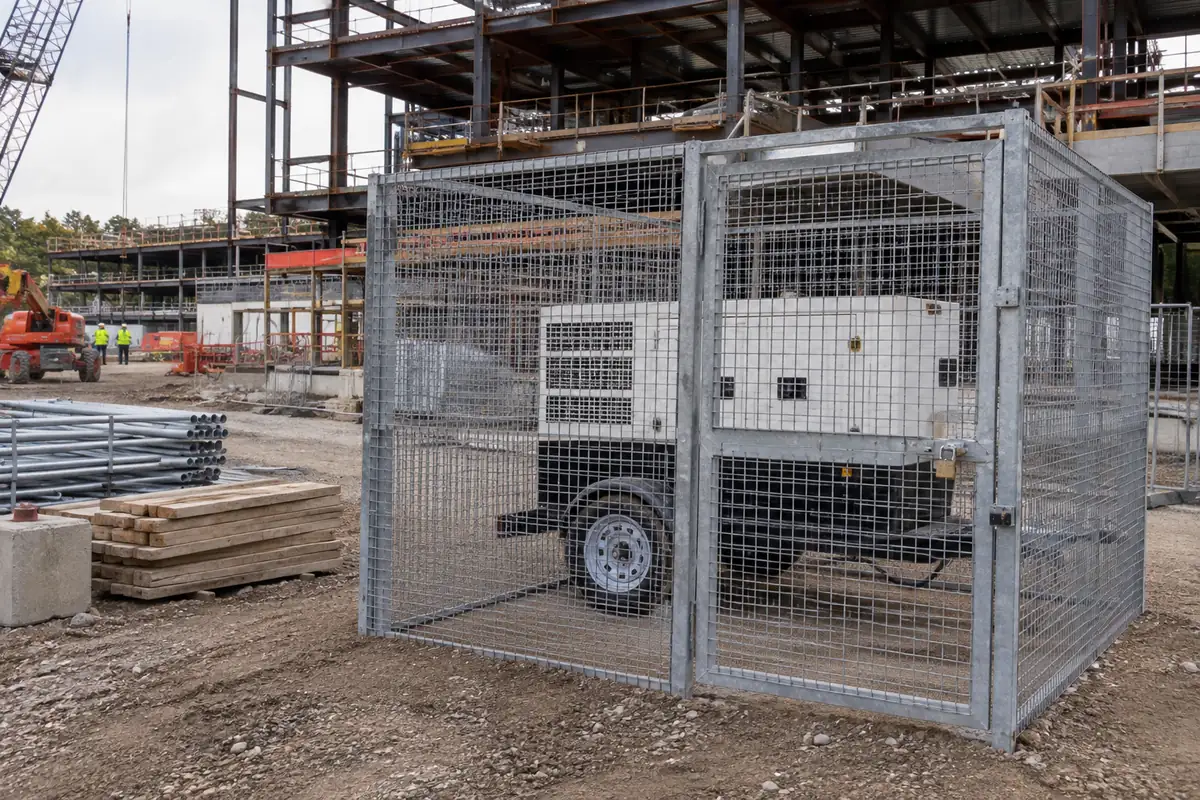
| Portable / job-site cage | Towable and portable generators on construction sites | Moves with the job, quick to set up | Never cage a running generator in an enclosed space |
| Walk-in equipment building | Sites that need weather, noise and security in one structure | Full weather and sound control | Ventilation, fire separation and cost |
Expanded metal gives a rigid, hard-to-cut panel with good airflow; welded wire mesh gives the smallest openings for the weight; chain link is the most economical for large compounds. Where you need a fully enclosed, weatherproof housing rather than an open cage, see our modular equipment enclosures. For other site equipment, see the outdoor security cages guide, AC unit security cages and backflow preventer cages.
Where generator cages are used
Construction and job sites
Towable and portable generators are some of the most stolen pieces of equipment on a construction site, because they are valuable, easy to move and often left outside overnight. A freestanding welded mesh cage with a padlocked gate, set on firm ground and ideally pinned or weighted, keeps the unit in place between shifts. Contractors often pair it with a lockable tool cage for cords, fuel cans and small equipment; our job-site security cage for Saunders Construction and mobile security cages show how that works.
Telecom, utility and remote sites
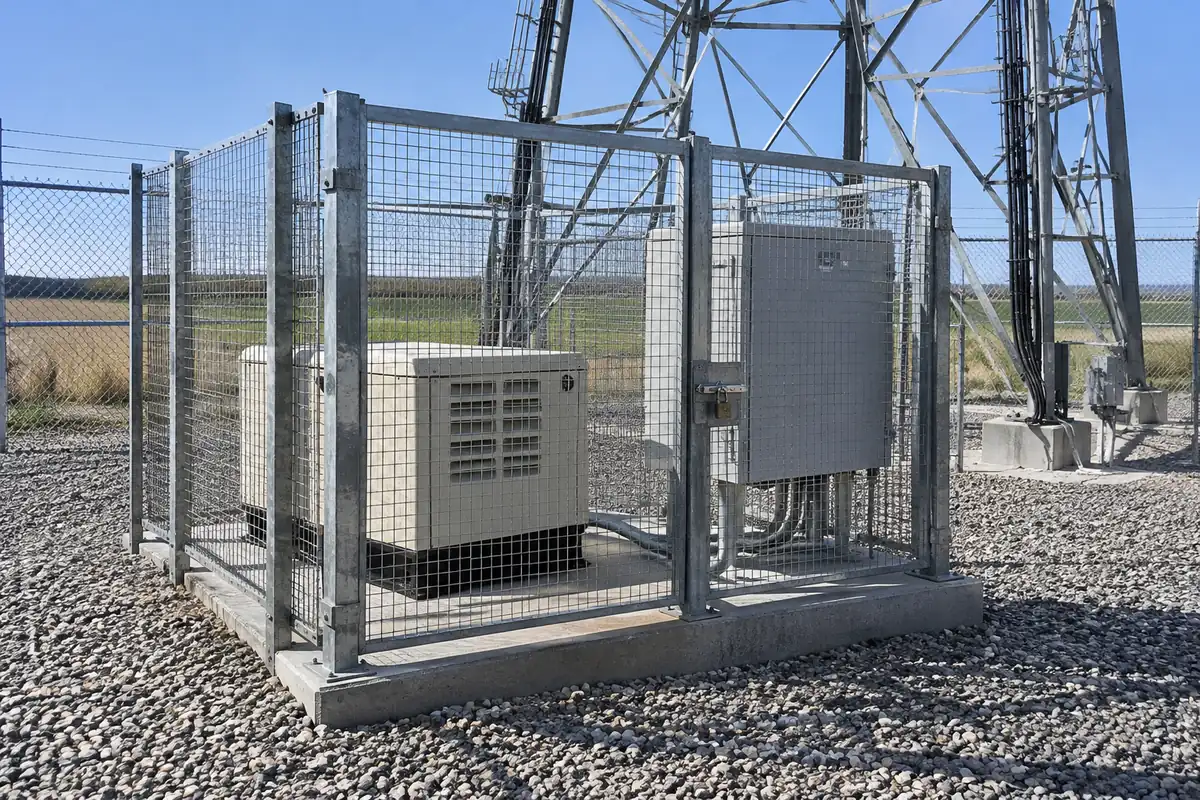
Cell towers, pump and lift stations, substations and remote equipment yards rely on small standby generators that sit unattended for weeks. Copper and battery theft is a constant problem at these sites. A bolt-down mesh cage around the generator and nearby cabinets adds a second layer inside the perimeter fence. Network contractors and utilities also cage their staging inventory, as in our network contractor staging cage and electric cooperative project.
Other common sites include:
- Hospitals, clinics and senior living: large standby sets and fuel tanks inside fenced compounds with service-truck access
- Offices, retail and restaurants: compact standby generators beside the building or a parking lot, where a neat black cage fits the site
- Multifamily and property management: generators for elevators, fire pumps and common areas
- Schools and public facilities: emergency shelters and city buildings that must keep power during storms — see our Town of Alta municipal security cage for an indoor example
- Data centers and IT rooms: generator yards that sit behind other security layers
- Fleet, rental and equipment yards: portable generators stored between rentals, as in our fleet operation security cage
Airflow, exhaust and clearances
A cage must not choke the generator
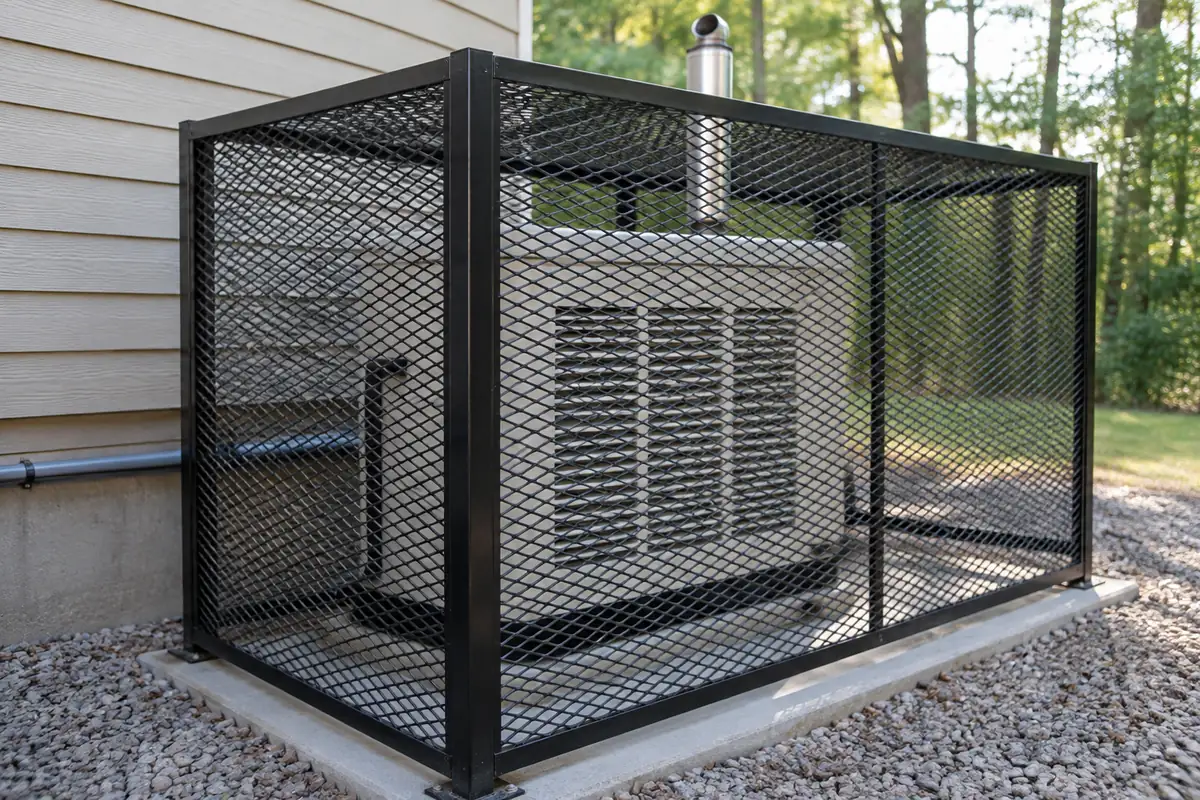
A running generator pulls in a large volume of air to cool its radiator and engine, and pushes out hot air and exhaust. Anything that restricts that flow raises operating temperature and can shut the unit down on a high-temperature alarm in the middle of an outage. That is why generator cages use open mesh rather than solid panels, and why the cage needs space between it and the housing — especially at the radiator air discharge and the exhaust outlet.
Most generator manufacturers publish minimum clearances around the housing for airflow and service. Start the cage layout from those numbers, add room for doors to swing fully open, and keep the exhaust path clear of the cage roof. Open-top or mesh-roof cages are the norm; solid roofs are rare and need the manufacturer’s approval.
Measure
- Generator make, model and housing size, including the base fuel tank
- Which side the radiator discharges and where the exhaust exits
- Which housing doors open, and how far they swing
- Pad size and condition, and distance to walls, windows, doors and vents
- Fuel fill, battery and control panel locations
Allow for
- The manufacturer’s airflow and service clearances on every side
- Gate width for technicians, load banks and replacement parts
- Clear paths for conduit, gas or fuel lines entering under the cage
- Space for a fuel delivery hose to reach the fill
- Snow, landscaping and drainage around the pad
Photos of every side of the generator with a tape measure in view, plus the model number, are usually enough for us to propose a cage. Large diesel sets, units with separate fuel tanks and multi-generator yards are almost always custom.
Service access, locking and anchoring
Plan for maintenance and emergencies
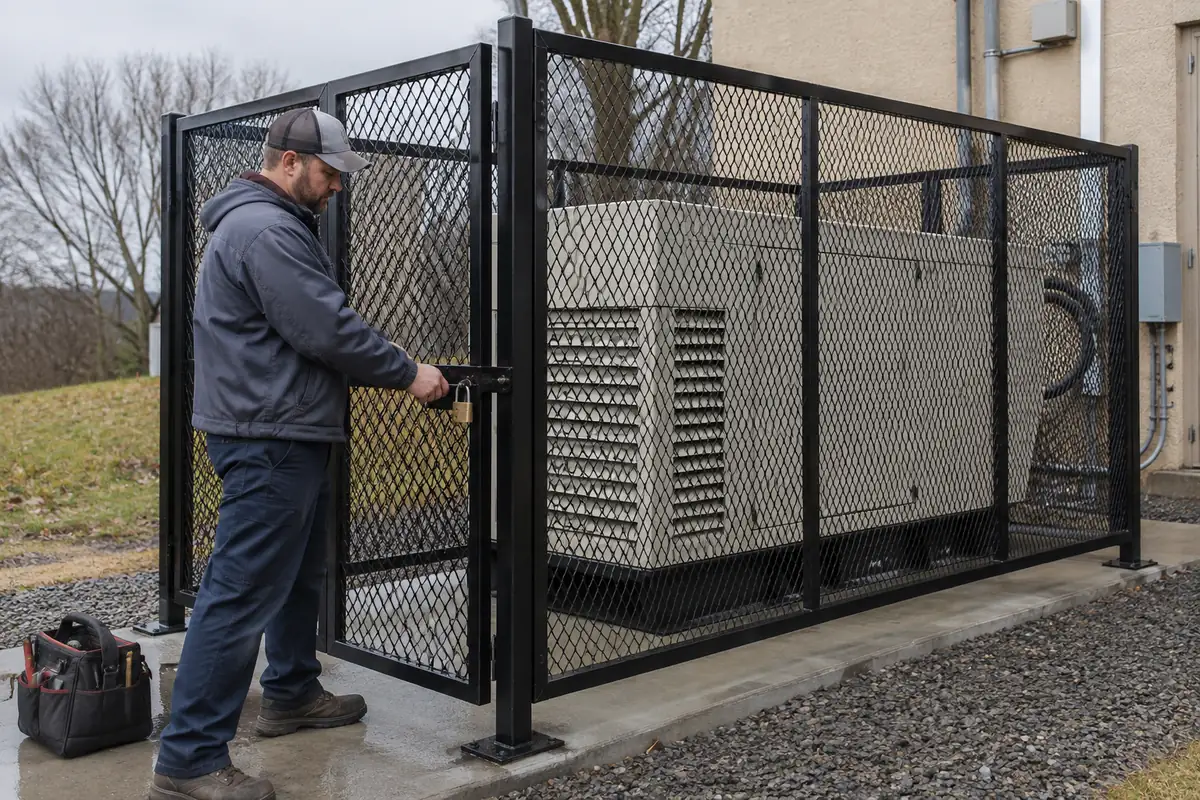
Standby generators are exercised regularly and serviced by technicians who need to open every housing door, change filters and batteries, and sometimes bring in a load bank. A cage that makes this hard will be left unlocked. Plan gates on the sides the technician uses most, wide enough to carry parts through, and on two sides for larger units.
Use shielded hasps or lock boxes so bolt cutters cannot reach the padlock shackle, and agree on who holds keys or combinations: the facility, the service contractor and, for emergency systems, the fire department. Compare options on our security cage locks and security cage doors pages.
Anchor the cage to the pad
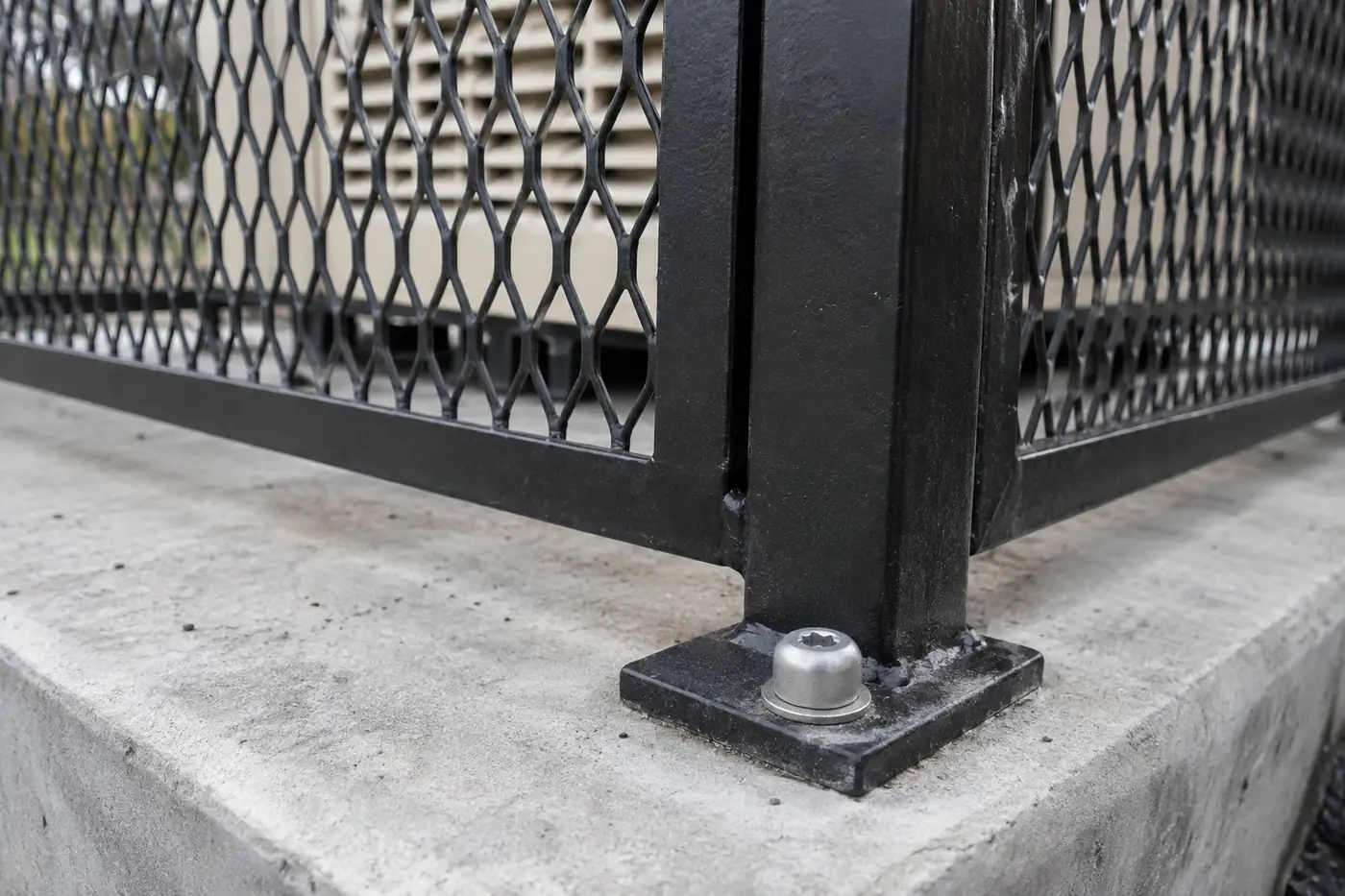
A cage that only sits on the pad can be tipped or lifted away, along with whatever is inside. Generator cages are fastened through welded foot plates into the concrete pad using wedge or expansion anchors with tamper-resistant heads, or with posts set in concrete footings around the pad. Bottom rails are kept low enough that no one can crawl under, with a small, planned gap only where conduit or fuel lines enter.
Our security cage anchoring guide explains anchor types, and security cage installation covers how we install.
Protect against vehicles where trucks turn
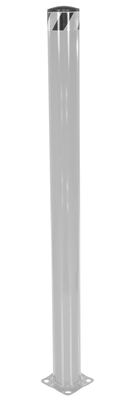
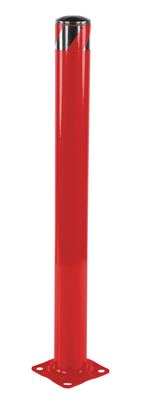
A mesh cage stops people, not vehicles. Generators beside drive lanes, loading areas or parking stalls should have steel bollards or another barrier in front of the cage, positioned so they do not block the gate or the fuel fill.
Rules to check before you cage a generator
There is no national standard for generator security cages themselves, but the cage must not break the rules that apply to the generator inside it.
Fire separation. NFPA 37, the standard for installing stationary combustion engines, says engines and their enclosures installed outdoors must be at least 5 feet from structures with combustible walls, unless the nearby wall has at least a 1-hour fire resistance rating or a fire test or engineering calculation shows a generator fire will not ignite it (NFPA 37, 2024 edition, TIA 24-1). Many factory housings are tested to sit closer, so follow the manufacturer’s installation instructions and your local fire official. A cage should never force the generator closer to a wall, window or vent than it would otherwise be.
Portable generators and carbon monoxide. OSHA’s fact sheet Using Portable Generators Safely says never to use a generator indoors or in enclosed spaces, to keep 3 to 4 feet of clear space on all sides and above it for ventilation, and not to place it where exhaust can enter occupied spaces through doors, windows or vents. A job-site cage must stay open mesh on every side and on top, and must not be wrapped in tarps or placed inside a building while the generator runs.
Electrical working space. OSHA’s electrical standard, 29 CFR 1910.303(g)(1), requires sufficient access and working space around electric equipment so it can be operated and maintained safely. Keep the generator’s control panel, breakers and any nearby transfer switch reachable with the gate open, and do not use the cage as storage.
Fuel storage. Large diesel tanks bring their own rules. EPA’s spill prevention rule exempts facilities whose aggregate aboveground oil storage capacity is 1,320 U.S. gallons or less, counting only containers of 55 gallons or more (40 CFR 112.1(d)(2)(ii)); above that, a spill prevention plan and secondary containment come into play. See our spill control and secondary containment options.
The site. Fire departments, landlords, HOAs and city design rules may control gate locations, color and appearance. Black, green and tan powder coats over galvanized steel are common.
Photograph the generator
Take photos of every side with a tape measure in view, and note the make and model.
Check clearances
Get the manufacturer’s airflow, exhaust and service clearances and your fire separation distances.
Choose the type
Panel cage for compact units, modular mesh or a fenced compound for large sets, mobile cages for job sites.
Plan access
Place gates for technicians and fuel delivery, and agree on who holds keys.
Add protection
Plan bollards near drive lanes and containment for large fuel tanks.
Fabricate and install
Cages are built to the unit, finished for outdoor exposure and anchored on site.
Price depends mainly on size, mesh type, finish, gate count and whether the cage is standard or custom. Our security cage cost guide explains the main cost drivers, and larger or unusual installations are built as custom security cages. For cages fastened to a building wall, see wall-mounted security cages. For Intermountain sites, our Utah security cage team measures and installs locally from Salt Lake City; elsewhere we supply nationwide.
Shop Fuel Storage and Bollards for Generator Sites
Generator cages are sized to each unit, so they are quoted rather than sold off the shelf. These products cover the rest of the site: approved safety cans and a flammable storage cabinet for portable-generator fuel, and steel bollards to keep vehicles off the cage. Priced online.


Get a free quote
Tell us what you are storing, the room size and your timeline. A project specialist will follow up with layout options and pricing. Prefer to talk? Call (800) 326-4403.
Generator Cage FAQs
What is a generator cage?
Will a security cage make my generator overheat?
How much clearance does a generator cage need?
Can I run a portable generator inside a cage?
What is the difference between a generator cage and a generator enclosure?
Is a generator fence the same as a generator cage?
How is a generator cage anchored?
Should the fire department have a key?
Do you supply generator cages outside Utah?
Need a cage for your generator?
Send photos of each side of the generator with a tape measure in view, plus the make and model. We will recommend the cage type and quote a cage built to fit — supplied nationwide from Salt Lake City.